Modern smart city lighting systems depend on seamless communication between field devices and centralized management platforms. As cities expand their intelligent infrastructure, reliable device integration has become essential for ensuring operational efficiency, scalability, and long-term compatibility.
4G NEMA lighting controllers are now widely adopted as intelligent lighting nodes that connect individual luminaires to centralized smart city platforms. When combined with cloud-based SaaS lighting management software, these controllers enable cities to achieve real-time control, structured monitoring, and scalable lighting automation.
This article explains how 4G NEMA controllers integrate into smart city lighting platforms, how communication workflows operate, and why this architecture is ideal for large urban lighting deployments.
Understanding the Role of 4G NEMA Controllers in Smart Lighting Networks
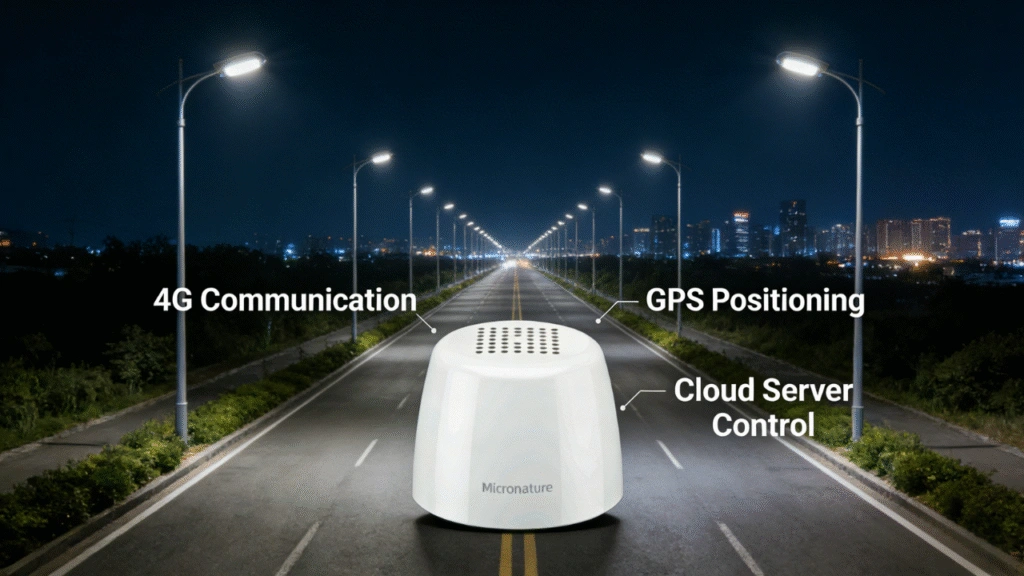
A 4G NEMA controller functions as an intelligent communication interface installed directly on street luminaires. It enables each lighting point to communicate with centralized systems through cellular networks.
Instead of relying on manual operation or basic timers, modern lighting infrastructure uses connected controllers to manage lighting performance dynamically.
Primary Functions of a 4G NEMA Controller
Typical functions include:
- Wireless communication via 4G LTE networks
- Remote ON/OFF control
- Dimming control using DALI protocol
- Lamp health monitoring
- Energy consumption tracking
- Alarm and failure reporting
- Remote firmware updating
- GPS-based location tracking
These features allow lighting networks to operate as fully connected digital systems.
Smart City Lighting Platforms: The Central Intelligence Layer
While 4G NEMA controllers operate at the field level, smart city lighting platforms act as the central control layer responsible for system-wide management.
Our cloud-based SaaS lighting platform provides the infrastructure required to monitor and control thousands of lighting nodes from a single interface.
Key Functions of Smart City Lighting Platforms
Modern platforms typically support:
- Centralized lighting control
- Scheduling and automation
- Real-time device monitoring
- Alarm management
- Energy analysis and reporting
- Asset management
- Maintenance workflow optimization
Because the system operates in the cloud, operators can access lighting networks from any location using secure web interfaces.
Integration Architecture of 4G NEMA Controllers
Integration between 4G NEMA controllers and smart city platforms follows a structured architecture designed for reliability and scalability.
Typical System Architecture
A complete lighting network typically includes:
- Street luminaires
- 4G NEMA lighting controllers
- Cellular communication network
- Cloud-based SaaS lighting platform
- Operator management interface
This layered structure allows efficient data exchange across thousands of devices.
Step-by-Step Integration Workflow
Understanding the integration workflow helps illustrate how smart lighting systems operate in real-world projects.
Step 1 — Device Installation and Commissioning
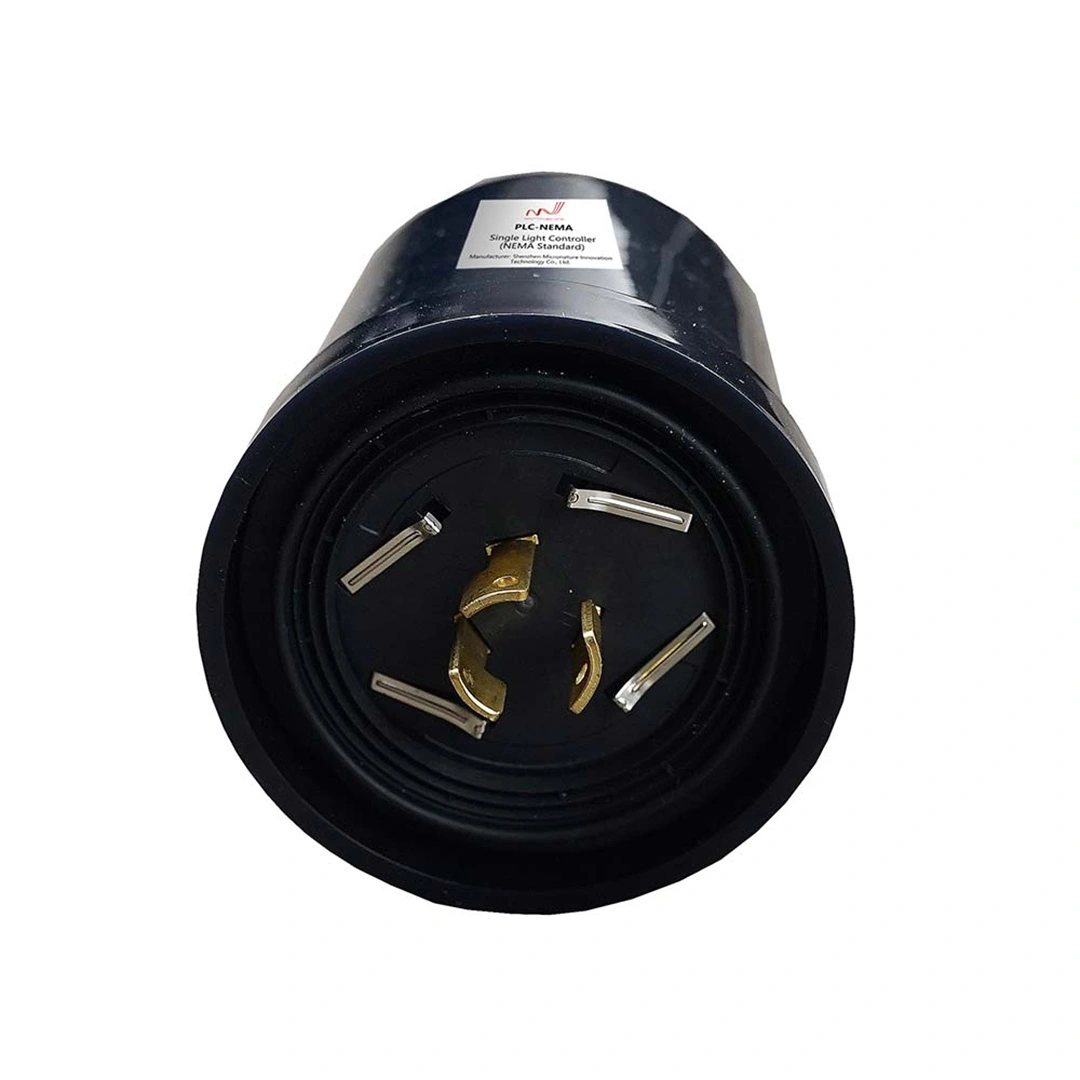
Each 4G NEMA controller is mounted onto a luminaire using a standard NEMA socket interface.
After installation:
- The controller powers on automatically
- Device identification begins
- Connection to the cellular network is established
- The controller registers with the SaaS platform
This process is often referred to as device onboarding.
Once registered, the lighting point becomes visible within the central platform.
Step 2 — Secure Wireless Communication
After commissioning, the controller maintains secure communication with the cloud platform using cellular connectivity.
Communication includes:
- Lighting status updates
- Energy usage reports
- Fault alerts
- Command responses
Wireless connectivity ensures reliable performance even across large urban environments.
Step 3 — Central Platform Synchronization
Once communication is established, the SaaS platform synchronizes device data and assigns control parameters.
Operators can:
- Assign lighting groups
- Configure brightness schedules
- Define dimming profiles
- Set alarm thresholds
These settings allow automated lighting behavior across the entire network.
Step 4 — Continuous Monitoring and Control
After configuration, the lighting network operates automatically.
The platform continuously:
- Monitors lamp performance
- Tracks power consumption
- Detects system abnormalities
- Logs operational data
If a failure occurs, alerts are generated immediately.
This allows maintenance teams to respond quickly.
4G NEMA Controller + SaaS Smart City Lighting Platform Topology
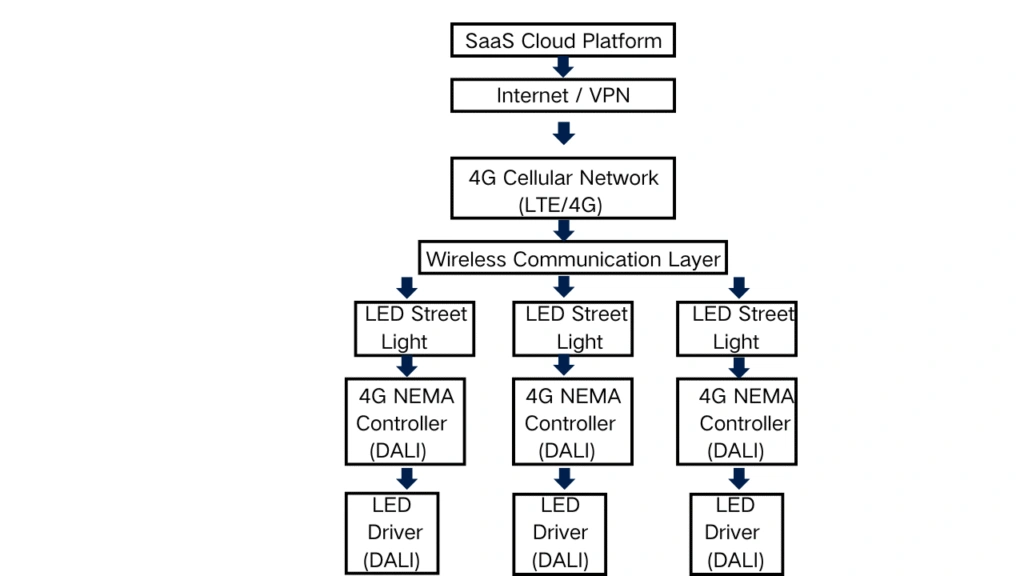
Topology of 4G NEMA Controllers connected to a cloud-based SaaS smart city lighting platform via 4G LTE cellular communication.
DALI Integration Enables Advanced Lighting Performance
Our 4G NEMA controllers support DALI-based dimming, enabling precise lighting control at the luminaire level.
This capability significantly improves both lighting quality and operational efficiency.
Benefits of DALI-Based Integration
With DALI control, cities can implement:
- Multi-level dimming schedules
- Time-based lighting profiles
- Adaptive brightness control
- Smooth dimming transitions
This reduces unnecessary energy usage and improves lighting consistency across urban areas.
Advantages of SaaS-Based Integration for Smart Cities
Cloud-based SaaS platforms provide major advantages over traditional locally installed systems.
Remote Accessibility
Operators can access the system from:
- Control centers
- Field offices
- Mobile devices
This enables flexible operation and faster decision-making.
Scalable Infrastructure
Cloud platforms allow easy expansion.
New lighting nodes can be added without modifying core infrastructure.
This supports long-term city growth.
Centralized Data Management
All operational data is stored securely in the cloud.
This enables:
- Long-term performance analysis
- Energy optimization planning
- Predictive maintenance strategies
Centralized data improves overall infrastructure intelligence.
Real-World Urban Deployment Scenario
To understand integration benefits, consider a typical city-wide lighting deployment.
Example Project Overview
Project Type: Urban Street Lighting
Lighting Points: 8,000 luminaires
Communication Method: 4G LTE
Control Method: Cloud-based SaaS platform
Dimming Standard: DALI
Operational Workflow
In this deployment:
- Controllers are installed on each luminaire
- Devices automatically connect to the platform
- Lighting schedules are configured
- Dimming profiles are activated
- Fault alerts are monitored continuously
This workflow allows city operators to manage thousands of lighting points efficiently.
Supporting Smart City Interoperability Requirements
Smart city systems are increasingly moving toward standardized communication structures and device compatibility models.
Our 4G NEMA controller architecture supports these evolving requirements by enabling:
- Structured device-level communication
- Standardized data reporting
- Expandable system integration
- Multi-system compatibility readiness
This allows cities to deploy lighting infrastructure that remains compatible with future technology frameworks.
Key Benefits of Integrated 4G NEMA Lighting Systems
Integration between controllers and smart city platforms delivers measurable operational improvements.
Reduced Operational Cost
Automation reduces manual inspection requirements.
Maintenance becomes more targeted and efficient.
Improved Lighting Reliability
Continuous monitoring ensures rapid fault detection.
Lighting uptime improves significantly.
Enhanced Energy Efficiency
Programmable dimming reduces unnecessary energy usage.
This lowers overall operating costs.
Faster Deployment
Wireless communication eliminates the need for additional network wiring.
Installation time is significantly reduced.
Future Expansion Possibilities
As smart cities evolve, lighting networks are becoming multi-functional infrastructure layers.
Integrated 4G NEMA controllers support future capabilities such as:
- Smart traffic-responsive lighting
- Environmental monitoring integration
- Public safety system coordination
- Predictive infrastructure maintenance
These functions transform lighting systems into intelligent urban service platforms.
To explore technical specifications, communication features, and installation options, visit our 4G NEMA Controller product page.