As smart city infrastructure continues to evolve, communication reliability and deployment flexibility have become critical factors in street lighting system design. While both PLC (Power Line Communication) and 4G wireless communication are widely used in smart lighting networks, many large-scale projects now adopt a hybrid PLC and 4G architecture to achieve maximum performance and coverage.
Hybrid communication systems combine the stability of PLC networks with the flexibility of wireless 4G connectivity. This approach allows cities to deploy reliable lighting control systems across complex urban environments, including roads, tunnels, industrial zones, and expanding districts.
This article explains how hybrid PLC and 4G smart street lighting architecture works, why it is increasingly adopted in modern infrastructure projects, and how it supports scalable smart city deployment.
Why Hybrid Communication Is Becoming the New Standard
Smart lighting projects today often span multiple environments, each with unique communication challenges. A single communication method may not provide optimal performance across all conditions.
For example:
- Urban roads benefit from wireless flexibility
- Tunnels require stable wired communication
- Industrial zones demand interference-resistant networks
- Remote districts require fast deployment
Hybrid PLC and 4G systems address these varied requirements by combining both technologies into a unified control architecture.
Key Challenges Addressed by Hybrid Systems
Traditional single-technology systems often face limitations such as:
- Communication gaps in enclosed environments
- High infrastructure costs in large-scale deployments
- Difficult expansion into new development areas
- Increased maintenance complexity
Hybrid architecture reduces these risks by enabling environment-specific communication selection.
Overview of Hybrid PLC and 4G Smart Lighting Architecture
Hybrid smart lighting architecture integrates PLC communication networks with 4G wireless nodes under a centralized cloud management platform.
Instead of relying on a single communication path, the system intelligently connects different network types into one unified lighting infrastructure.
Core Components of Hybrid Systems
A typical hybrid PLC and 4G lighting architecture includes:
- Cloud-based SaaS lighting management platform
- PLC central concentrators
- PLC lighting controllers
- 4G NEMA lighting controllers
- LED luminaires with DALI drivers
- Communication gateways
- Power line communication networks
- 4G cellular communication network
Together, these components enable flexible communication across different infrastructure environments.
How Hybrid PLC and 4G Lighting Systems Work
Understanding the workflow of hybrid lighting systems helps illustrate their advantages in real-world applications.
Hybrid PLC + 4G Smart Street Lighting System Architecture
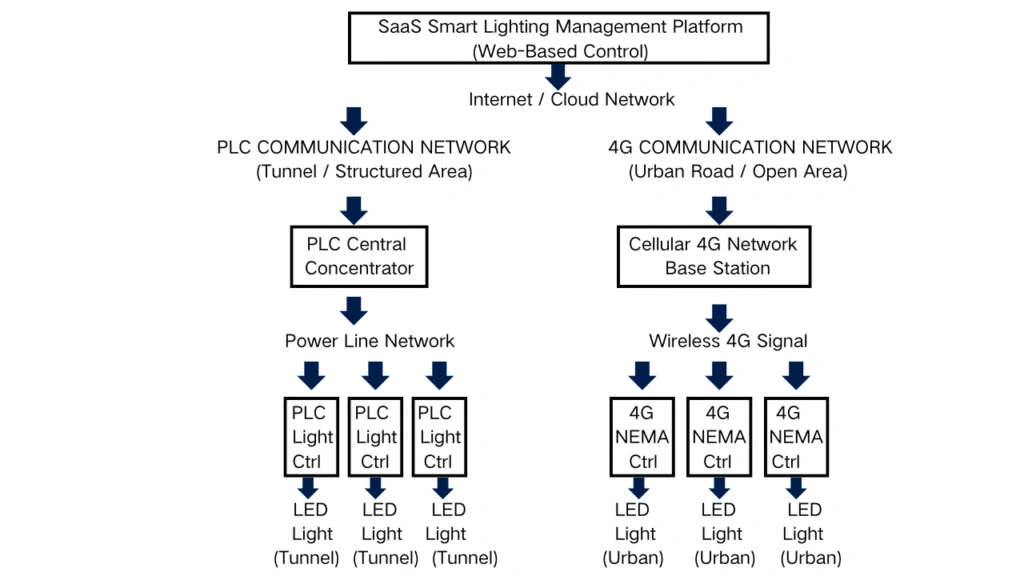
Hybrid PLC and 4G smart street lighting topology combining power line communication in structured environments and wireless 4G communication in open urban areas under a centralized SaaS management platform.
Step 1 — Centralized Cloud-Based Control Platform
At the top of the architecture is the SaaS smart lighting platform.
This platform manages:
- Device communication
- Lighting schedules
- Alarm monitoring
- Energy analytics
- System diagnostics
All lighting nodes—whether PLC or 4G—connect to the same centralized system.
This ensures unified monitoring and control.
Step 2 — PLC Communication in Structured Environments
PLC communication operates through existing power lines.
It is typically used in:
- Tunnel lighting systems
- Underground infrastructure
- Industrial facilities
- Controlled campus environments
PLC lighting controllers communicate with central concentrators using electrical power lines as the data transmission medium.
This provides stable communication where wireless signals may be limited.
Step 3 — 4G Wireless Communication in Open Environments
4G communication provides flexible wireless connectivity.
It is commonly used in:
- Urban road lighting
- Highway lighting
- Residential areas
- Expanding city districts
Each luminaire equipped with a 4G NEMA controller communicates directly with the cloud platform.
This allows fast deployment without additional communication cables.
Step 4 — Unified Network Integration
Both PLC and 4G communication networks connect to the central management platform.
From the operator’s perspective, the system functions as a single unified network.
This enables:
- Centralized monitoring
- Group-based lighting control
- Integrated alarm management
- Unified data reporting
This integration is a defining advantage of hybrid architecture.
Typical Hybrid Deployment Scenario
Hybrid PLC and 4G systems are particularly useful in complex infrastructure environments that combine open roads with enclosed structures.
Example: Smart City Road and Tunnel Lighting
Consider a large urban infrastructure project that includes both city roads and underground tunnels.
Tunnel Section
Tunnel lighting systems use PLC communication because:
- Power lines are continuous
- Wireless signals are limited
- Communication reliability is critical
PLC controllers connect to a central concentrator located inside the tunnel.
Surface Road Section
Roadside luminaires use 4G NEMA controllers.
Reasons include:
- Fast installation
- Flexible network expansion
- Minimal infrastructure modification
Wireless connectivity supports rapid deployment across urban districts.
Central Management
Both PLC and 4G systems connect to the same cloud platform.
Operators can:
- Monitor all lighting points
- Adjust brightness levels
- Detect failures
- Manage maintenance workflows
This unified approach simplifies operational management.
Key Advantages of Hybrid PLC and 4G Lighting Systems
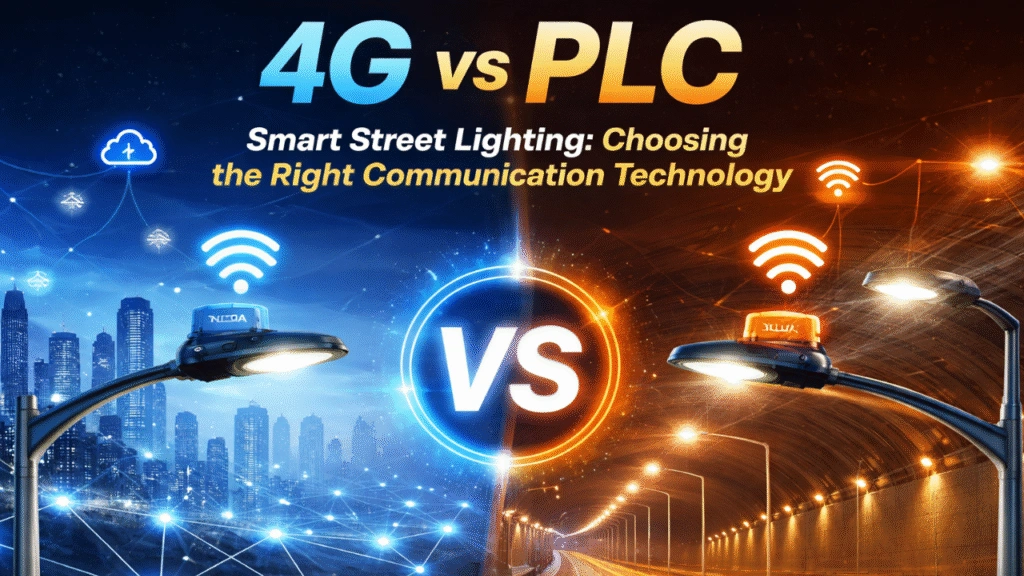
Hybrid communication architecture delivers several practical advantages for smart city deployments. To understand the differences between communication technologies, refer to our 4G vs PLC smart street lighting comparison guide.
Maximum Communication Reliability
Hybrid systems improve overall reliability by selecting the most suitable communication method for each environment.
Benefits include:
- Reduced communication failure risk
- Improved system uptime
- Enhanced operational stability
This is especially important in critical infrastructure such as tunnels and highways.
Flexible Deployment Across Mixed Environments
Cities often contain both structured and open environments.
Hybrid architecture supports:
- Urban districts
- Tunnel networks
- Industrial zones
- Expanding infrastructure
This flexibility allows consistent system performance across diverse environments.
Faster Project Implementation
Wireless 4G deployment reduces installation time in open areas, while PLC leverages existing infrastructure in controlled environments.
This reduces:
- Civil construction requirements
- Installation complexity
- Project delays
Improved Maintenance Efficiency
Unified monitoring enables faster identification of faults across both communication systems.
Maintenance teams can:
- Identify failure locations
- Schedule targeted repairs
- Reduce manual inspection time
This improves operational efficiency.
Long-Term Scalability
Hybrid systems support gradual network expansion.
New lighting nodes can be added using either PLC or 4G communication depending on site conditions.
This supports:
- Future city growth
- Infrastructure upgrades
- Technology evolution
Hybrid Architecture and Smart City Integration
Modern smart city platforms require lighting networks to function as integrated digital infrastructure.
Hybrid PLC and 4G systems support this requirement by enabling structured data communication across multiple device types.
Integration Capabilities
Hybrid lighting systems can integrate with:
- Traffic monitoring systems
- Environmental sensors
- Emergency response systems
- Smart parking infrastructure
- Urban analytics platforms
This transforms lighting networks into multifunction smart city assets.
Real-World Applications of Hybrid Smart Lighting Systems
Hybrid communication is widely applicable across various infrastructure types.
Urban Smart City Infrastructure
Hybrid systems support large-scale urban lighting networks that include both roads and enclosed structures.
Typical examples include:
- City transportation corridors
- Metropolitan road networks
- Multi-zone lighting systems
Highway and Tunnel Projects
Hybrid communication ensures reliable operation across extended infrastructure.
Highway projects often include:
- Open-road lighting (4G)
- Tunnel lighting (PLC)
This combination provides consistent lighting control across the entire route.
Industrial and Logistics Zones
Large industrial facilities benefit from hybrid architecture.
These sites often include:
- Outdoor yards
- Warehouses
- Underground infrastructure
Hybrid communication supports reliable operation across all areas.
When Should You Choose Hybrid PLC and 4G Systems?
Hybrid architecture is particularly suitable when projects involve mixed infrastructure environments.
Recommended Use Cases
Choose hybrid communication when:
- Projects include tunnels and open roads
- Communication conditions vary across zones
- Rapid deployment is required
- Long-term expansion is planned
- System reliability is critical
These conditions are common in modern smart city infrastructure.
Future Trends in Hybrid Smart Lighting Communication
Hybrid communication is expected to play a central role in next-generation smart city infrastructure.
Future developments may include:
- AI-based adaptive lighting control
- Predictive maintenance analytics
- Integrated smart city sensor networks
- Real-time traffic-responsive lighting
- Multi-layer communication redundancy
These innovations will further enhance the value of hybrid communication systems.