As highlighted in the recent survey by the Association for Advancing Automation (A3), 41% of manufacturers are prioritizing AI Vision in 2026. While most discussions focus on factory inspection and robotics, one critical application is often overlooked:
Smart Lighting Infrastructure — especially complex tunnel and transportation projects.
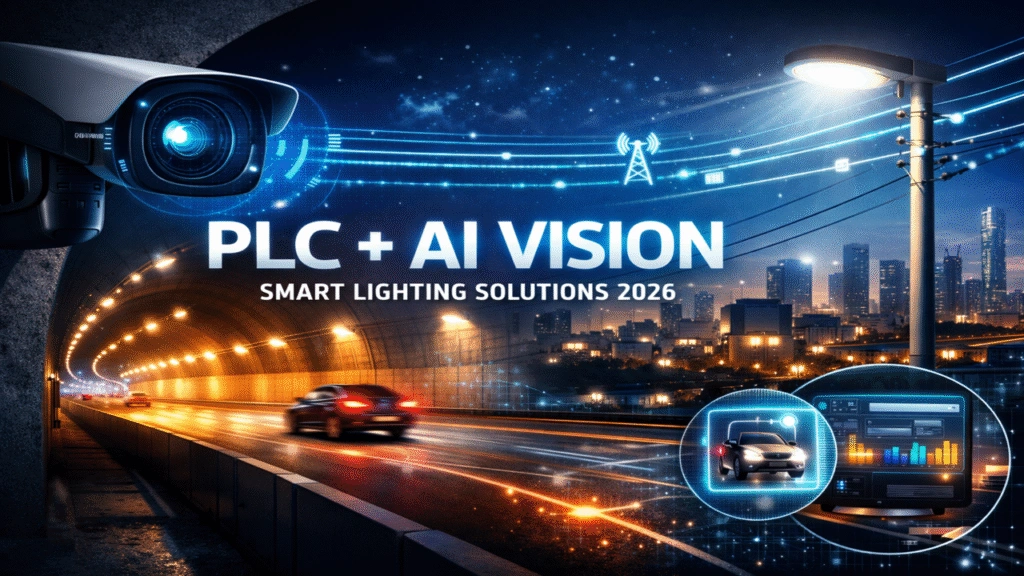
In 2026, the convergence of AI Vision (perception) and PLC (Power Line Communication) (connectivity) is redefining how lighting systems operate — transforming them from static infrastructure into intelligent, adaptive networks.
This is where “High Tech” truly meets real-world infrastructure.
Why PLC + AI Vision Is a Game Changer for Smart Lighting
1. AI Vision: The “Eyes” of Infrastructure
AI Vision systems detect:
- Vehicle flow density
- Speed variation
- Congestion patterns
- Accidents or abnormal stops
- Pedestrian presence
- Environmental visibility conditions (fog, smoke, dust)
In tunnel environments, these insights are critical. Lighting must dynamically adapt to:
- Entry/exit luminance transitions
- Emergency situations
- Traffic flow changes
- Daylight intensity outside the tunnel
Unlike traditional motion sensors, AI Vision delivers context-aware intelligence, not just simple triggers.
But intelligence alone is not enough.
You need a reliable communication backbone.
2. PLC: The Hidden Infrastructure Advantage
Power Line Communication (PLC) allows data transmission through existing electrical wiring — eliminating the need for additional communication cables.
For tunnel and infrastructure projects, this creates three major advantages:
A. No Extra Communication Wiring
Tunnels are complex environments:
- Harsh installation conditions
- High retrofit cost
- Limited shutdown windows
PLC uses existing power lines, reducing:
- Installation cost
- Downtime
- Engineering complexity
B. Ideal for Retrofit Projects
Many tunnels and municipal lighting systems were built years ago. Running new fiber or Ethernet is expensive and disruptive.
PLC enables:
- Digital transformation without rewiring
- Gradual smart upgrades
- Minimal civil engineering work
C. Stable in Harsh Environments
Tunnels face:
- Humidity
- Vibration
- Dust
- Electromagnetic interference
A well-designed industrial PLC system provides robust communication where wireless may struggle.
Why Tunnel Projects Are Perfect for PLC + AI Vision
Tunnel lighting has strict regulatory requirements:
- Uniform luminance
- Adaptive brightness control
- Emergency response protocols
- Energy efficiency targets
Combining AI Vision + PLC creates a closed-loop system:
- AI Vision detects real-time traffic and environmental data.
- Algorithms calculate optimal brightness levels.
- PLC instantly communicates dimming commands to each luminaire.
- Energy consumption adjusts dynamically.
Benefits for Tunnel Operators
- 30–60% energy savings through adaptive dimming
- Reduced maintenance via predictive diagnostics
- Faster emergency response
- Extended luminaire lifespan
- Lower total cost of ownership
In an era of “profitless prosperity,” efficiency is not optional — it is survival.
Beyond Tunnels: Where Else PLC + AI Vision Works Best
While tunnels are ideal, several other project sites benefit greatly from this combination:
1. Smart Highways & Expressways
- Traffic density-based dimming
- Accident detection
- Weather-responsive lighting
- Near-zero additional communication cabling
Perfect for large-scale infrastructure upgrades.
2. Industrial Parks & Smart Factories
In alignment with the A3 trend:
- AI Vision monitors logistics movement
- PLC connects warehouse lighting and control nodes
- Lighting adapts to operational zones
This creates synergy between production efficiency and energy management.
3. Airports & Logistics Hubs
Large lighting networks + high safety requirements:
- Runway perimeter lighting control
- Cargo warehouse smart illumination
- Apron vehicle detection
PLC reduces wiring complexity across massive sites.
4. Ports & Container Terminals
Harsh outdoor conditions make wireless unstable.
AI Vision can:
- Detect container movement
- Identify crane operations
- Optimize yard lighting zones
PLC ensures stable, interference-resistant communication.
5. Urban Smart Street Lighting
Municipalities seeking:
- Energy savings
- Carbon reduction
- Smart city integration
PLC enables cost-effective upgrades without citywide cable replacement.
The Strategic Advantage in 2026
According to A3 data, AI Vision adoption is accelerating. But vision systems alone only provide data.
Infrastructure requires reliable execution.
PLC provides:
- Deterministic communication
- Scalable node management
- Low incremental deployment cost
- Strong ROI for public projects
In tunnel and transportation environments — where reliability, retrofit capability, and energy savings matter most — PLC + AI Vision is not just innovative.
It is practical.
The 2026 Infrastructure Upgrade Formula
AI Vision = Intelligence
PLC = Connectivity
Smart Lighting = Immediate ROI
As manufacturers and infrastructure operators face:
- Rising labor costs
- Margin pressure
- Sustainability mandates
- Aging infrastructure
The integration of Physical AI with power-line-based communication networks becomes the most efficient path forward.
In 2026, smart factories may lead the automation narrative.
But smart tunnels and smart infrastructure are where AI Vision + PLC deliver measurable, immediate, and scalable impact.