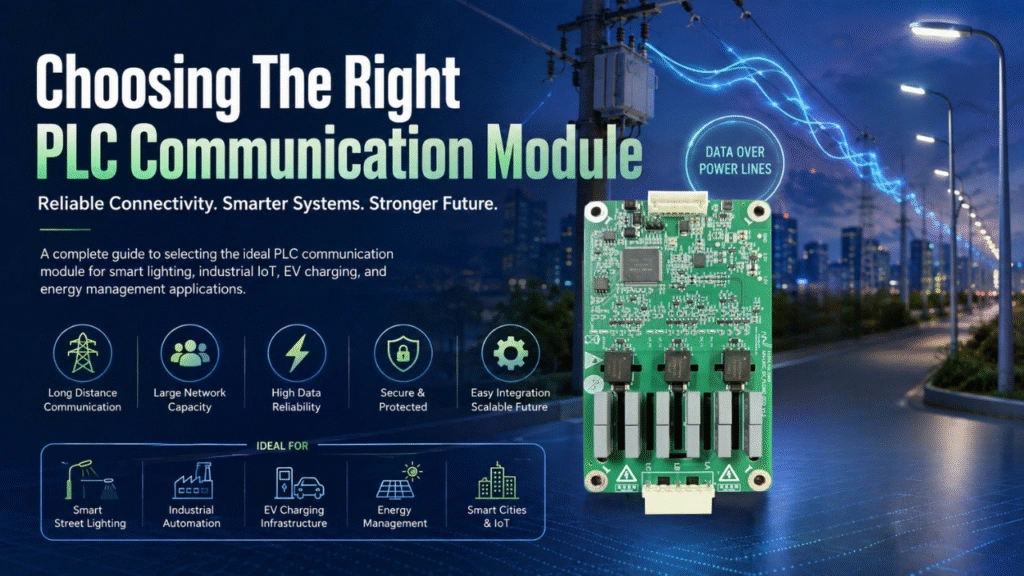
La technologie de communication par ligne électrique (PLC) permet la transmission de données sur des câbles électriques existants, éliminant ainsi le besoin de câblage de communication supplémentaire. De l’éclairage public intelligent et l’automatisation industrielle aux systèmes photovoltaïques et aux infrastructures de recharge pour VE, la technologie des PLC devient une solution privilégiée pour une connectivité fiable, évolutive et économique.
Cependant, choisir le bon module de communication PLC peut être difficile. Différents projets nécessitent différentes distances de communication, débits de données, capacités réseau, protections environnementales et méthodes d’intégration différentes.
Ce guide explique les facteurs les plus importants à considérer lors du choix d’un module de communication PLC et aide les ingénieurs, intégrateurs de systèmes et fabricants OEM à identifier la solution idéale pour leurs applications.
Qu’est-ce qu’un module de communication PLC ?
Un module de communication PLC est un dispositif de communication embarqué qui permet aux équipements d’échanger des données via les lignes électriques existantes.
Au lieu de déployer des câbles Ethernet séparés, des lignes à fibre optique ou des réseaux sans fil, un module PLC utilise l’infrastructure électrique elle-même comme support de communication.
Les modules PLC comprennent généralement :
- Circuiterie de traitement du signal
- Fonctions de modulation et de démodulation
- Circuits de couplage
- Capacités de gestion réseau
- Interfaces de communication telles que UART, SPI, Ethernet ou RS-485
Les applications typiques incluent :
- Éclairage public intelligent
- Systèmes d’éclairage industriel
- Éclairage en tunnel
- Éclairage d’entrepôt
- Systèmes d’énergie solaire
- Stations de recharge pour véhicules électriques
- Bâtiments intelligents
- Systèmes de surveillance énergétique
Pourquoi choisir le bon module PLC est important
Choisir le mauvais module de communication peut entraîner plusieurs problèmes :
- Performance de communication instable
- Augmentation des coûts de déploiement
- Capacité réseau réduite
- Intégration difficile du système
- Faible scalabilité
- Exigences d’entretien plus importantes
Le bon module améliore :
- Efficacité d’installation
- Fiabilité du système
- Stabilité du réseau
- Efficacité énergétique
- Retour sur investissement à long terme
Facteurs clés à prendre en compte
1. Distance de communication
La portée de communication est souvent le premier paramètre que les ingénieurs évaluent.
La distance de transmission dépend de plusieurs facteurs :
- Qualité des lignes électriques
- Interférences électromagnétiques (EMI)
- Longueur du câble
- Conception de l’accouplement
- Configuration du transformateur
Des applications telles que l’éclairage public intelligent nécessitent généralement une communication à travers de vastes zones, rendant les capacités de transmission longue distance essentielles.
2. Capacité réseau
La capacité réseau détermine combien d’appareils peuvent fonctionner dans le même réseau.
Les questions à considérer incluent :
- Combien de luminaires seront installés ?
- D’autres appareils seront-ils ajoutés plus tard ?
- Le réseau maillé est-il nécessaire ?
- Combien de passerelles seront déployées ?
Les grands projets d’éclairage municipal nécessitent souvent des centaines voire des milliers de nœuds.
3. Vitesse de transmission des données
Différentes applications nécessitent différents niveaux de bande passante.
| Application | Exigence typique |
|---|---|
| Contrôle de l’éclairage public | Bande passante faible |
| Lecture du compteur | Bande passante moyenne |
| Transmission vidéo | Haute bande passante |
| Intégration des capteurs IA | Haute bande passante |
Sélectionner un module avec un débit de données approprié garantit un fonctionnement stable et efficace.
4. Technologie OFDM ou FSK
Les modules de communication PLC utilisent généralement soit OFDM (multiplexage par répartition orthogonale de fréquence) soit FSK (modulation par décalage de fréquence).
| Caractéristiques | OFDM | FSK |
| Débit de données | Plus haut | Lower |
| Immunité au bruit | Excellent | Bien |
| Efficacité de la transmission | Haut | Modéré |
| Capacité réseau | Grands | Plus petit |
| Complexité | Plus haut | Lower |
Les solutions OFDM sont couramment sélectionnées pour les grands réseaux d’éclairage intelligent en raison de leur robustesse et de leur scalabilité.
5. Conditions environnementales
Les environnements industriels présentent souvent un bruit électrique important et des conditions de fonctionnement difficiles.
Considérez les facteurs suivants :
- Plage de température
- Humidité
- Résistance à la poussière
- Interférences électromagnétiques
- Fluctuations de tension
- Exigences de protection contre la foudre
Les modules fiables doivent continuer à fonctionner même dans des environnements exigeants.
6. Compatibilité des interfaces
Le module PLC doit s’intégrer harmonieusement avec le système hôte.
Les interfaces courantes incluent :
- UART
- SPI
- I²C
- Ethernet
- RS-485
- Modbus
Choisir la bonne interface réduit le temps de développement et simplifie l’intégration système.
7. Exigences de sécurité
La cybersécurité est devenue de plus en plus importante dans les réseaux d’éclairage modernes et les déploiements de l’Internet des objets industriels (IIoT).
Les caractéristiques importantes incluent :
- Chiffrement des données
- Authentification des appareils
- Mises à jour sécurisées du firmware
- Mécanismes de contrôle d’accès
Ces fonctions contribuent à garantir l’intégrité du système et à prévenir les accès non autorisés.
Processus typique de sélection de module PLC
Les ingénieurs suivent généralement les étapes ci-dessous :
Étape 1 : Définir les exigences de la candidature
Déterminez :
- Distance de communication
- Nombre de nœuds
- Conditions environnementales
- Débits de données requis
Étape 2 : Évaluer la topologie du réseau
Les structures réseau possibles incluent :
- Communication point à point
- Topologie en étoile
- Topologie du maillage
Étape 3 : Vérifier la compatibilité de l’interface
Assurez-vous de la compatibilité entre le module PLC, la passerelle, les capteurs et la plateforme cloud.
Étape 4 : Effectuer des tests sur le terrain
Les tests en laboratoire seuls sont insuffisants. Les conditions de déploiement réelles doivent toujours être prises en compte.
Applications recommandées
Éclairage public intelligent
La technologie PLC permet :
- Commutation à distance
- Contrôle de gradation
- Surveillance des pannes
- Gestion de l’énergie
Installations industrielles
Exemples courants incluent :
- Entrepôts
- Ports
- Usines de fabrication
- Centres logistiques
Systèmes d’énergie renouvelable
Supports de communication des API :
- Installations solaires
- Systèmes de stockage d’énergie par batterie
- Réseaux intelligents
- Infrastructure de recharge pour VE
Pourquoi de nombreux fabricants d’éclairage intelligent choisissent la technologie des PLC
Comparée aux alternatives sans fil, la technologie PLC présente plusieurs avantages :
- Les infrastructures électriques existantes peuvent être réutilisées.
- Des câbles de communication supplémentaires sont inutiles.
- L’expansion du réseau est plus facile.
- Les coûts d’entretien sont réduits.
- La fiabilité de la communication est améliorée.
Pour les municipalités et les installations industrielles, ces avantages se traduisent souvent par des coûts de déploiement plus faibles et une mise en œuvre plus rapide.
Dernières réflexions
Choisir le bon module de communication PLC nécessite une prise en compte attentive de la distance de communication, de la capacité du réseau, des conditions environnementales, des débits de données, des interfaces, des exigences de sécurité et des besoins d’expansion futures.
Un réseau PLC bien conçu assure une communication fiable tout en minimisant les coûts d’installation et en simplifiant la maintenance à long terme.
À mesure que les villes intelligentes et les applications IoT industrielles continuent de se développer, la technologie de communication PLC jouera un rôle de plus en plus important dans la construction d’infrastructures connectées et intelligentes.
Les organisations qui investissent aujourd’hui dans la solution API appropriée seront mieux placées pour développer demain des systèmes évolutifs, efficaces et à l’épreuve de l’avenir.