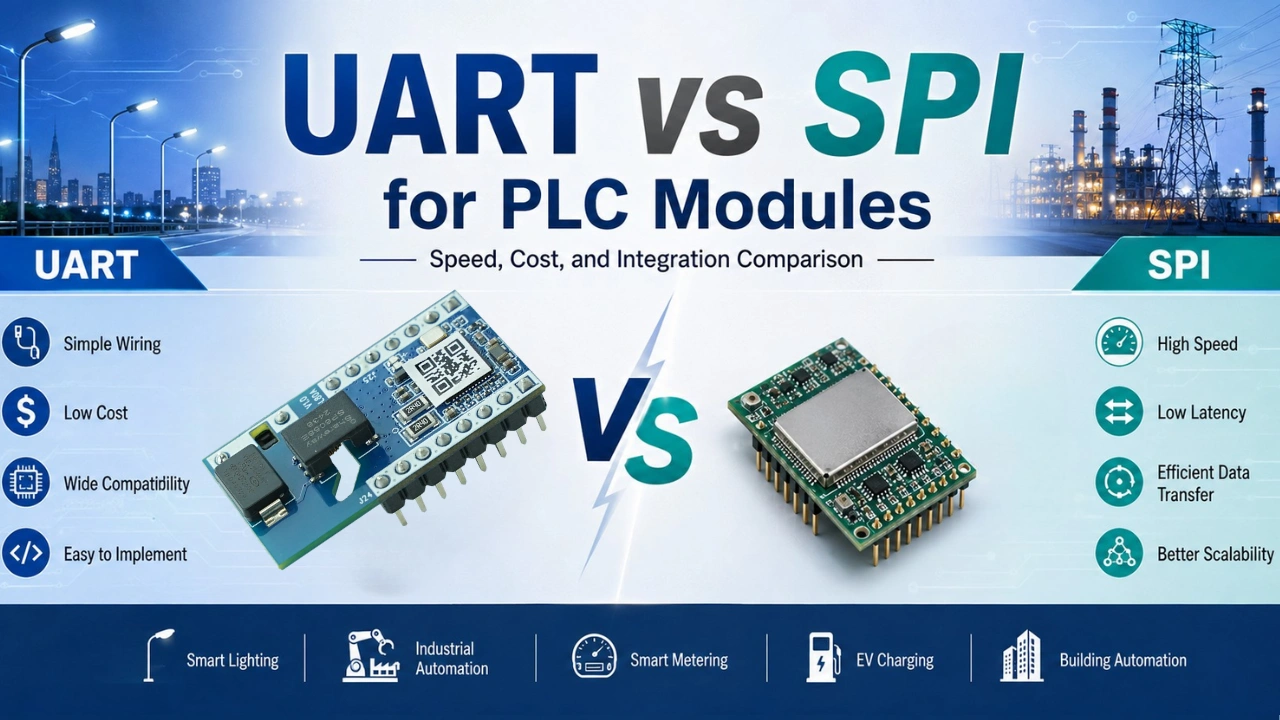
Choisir entre UART vs SPI pour les modules API est l’une des décisions les plus importantes lors de la conception de systèmes d’éclairage intelligent, d’équipements d’automatisation industrielle, de réseaux intelligents et de réseaux IoT. L’interface sélectionnée influence directement la vitesse de communication, la complexité matérielle, la consommation d’énergie, les coûts de développement et la performance globale du système.
Parmi toutes les interfaces disponibles, UART (Récepteur/Émetteur Universel Asynchrone) et SPI (Interface périphérique série) sont les deux options les plus couramment utilisées.
Mais lequel devriez-vous choisir ? Avant de choisir une interface, les ingénieurs doivent comprendre les fondamentaux expliqués dans notre article, Qu’est-ce que la communication par ligne électrique (PLC) ?
La réponse dépend de plusieurs facteurs, notamment la vitesse de transmission, la complexité matérielle, le coût de développement, la capacité de traitement et les exigences de l’application.
Dans cet article, nous allons comparer en détail l’UART et le SPI et expliquer quelle interface convient le mieux à différentes applications PLC.
UART vs. SPI pour les modules PLC : quelle interface est la meilleure ?
À mesure que la technologie de communication par ligne électrique (PLC) devient de plus en plus populaire dans l’éclairage intelligent, l’automatisation industrielle, les réseaux intelligents, la recharge de véhicules électriques et les applications IoT, il devient crucial de choisir la bonne interface de communication entre le contrôleur hôte et le module API.
Parmi toutes les interfaces disponibles, UART (Récepteur/Émetteur Universel Asynchrone) et SPI (Interface périphérique série) sont les deux options les plus couramment utilisées.
Mais lequel devriez-vous choisir ?
La réponse dépend de plusieurs facteurs, notamment la vitesse de transmission, la complexité matérielle, le coût de développement, la capacité de traitement et les exigences de l’application.
Dans cet article, nous allons comparer en détail l’UART et le SPI et expliquer quelle interface convient le mieux à différentes applications PLC.
UART vs SPI pour les modules PLC : comprendre UART
UART est un protocole de communication série asynchrone qui transfère les données bit par bit via des lignes dédiées de transmission (TX) et de réception (RX). Si vous êtes un nouvel utilisateur, vous pouvez consulter notre article Comment intégrer un module API dans des systèmes embarqués.
Contrairement aux interfaces synchrones, la communication UART ne nécessite pas de signal d’horloge. Au lieu de cela, les deux dispositifs fonctionnent selon un débit en bauds prédéfini.
Connexion typique avec l’UART
- TX (Transmission)
- RX (Réception)
- GND (Masse)
- Signaux optionnels de contrôle de flux
Avantages de l’UART
- Conception matérielle simple
- Faible coût d’implémentation
- Moins de fils de connexion
- Excellente compatibilité avec les microcontrôleurs
- Débogage et tests faciles
Limites de l’UART
- Vitesse de transmission plus basse
- Latence de communication plus élevée
- Une plus grande susceptibilité aux incompatibilités de timing
- Évolutivité limitée
UART vs SPI pour les modules PLC : comprendre SPI
SPI est un protocole de communication synchrone qui utilise un signal d’horloge généré par le dispositif maître. Cela peut voir le Norme IEEE Pour référence.
Parce que les deux dispositifs partagent la même référence de synchronisation, SPI peut atteindre des vitesses de transmission nettement supérieures à celles de l’UART.
Connexion SPI typique
- MOSI (entrée esclave de sortie maître)
- MISO (Master Input Slave Output)
- SCLK (Horloge)
- CS (Sélection de puce)
Avantages de la SPI
- Communication à haute vitesse
- Latence plus faible
- Exploitation en duplex complet
- Excellentes performances dans les applications à forte intensité de données
- Transfert de données plus efficace
Limitations de la SPI
- Conception matérielle plus complexe
- Exigences supplémentaires en câblage
- Complexité accrue du développement logiciel
- Distance de communication plus courte
UART vs. SPI : Une comparaison détaillée
| Caractéristiques | UART | SPI |
|---|---|---|
| Synchronisation | Asynchrone | Synchrone |
| Signal d’horloge | Pas obligatoire | Obligatoire |
| Mode de communication | Full duplex | Full duplex |
| Vitesse typique | 9,6 kbps–1 Mbps | De plusieurs Mbps à des dizaines de Mbps |
| Complexité du câblage | Low | Douleur moyenne |
| Surcharge CPU | Modéré | Low |
| Coût de mise en œuvre | Lower | Un peu plus haut |
| Évolutivité | Limité | Mieux |
| Difficulté du débogage | Doucement | Modéré |
| Adéquation des modules PLC | Systèmes d’entrée de gamme | Systèmes haute performance |
Module PLC vs chipset API : différences clés expliquées Cet article pourrait vous aider à en apprendre davantage à ce sujet.
Pourquoi de nombreux modules API prennent en charge les deux interfaces
Les fabricants modernes de modules PLC fournissent fréquemment à la fois des interfaces UART et SPI car différentes applications ont des exigences différentes.
L’UART est couramment sélectionné pour :
- Systèmes d’éclairage public intelligent
- Automatisation des bâtiments
- Systèmes de surveillance environnementale
- Comptage à distance
- Réseaux de capteurs à faible bande passante
Le SPI est souvent préféré pour :
- Systèmes d’automatisation industrielle
- Plateformes d’éclairage à vision IA
- Applications de l’informatique en périphérie
- Réseaux de capteurs à haute densité
- Systèmes de contrôle en temps réel
Par exemple, un contrôleur intelligent de lampadaire peut seulement transmettre des commandes de commutation, des instructions de gradation et des données de capteurs, faisant de l’UART une solution économique.
Cependant, une passerelle PLC industrielle qui traite de grandes quantités de données provenant de plusieurs nœuds peut nécessiter le débit plus élevé fourni par SPI.
Facteurs clés à prendre en compte lors du choix d’une interface
1. Vitesse de transmission
Si votre application nécessite un échange rapide de données, SPI est généralement le meilleur choix.
2. Ressources matérielles
Les petits microcontrôleurs ont souvent des broches et des ressources mémoire limitées, ce qui rend l’UART plus attractif.
3. Complexité logicielle
Les pilotes UART sont généralement plus faciles à développer et à entretenir.
4. Interférences électromagnétiques (EMI)
Les environnements industriels comportent souvent un fort bruit électrique. Un filtrage, un blindage et une isolation appropriés deviennent essentiels, quelle que soit l’interface choisie.
5. Évolutivité future
Les applications censées prendre en charge des capteurs supplémentaires, des passerelles ou des capacités de calcul en périphérie pourraient bénéficier de la bande passante plus élevée de SPI.
Architecture typique des modules PLC
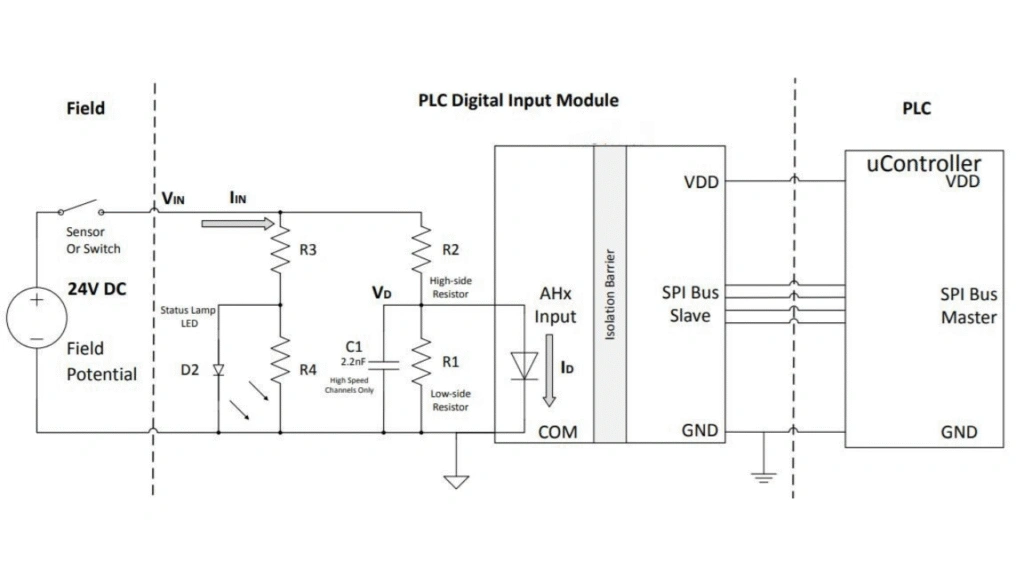
Une solution PLC embarquée typique se compose généralement des composants suivants :
- Microcontrôleur hôte (MCU)
- Interface UART ou SPI
- Puce modem PLC
- Circuit frontal analogique
- Circuit de couplage de puissance
- Réseau de lignes électriques
Cette architecture permet aux ingénieurs d’intégrer la technologie des PLC dans les systèmes d’éclairage intelligent, les équipements de contrôle industriel et les plateformes de gestion de l’énergie tout en minimisant la complexité du développement.
UART vs SPI pour les modules PLC : quelle interface choisir ?
Les recommandations suivantes peuvent servir de guide pratique :
| Scénario | Interface recommandée |
|---|---|
| Dispositifs à faible coût | UART |
| Déploiement rapide | UART |
| Ressources limitées du MCU | UART |
| Communication à haute vitesse | SPI |
| Applications en temps réel | SPI |
| Automatisation industrielle | SPI |
| Grands réseaux PLC | SPI |
Au final, aucune des deux interfaces n’est universellement meilleure. La bonne décision dépend entièrement de l’architecture de votre système et de vos exigences de performance.