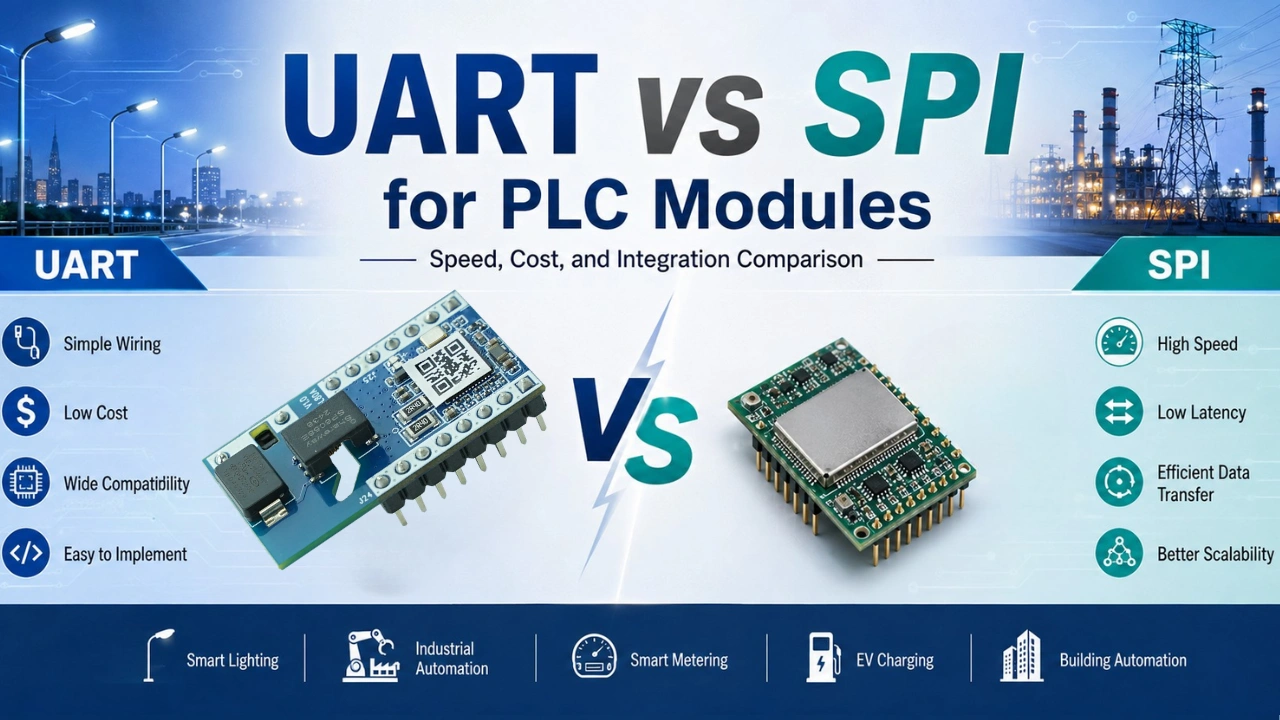
UART vs SPI for PLC Modules: Speed, Cost, and Integration Guide

UART vs SPI for PLC modules: learn the differences in speed, latency, wiring complexity, cost, and integration requirements for smart lighting and industrial PLC applications.

UART vs. SPI for PLC Modules: Which Interface Is Better?

Choosing the right interface is essential when integrating PLC modules into embedded systems. This guide compares UART and SPI communication protocols, covering transmission speed, hardware complexity, latency, cost, and application scenarios.

Choosing between UART vs SPI for PLC modules is one of the most important decisions when designing smart lighting systems, industrial automation equipment, smart grids, and IoT networks. The selected interface directly affects communication speed, hardware complexity, power consumption, development costs, and overall system performance.

Among all available interfaces, UART (Universal Asynchronous Receiver/Transmitter) 그리고 SPI (Serial Peripheral Interface) are the two most commonly used options.

But which one should you choose? Before selecting an interface, engineers should understand the fundamentals explained in our article, What Is Power Line Communication (PLC)?

The answer depends on several factors, including transmission speed, hardware complexity, development cost, processing capability, and application requirements.

In this article, we’ll compare UART and SPI in detail and explain which interface is best suited for different PLC applications.

UART vs. SPI for PLC Modules: Which Interface Is Better?

As power line communication (PLC) technology becomes increasingly popular in smart lighting, industrial automation, smart grids, EV charging, and IoT applications, selecting the right communication interface between the host controller and the PLC module becomes critically important.

Among all available interfaces, UART (Universal Asynchronous Receiver/Transmitter) 그리고 SPI (Serial Peripheral Interface) are the two most commonly used options.

But which one should you choose?

The answer depends on several factors, including transmission speed, hardware complexity, development cost, processing capability, and application requirements.

In this article, we’ll compare UART and SPI in detail and explain which interface is best suited for different PLC applications.

UART vs SPI for PLC Modules: Understanding UART

UART is an asynchronous serial communication protocol that transfers data one bit at a time through dedicated transmission (TX) and reception (RX) lines. If you are a new user, can see our article 임베디드 시스템에 PLC 모듈을 통합하는 방법.

Unlike synchronous interfaces, UART communication does not require a clock signal. Instead, both devices operate according to a predefined baud rate.

Typical UART connection

  • TX (Transmit)
  • RX (Receive)
  • GND (Ground)
  • Optional flow-control signals

Advantages of UART

  • 간단한 하드웨어 설계
  • Low implementation cost
  • Fewer connection wires
  • Excellent compatibility with microcontrollers
  • Easy debugging and testing

Limitations of UART

  • Lower transmission speed
  • Higher communication latency
  • Greater susceptibility to timing mismatches
  • Limited scalability

UART vs SPI for PLC Modules: Understanding SPI

SPI is a synchronous communication protocol that uses a clock signal generated by the master device. This can see the IEEE 표준 for reference.

Because both devices share the same timing reference, SPI can achieve significantly higher transmission speeds than UART.

Typical SPI connection

  • MOSI (Master Output Slave Input)
  • MISO (Master Input Slave Output)
  • SCLK (Clock)
  • CS (Chip Select)

Advantages of SPI

  • 고속 통신
  • 낮은 지연
  • Full-duplex operation
  • Excellent performance in data-intensive applications
  • More efficient data transfer

Limitations of SPI

  • More complicated hardware design
  • 추가 배선 요구 사항
  • Higher software development complexity
  • Shorter communication distance

UART vs. SPI: A Detailed Comparison

특징 UART SPI
Synchronization Asynchronous Synchronous
Clock signal 필수 사항 필수
통신 방식 Full duplex Full duplex
Typical speed 9.6 kbps–1 Mbps Several Mbps to tens of Mbps
Wiring complexity 낮게 보통
CPU overhead 중도 낮게
Implementation cost 더 하부 Slightly higher
확장성 제한 Better
Debugging difficulty 천만히 중도
PLC module suitability Entry-level systems High-performance systems

PLC 모듈과 PLC 칩셋: 주요 차이점 설명 this article may help you know more about it.

Why Many PLC Modules Support Both Interfaces

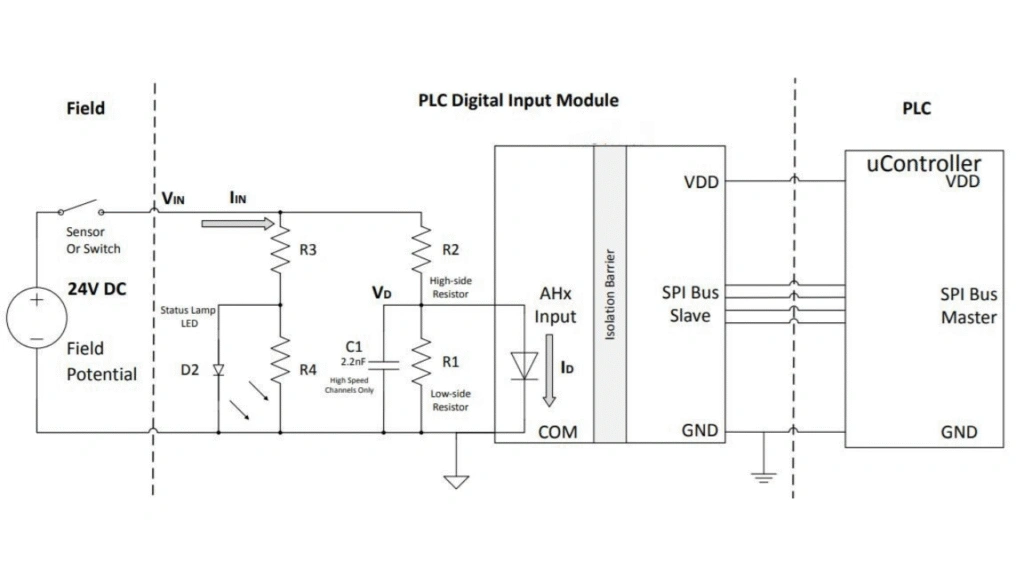
PLC digital input module

Modern PLC module manufacturers frequently provide both UART and SPI interfaces because different applications have different requirements.

UART is commonly selected for:

  • 스마트 가로등 시스템
  • Building automation
  • 환경 모니터링 시스템
  • Remote metering
  • Low-bandwidth sensor networks

SPI is often preferred for:

  • 산업 자동화 시스템
  • AI vision lighting platforms
  • Edge computing applications
  • High-density sensor networks
  • Real-time control systems

For example, a smart streetlight controller may only transmit switching commands, dimming instructions, and sensor data, making UART a cost-effective solution.

However, an industrial PLC gateway that processes large amounts of data from multiple nodes may require the higher throughput provided by SPI.

Key Factors to Consider When Selecting an Interface

1. Transmission speed

If your application requires rapid data exchange, SPI is usually the better choice.

2. Hardware resources

Small microcontrollers often have limited pins and memory resources, making UART more attractive.

3. Software complexity

UART drivers are generally easier to develop and maintain.

4. Electromagnetic interference (EMI)

Industrial environments often contain heavy electrical noise. Proper filtering, shielding, and isolation become essential regardless of the chosen interface.

5. Future scalability

Applications expected to support additional sensors, gateways, or edge computing capabilities may benefit from SPI’s higher bandwidth.

Typical PLC Module Architecture

A typical embedded PLC solution usually consists of the following components:

  1. Host microcontroller (MCU)
  2. UART or SPI interface
  3. PLC modem chip
  4. Analog front-end circuit
  5. Power coupling circuit
  6. Power line network

This architecture allows engineers to integrate PLC technology into smart lighting systems, industrial control equipment, and energy management platforms while minimizing development complexity.

UART vs SPI for PLC Modules: Which Interface Should You Choose?

The following recommendations can serve as a practical guideline:

시나리오 Recommended interface
Low-cost devices UART
빠른 배치 UART
Limited MCU resources UART
고속 통신 SPI
Real-time applications SPI
산업 자동화 SPI
대형 PLC 네트워크 SPI

Ultimately, neither interface is universally better. The right decision depends entirely on your system architecture and performance requirements.

스티븐 셰

선전 마이크로네이처 혁신기술유한회사의 CTO, 중국과학원 박사, 15년간 전력선 통신 기술에 집중해왔습니다. 실외 및 실내 스마트 조명 장치에 대한 11건의 특허를 추가로 보유했습니다.

FAQ

No. SPI generally supports significantly higher data rates than UART because it uses a dedicated clock signal.

이 글을 공유하세요