Lessons from Advanced Underground Communication Projects
In modern underground industries such as mining, tunneling, and large infrastructure construction, communication reliability is not just important—it is mission-critical. Traditional wireless communication systems often struggle underground due to signal blockage, harsh conditions, and long distances. This is where Power Line Communication (PLC) technology demonstrates its unique advantages.
A notable industry example shows how underground equipment can be monitored and controlled from the surface using broadband communication through existing power cables. This approach significantly improves safety, productivity, and operational efficiency.
The Challenge of Underground Communication
Underground environments present some of the most difficult communication conditions found in industrial operations. These challenges include:
- Confined underground spaces
- Lack of GPS signals
- High electrical noise from heavy machinery
- Explosive or hazardous atmospheres
- Long-distance communication requirements
- Complex infrastructure layouts
Because of these conditions, traditional wireless technologies often experience signal loss or unstable connections. In many underground operations, reducing human exposure to dangerous environments is also a top priority.
Reliable remote communication allows operators to control and monitor equipment from the surface, minimizing the need for workers to enter hazardous zones. This capability greatly improves workplace safety and operational reliability.
Why PLC Is Ideal for Underground Applications
Power Line Communication (PLC) uses existing electrical power cables to transmit data signals. Instead of installing separate communication cables, PLC injects communication signals directly into the power network. PLC technology is widely used in industrial automation, similar to modern PLC smart lighting technology that enables reliable communication across existing power infrastructure.
This approach is particularly suitable for underground environments because:
1. Existing Infrastructure Can Be Used
Underground equipment already requires power cables. PLC technology leverages these same cables to transmit communication signals, eliminating the need for additional wiring.
This results in:
- Lower installation cost
- Faster deployment
- Reduced infrastructure complexity
- Improved system reliability
In many underground systems, PLC devices send data packets through power cores or pilot cores within trailing cables, allowing machines and control centers to communicate over long distances.
2. Reliable Long-Distance Communication
Wireless signals weaken rapidly underground due to rock, metal structures, and confined spaces. PLC, however, transmits data directly through wired electrical paths, maintaining consistent connectivity even in complex tunnel networks.
PLC networks can connect:
- Mobile mining machines
- Conveyor systems
- Ventilation equipment
- Monitoring sensors
- Surface control centers
These networks allow real-time communication between underground equipment and surface operations, enabling faster response and improved productivity.
3. Enhanced Safety Through Surface Monitoring
One of the most valuable benefits of PLC technology is its ability to support remote surface control.
In advanced underground communication systems, monitoring tools allow operators to:
- Measure signal strength and network health
- Monitor equipment performance
- Diagnose communication faults
- Update firmware remotely
- Configure network structures from the surface
This significantly reduces the need for personnel to travel underground to troubleshoot communication issues.
In industrial projects using PLC-based communication networks, specialized monitoring tools can remotely assess system performance and bandwidth usage across underground equipment networks.
How PLC Works in Underground Environments
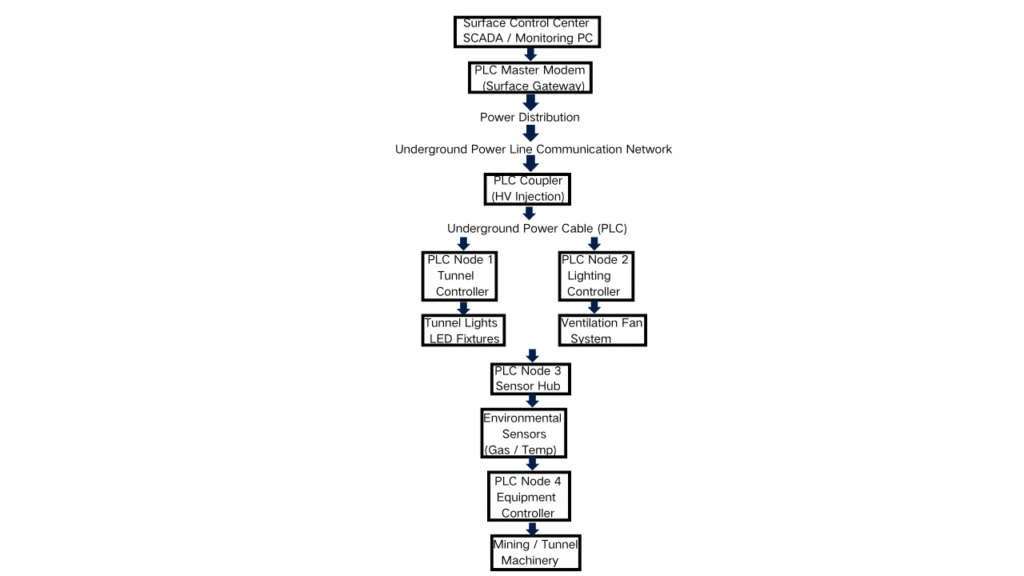
Understanding how PLC operates underground helps illustrate why it performs so well in harsh conditions.
Step-by-Step PLC Communication Process
Step 1: Data Injection Into Power Lines
A PLC data concentrator unit(DCU) injects high-frequency communication signals into existing power cables.
These signals travel alongside electrical power without interfering with normal operations.
Step 2: Signal Transmission Through Underground Cables
The communication signal travels through:
- Power cores
- Pilot cores
- Trailing cables
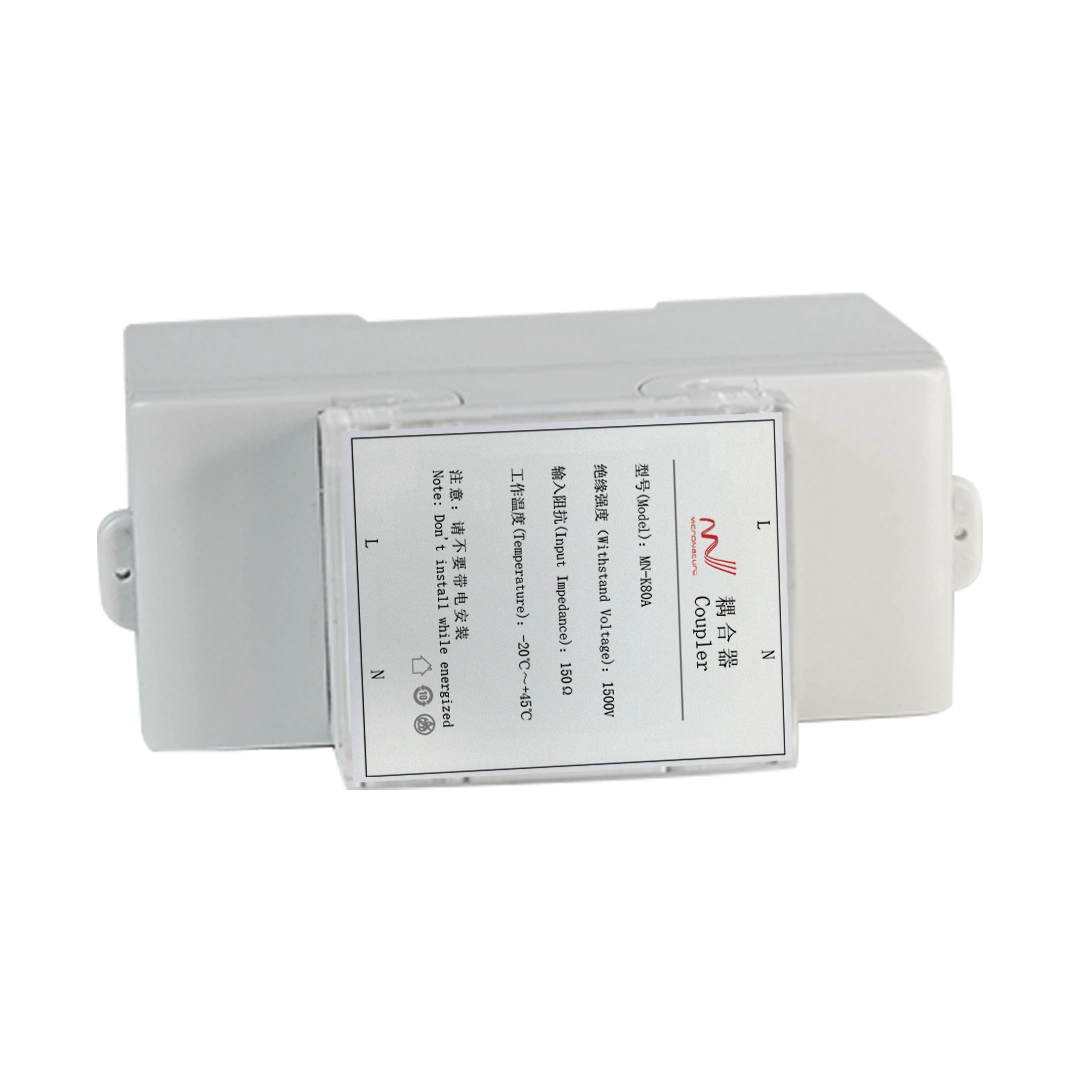
Special coupling devices connect PLC DATA TRANSFER UNIT to high-voltage power lines safely, allowing communication signals to pass while maintaining electrical isolation.
Capacitive coupling methods are commonly used to transmit signals through high-voltage cables safely.
Step 3: Equipment-Level Communication
Each underground machine connected to the power network becomes a communication node.
Typical connected devices include:
- Continuous miners
- Shuttle cars
- Feeder breakers
- Ventilation fans
- Conveyor systems
These machines transmit operational data to the surface in real time.
Step 4: Surface-Level Monitoring and Control
Data transmitted through the PLC network reaches the surface control system.
Operators can:
- Monitor machine status
- View performance data
- Analyze productivity
- Receive alerts
- Perform remote diagnostics
This real-time connection allows rapid decision-making and improved operational safety.
Real-World Applications of PLC Underground Communication
PLC technology is widely used across multiple underground and industrial applications. Many mining and tunnel facilities deploy industrial PLC lighting solutions to ensure stable communication and monitoring across underground equipment.
Underground Mining Operations
Mining remains one of the most demanding environments for communication technology.
PLC supports:
- Remote equipment monitoring
- Machine-to-surface communication
- Safety system integration
- Real-time productivity tracking
- Video and sensor data transmission
Reliable underground communication systems help reduce downtime and improve emergency response efficiency.
Tunnel Construction Projects
Tunnel projects require long communication distances and high reliability. Modern tunnels increasingly adopt PLC tunnel lighting solutions to achieve both illumination control and reliable communication.
PLC enables:
- Communication across long tunnel sections
- Equipment synchronization
- Monitoring of ventilation and lighting
- Remote diagnostics during excavation
PLC is especially useful when installing new cables is difficult or expensive.
Underground Smart Infrastructure
Beyond mining and tunneling, PLC technology plays an increasing role in:
- Underground transportation systems
- Metro tunnels
- Utility corridors
- Industrial plants
- Underground storage facilities
These environments benefit from PLC’s ability to transmit data reliably using existing power infrastructure.
Key Advantages of PLC in Underground Environments
Compared to wireless or fiber-based systems, PLC provides several practical advantages:
High Reliability
PLC avoids common wireless signal problems such as:
- Signal blockage
- Interference
- Dead zones
Wired transmission ensures stable communication even in harsh conditions.
Lower Installation Cost
Since PLC uses existing power cables:
- No separate communication wiring is required
- Installation time is reduced
- Maintenance costs are lower
This makes PLC especially attractive for large-scale underground projects.
Real-Time Monitoring
PLC supports:
- Real-time data transfer
- Network diagnostics
- Remote configuration
This enables efficient system management from centralized control rooms.
Improved Worker Safety
Reducing underground manual inspection significantly lowers operational risk.
Surface-level control reduces worker exposure to:
- Hazardous gases
- Mechanical risks
- Structural instability
Safety improvement remains one of the strongest drivers for adopting PLC systems.
The Future of PLC in Underground Communication
As industrial automation continues to expand, underground environments are becoming increasingly digital.
Future trends include:
- Integration with IoT platforms
- AI-driven predictive maintenance
- Real-time video analytics
- Remote robotic operations
- Smart underground infrastructure networks
PLC will remain a core communication technology due to its reliability and compatibility with existing electrical systems.
The ability to build high-performance communication networks without installing new communication infrastructure makes PLC an essential technology for future underground operations.