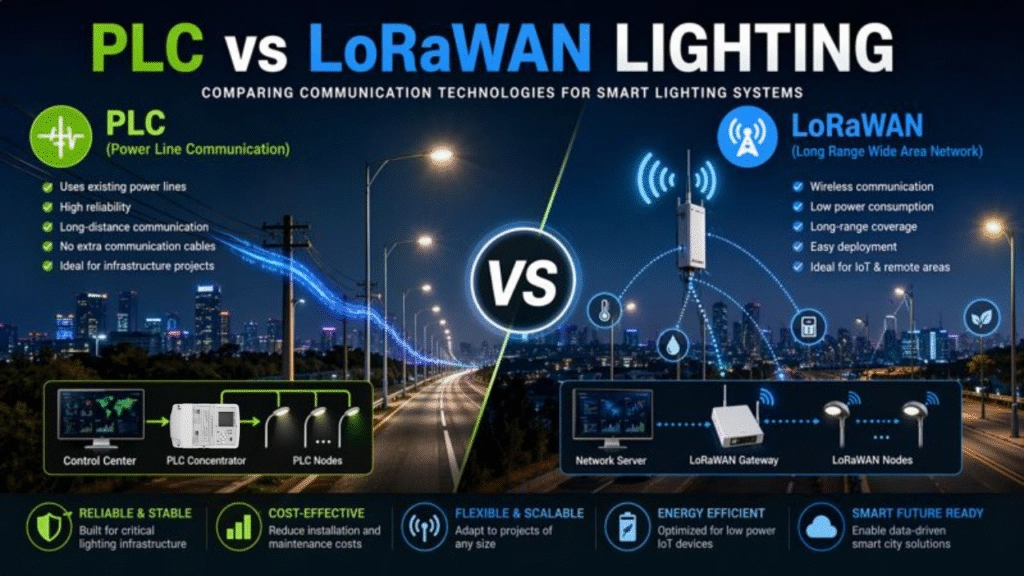
Selecting the right communication technology is a critical decision in modern smart lighting systems. Two widely used technologies—Power Line Communication (PLC) and LoRaWAN—offer different advantages depending on infrastructure, distance, and reliability requirements. For a broader comparison of communication technologies, you can also explore our PLC vs DALI vs Zigbee lighting comparison guide.
This guide compares PLC vs LoRaWAN lighting communication technologies, helping engineers, system integrators, and smart city planners determine the most suitable solution for their projects.
What Is PLC Lighting Communication?
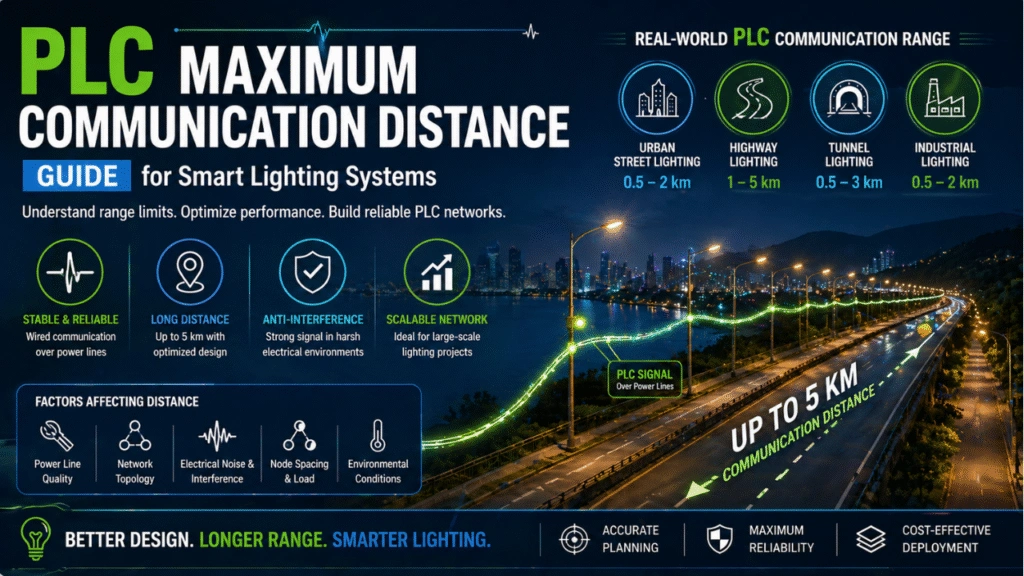
Power Line Communication (PLC) enables data transmission over existing electrical power lines. This eliminates the need for additional communication wiring, making PLC particularly suitable for large-scale lighting infrastructure.
Key Characteristics of PLC
- Uses existing power lines
- No extra communication cables required
- Long-distance communication capability
- High reliability in harsh environments
- Ideal for infrastructure-based lighting systems
Typical PLC Applications
- Street lighting
- Tunnel lighting
- Industrial lighting
- Highways
- Parking lots
What Is LoRaWAN Lighting Communication?
LoRaWAN (Long Range Wide Area Network) is a wireless communication technology designed for long-distance, low-power IoT communication.
It enables wireless data transmission between devices and gateways over several kilometers.
Key Characteristics of LoRaWAN
- Wireless communication
- Long transmission range
- Low power consumption
- Suitable for IoT sensor networks
- Requires gateway infrastructure
Typical LoRaWAN Applications
- Smart city IoT systems
- Environmental monitoring
- Smart metering
- Remote asset tracking
- Distributed sensor networks
PLC vs LoRaWAN Lighting: Key Differences
Understanding the differences between PLC and LoRaWAN helps determine which technology is better suited for specific lighting applications.
Communication Medium
| Technology | Medium |
|---|---|
| PLC | Power lines |
| LoRaWAN | Wireless RF |
PLC uses existing electrical wiring, while LoRaWAN relies on wireless communication networks.
Communication Distance
| Technology | Typical Range |
|---|---|
| PLC | Up to several kilometers |
| LoRaWAN | Up to 5–15 km (open areas) |
LoRaWAN supports wide-area coverage, especially in rural environments.
Installation Complexity
| Technology | Complexity |
|---|---|
| PLC | Low (no extra cable) |
| LoRaWAN | Medium (gateway required) |
LoRaWAN installations require planning of gateway locations.
Reliability
| Technology | Reliability |
|---|---|
| PLC | Very High |
| LoRaWAN | Medium to High |
Wireless signals may be affected by interference or obstacles.
Scalability
| Technology | Scalability |
|---|---|
| PLC | High |
| LoRaWAN | Very High |
LoRaWAN supports large IoT device networks.
Power Consumption
| Technology | Power Efficiency |
|---|---|
| PLC | Medium |
| LoRaWAN | Very High |
LoRaWAN is designed for low-power battery-based devices.
PLC vs LoRaWAN Topology Comparison
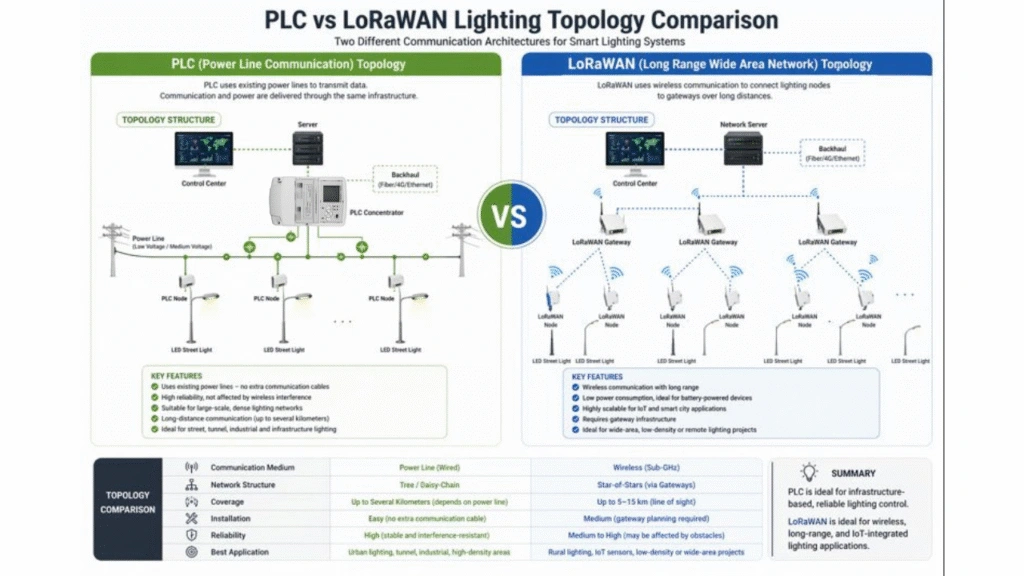
PLC typically uses:
- Tree topology
- Daisy-chain structure
- Centralized concentrator
LoRaWAN typically uses:
- Star topology
- Gateway-based architecture
- Wide-area coverage
When to Choose PLC Lighting
PLC is recommended when:
- Power infrastructure already exists
- High reliability is required
- Communication stability is critical
- Large-scale lighting control is needed
- Harsh environments are present
Typical PLC scenarios:
- Street lighting
- Tunnel lighting
- Industrial lighting
- Smart city backbone systems
When to Choose LoRaWAN Lighting
LoRaWAN is recommended when:
- Wireless deployment is preferred
- Power lines are unavailable
- Battery-powered devices are required
- Long-distance wireless coverage is needed
- IoT sensor integration is required
Typical LoRaWAN scenarios:
- Remote rural lighting
- Smart agriculture
- Smart metering
- Environmental monitoring
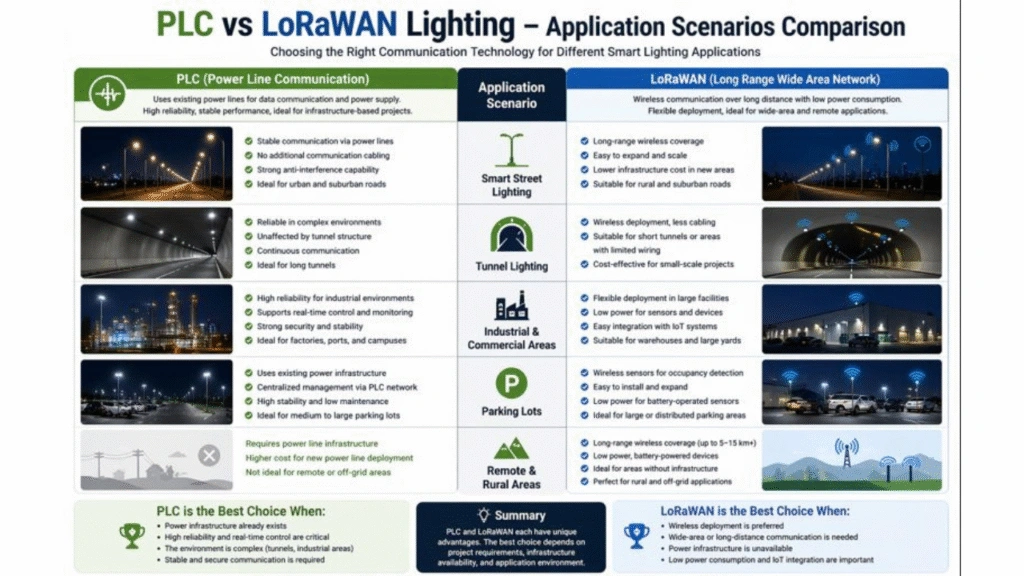
Real-World Application Comparison
| Application | Recommended Technology |
|---|---|
| Smart Street Lighting | PLC |
| Tunnel Lighting | PLC |
| Industrial Facilities | PLC |
| Rural Lighting | LoRaWAN |
| Remote Monitoring | LoRaWAN |
| Smart Sensors | LoRaWAN |
Future Trends: Hybrid PLC + LoRaWAN Networks
Modern smart lighting systems increasingly combine multiple communication technologies.
Hybrid systems may use:
- PLC for backbone lighting communication
- LoRaWAN for IoT sensor networks
- Cloud-based monitoring platforms
- AI-powered predictive maintenance
Hybrid architectures provide flexibility and scalability for complex infrastructure.