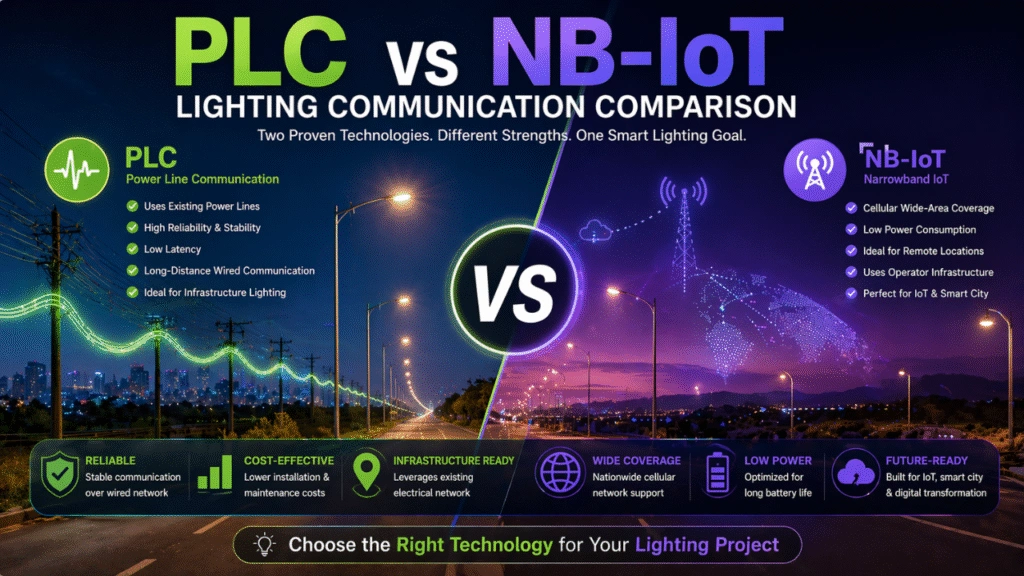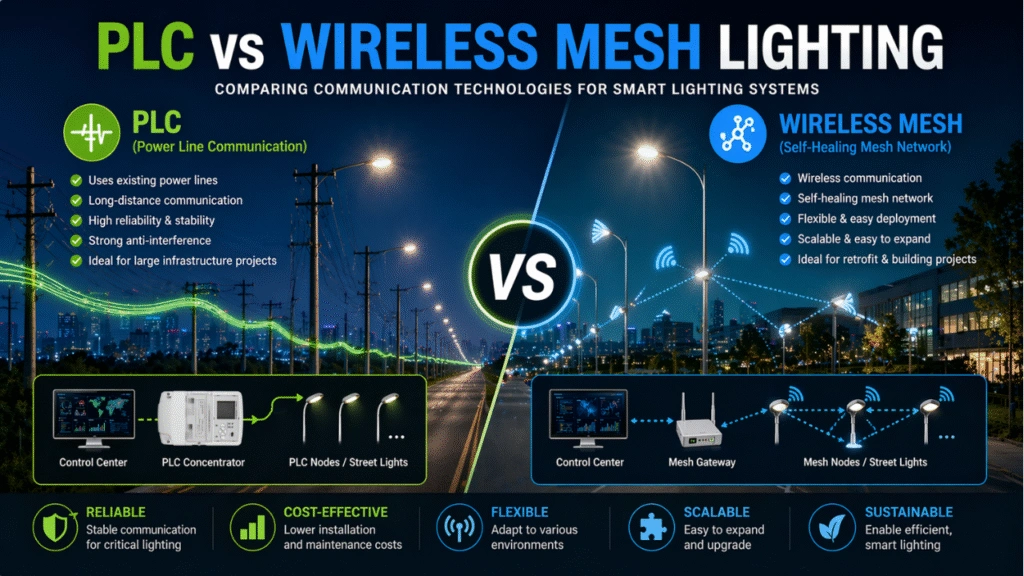
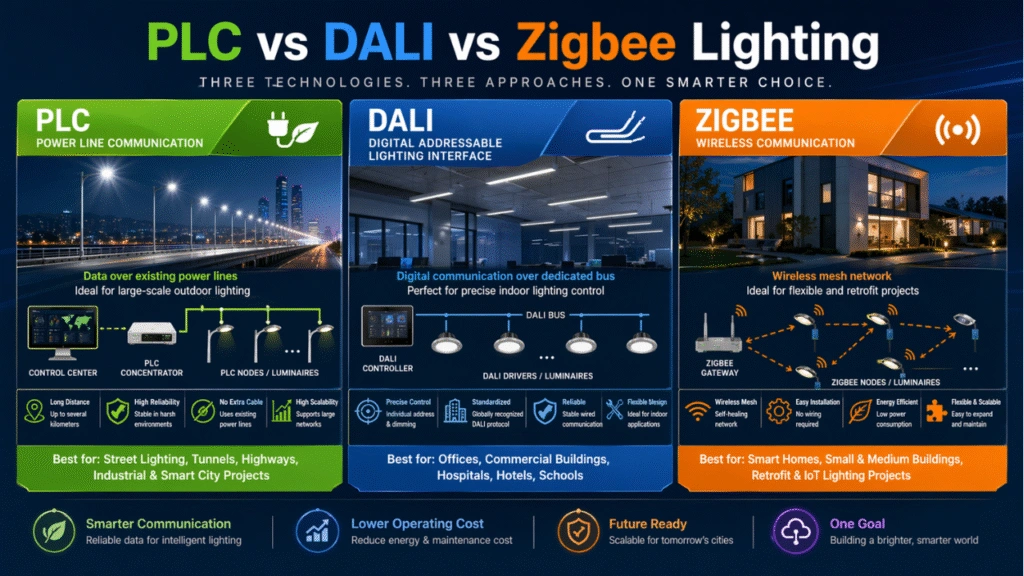
Modern smart lighting systems rely on reliable communication technologies to deliver centralized control, automation, and energy efficiency. Among the most widely used solutions are Power Line Communication (PLC), DALI, and Zigbee.
Each technology offers unique advantages depending on project scale, infrastructure conditions, and communication requirements.
This guide provides a detailed comparison of PLC vs DALI vs Zigbee lighting, helping engineers, system designers, and project managers choose the right solution for their smart lighting deployment.
What Is PLC Lighting Communication?
Power Line Communication (PLC) uses existing electrical power lines to transmit data signals alongside electrical power.
Instead of installing additional communication cables, PLC allows lighting control signals to travel through the same wiring used to power luminaires.
Key Characteristics of PLC
- Uses existing power lines
- No extra communication cable required
- Long-distance communication capability
- High reliability in outdoor infrastructure
- Ideal for large-scale smart lighting systems
Typical PLC Applications
Smart city infrastructure
Street lighting networks
Industrial facilities
Parking lots
What Is DALI Lighting Communication?
Digital Addressable Lighting Interface (DALI) is a wired communication protocol specifically designed for lighting control systems.
DALI systems require a dedicated communication bus connecting lighting fixtures and controllers.
Key Characteristics of DALI
- Dedicated communication wiring required
- Standardized lighting protocol
- Individual luminaire control
- Reliable indoor communication
- Widely used in commercial buildings
Typical DALI Applications
Indoor lighting automation
Office buildings
Hospitals
Hotels
Schools
What Is Zigbee Lighting Communication?
Zigbee is a wireless communication technology commonly used in IoT-based smart lighting systems.
Zigbee devices form a wireless mesh network, allowing signals to travel between nodes.
Key Characteristics of Zigbee
- Wireless communication
- Mesh networking capability
- Flexible installation
- Suitable for retrofit projects
- Requires wireless signal management
Typical Zigbee Applications
Residential automation
Smart homes
Offices
Commercial lighting
PLC vs DALI vs Zigbee: Side-by-Side Comparison
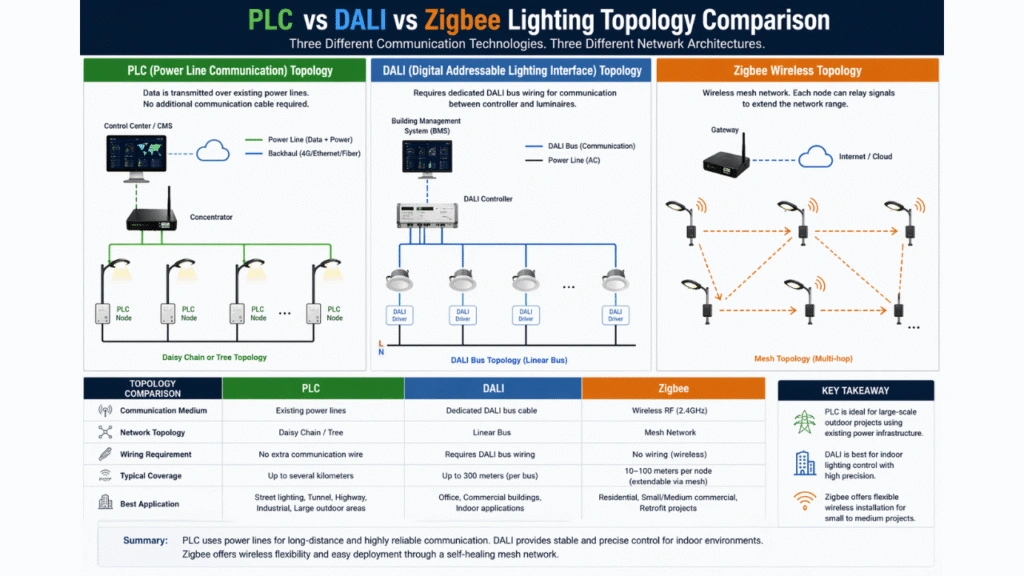
Here is a detailed comparison across key engineering factors.
Communication Medium
| Technology | Medium |
|---|---|
| PLC | Existing power lines |
| DALI | Dedicated control cable |
| Zigbee | Wireless RF |
Engineering Insight:
PLC minimizes installation complexity by using existing wiring, while DALI requires additional cable infrastructure and Zigbee depends on stable wireless signals.
Installation Complexity
| Technology | Complexity |
|---|---|
| PLC | Low (no extra cable) |
| DALI | Medium (new wiring required) |
| Zigbee | Low (wireless setup) |
PLC is particularly beneficial in retrofit projects, where running new cables can be costly.
Communication Distance
| Technology | Typical Range |
|---|---|
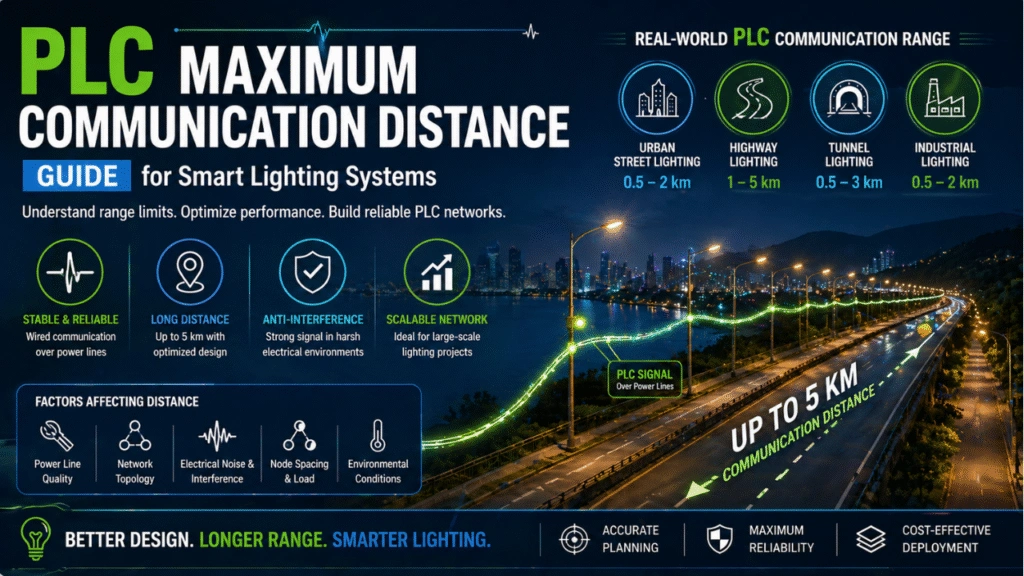
| PLC | Up to several kilometers |
| DALI | Up to 300 meters |
| Zigbee | 10–100 meters per node |
PLC supports large-area deployments such as highways and industrial zones.
Scalability
| Technology | Scalability |
|---|---|
| PLC | Very High |
| DALI | Moderate |
| Zigbee | High (mesh-based) |
Large smart city lighting systems typically favor PLC due to its scalability.
Reliability
| Technology | Reliability |
|---|---|
| PLC | Very High |
| DALI | High |
| Zigbee | Medium (signal interference possible) |
Wireless interference can impact Zigbee reliability in dense environments.
Maintenance Requirements
| Technology | Maintenance |
|---|---|
| PLC | Low |
| DALI | Moderate |
| Zigbee | Moderate to High |
Wireless systems require ongoing network optimization.
Cost Considerations
| Technology | Cost Level |
|---|---|
| PLC | Medium |
| DALI | Medium |
| Zigbee | Low–Medium |
Total project cost depends heavily on installation environment.
When to Choose PLC Lighting
PLC is the preferred choice when:
- Large-scale outdoor deployment is required
- Existing power infrastructure is available
- Long-distance communication is necessary
- High reliability is critical
- Minimal wiring installation is desired
Typical PLC project environments include:
- Highways
- Tunnels
- Industrial parks
- Smart city lighting
When to Choose DALI Lighting
DALI is ideal when:
- Indoor lighting control is required
- Precise dimming and scene control are needed
- Building-level automation is the focus
- Wiring installation is feasible
Typical DALI environments include:
- Offices
- Hospitals
- Commercial buildings
When to Choose Zigbee Lighting
Zigbee is best suited for:
- Wireless lighting networks
- Retrofit installations
- Smart home systems
- Small-to-medium commercial projects
Typical Zigbee environments include:
- Residential buildings
- Offices
- Retail spaces
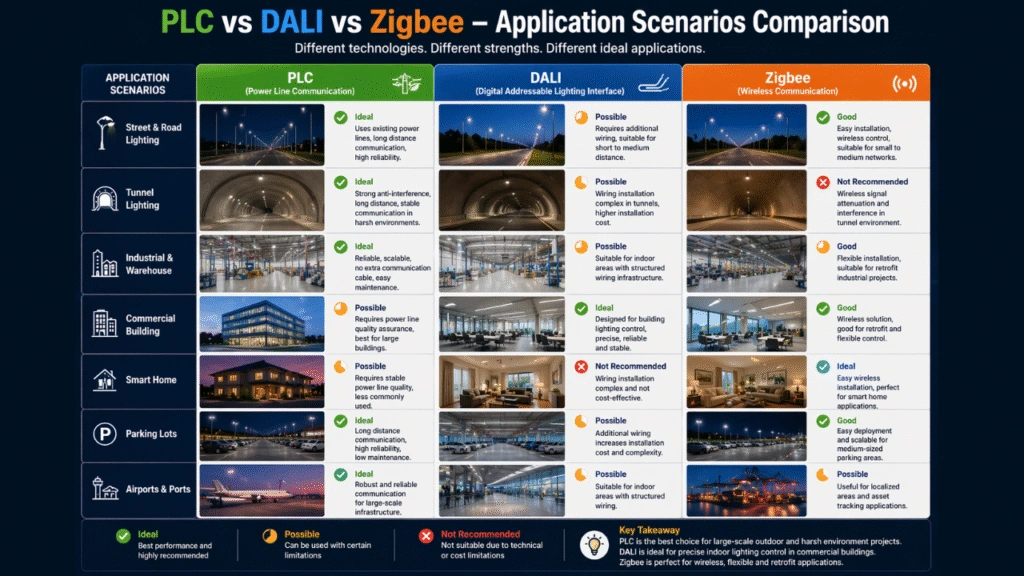
Real-World Application Recommendations
Here is a simplified engineering recommendation guide.
| Application | Recommended Technology |
|---|---|
| Smart Street Lighting | PLC |
| Tunnel Lighting | PLC |
| Industrial Facilities | PLC |
| Office Buildings | DALI |
| Hotels | DALI |
| Smart Homes | Zigbee |
| Commercial Buildings | Zigbee / DALI |
Future Trends in Smart Lighting Communication
The future of smart lighting systems is moving toward hybrid communication architectures.
Emerging systems integrate:
- PLC for backbone communication
- Zigbee for local wireless control
- IoT cloud platforms for remote monitoring
- AI-based analytics for predictive maintenance
Hybrid networks are expected to dominate large-scale smart city deployments.