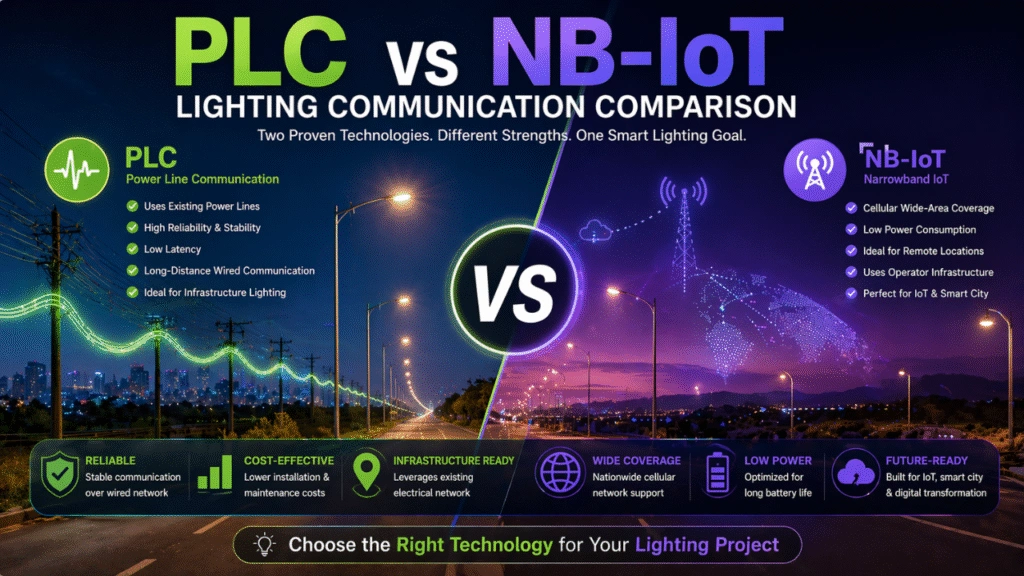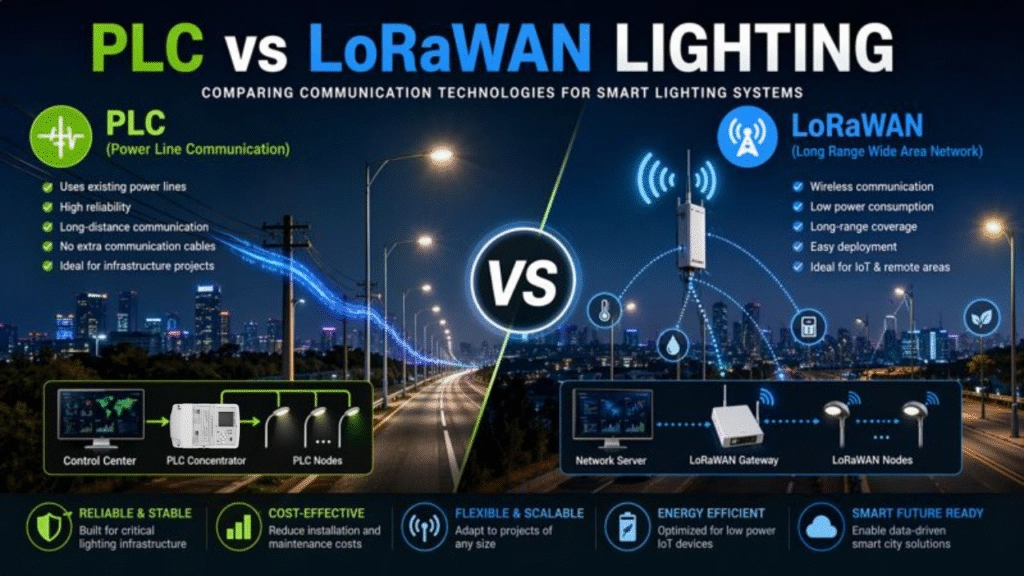
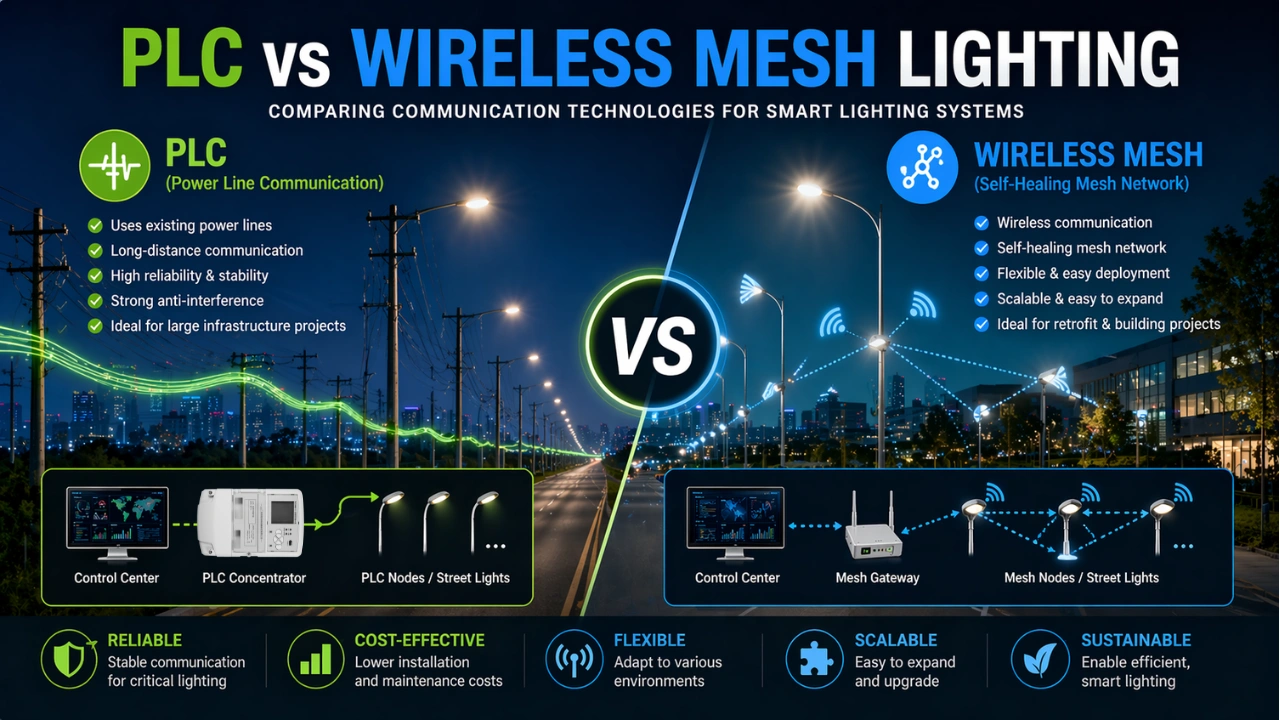
Modern smart lighting systems rely on reliable communication technologies to ensure efficient operation, centralized control, and scalable infrastructure. Two widely used communication methods are Power Line Communication (PLC) and Wireless Mesh networking. For wireless communication alternatives, you may also review our PLC vs LoRaWAN lighting comparison to understand long-range wireless options.
This article provides a detailed comparison of PLC vs wireless mesh lighting communication technologies, helping engineers and system designers select the most suitable solution for their projects.
What Is PLC Lighting Communication?
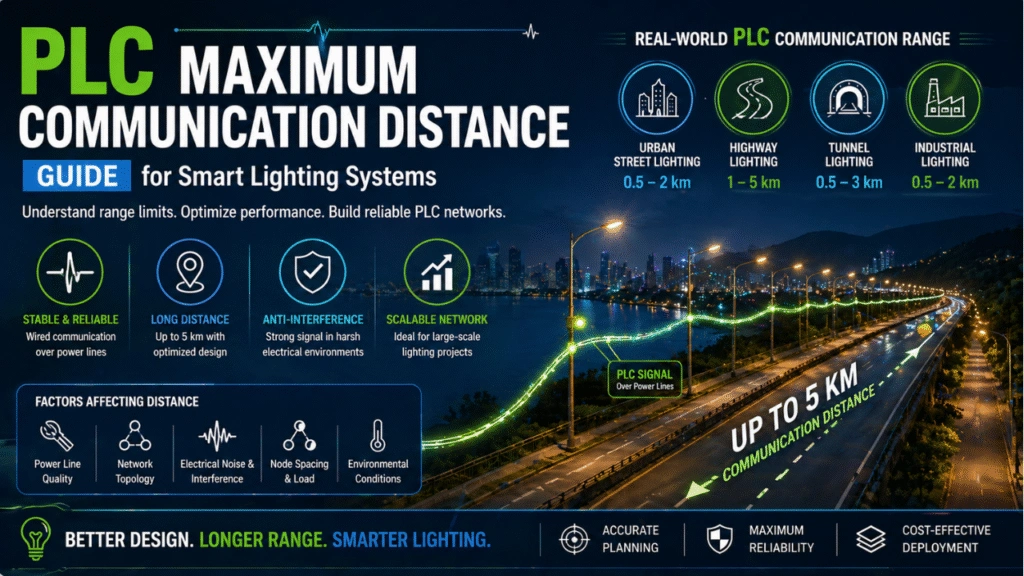
Power Line Communication (PLC) enables lighting devices to communicate through existing electrical power lines. By using power infrastructure as the communication medium, PLC reduces the need for additional wiring and supports stable long-distance communication.
Key Characteristics of PLC
- Uses existing power lines
- No additional communication cable required
- Long communication distance
- High reliability in harsh environments
- Suitable for large infrastructure lighting
Typical PLC Applications
- Street lighting systems
- Tunnel lighting systems
- Industrial facilities
- Highway lighting
- Parking lot lighting
What Is Wireless Mesh Lighting Communication?
Wireless Mesh communication is a networking method where lighting devices communicate wirelessly with nearby nodes, forming a mesh network that allows signals to be relayed across multiple devices.
Each device acts as both a transmitter and receiver, allowing communication to extend beyond direct line-of-sight.
Key Characteristics of Wireless Mesh
- Wireless communication
- Mesh network topology
- Self-healing network capability
- Flexible deployment
- Suitable for retrofit environments
Typical Wireless Mesh Applications
- Commercial building lighting
- Office lighting
- Campus lighting
- Retrofit lighting upgrades
- Smart building automation
PLC vs Wireless Mesh Lighting: Key Differences
Understanding the differences between PLC and wireless mesh communication helps determine which solution best fits specific lighting scenarios.
Communication Medium
| Technology | Medium |
|---|---|
| PLC | Power lines |
| Wireless Mesh | Wireless RF |
PLC uses wired electrical infrastructure, while wireless mesh relies on radio communication.
Network Topology
| Technology | Range |
|---|---|
| PLC | Long-distance (kilometers) |
| Wireless Mesh | Short-to-medium distance |
Wireless mesh networks allow nodes to relay communication dynamically.
Communication Distance
| Technology | Range |
|---|---|
| PLC | Long-distance (kilometers) |
| Wireless Mesh | Short-to-medium distance |
Mesh networks rely on multiple nodes to extend coverage.
Installation Complexity
| Technology | Complexity |
|---|---|
| PLC | Low (uses existing wiring) |
| Wireless Mesh | Low to Medium |
Wireless mesh requires device placement planning.
Reliability
| Technology | Reliability |
|---|---|
| PLC | Very High |
| Wireless Mesh | Medium to High |
Wireless signals may be affected by interference or physical barriers.
Scalability
| Technology | Scalability |
|---|---|
| PLC | High |
| Wireless Mesh | Very High |
Mesh networks can grow dynamically.
PLC vs Wireless Mesh Topology Comparison
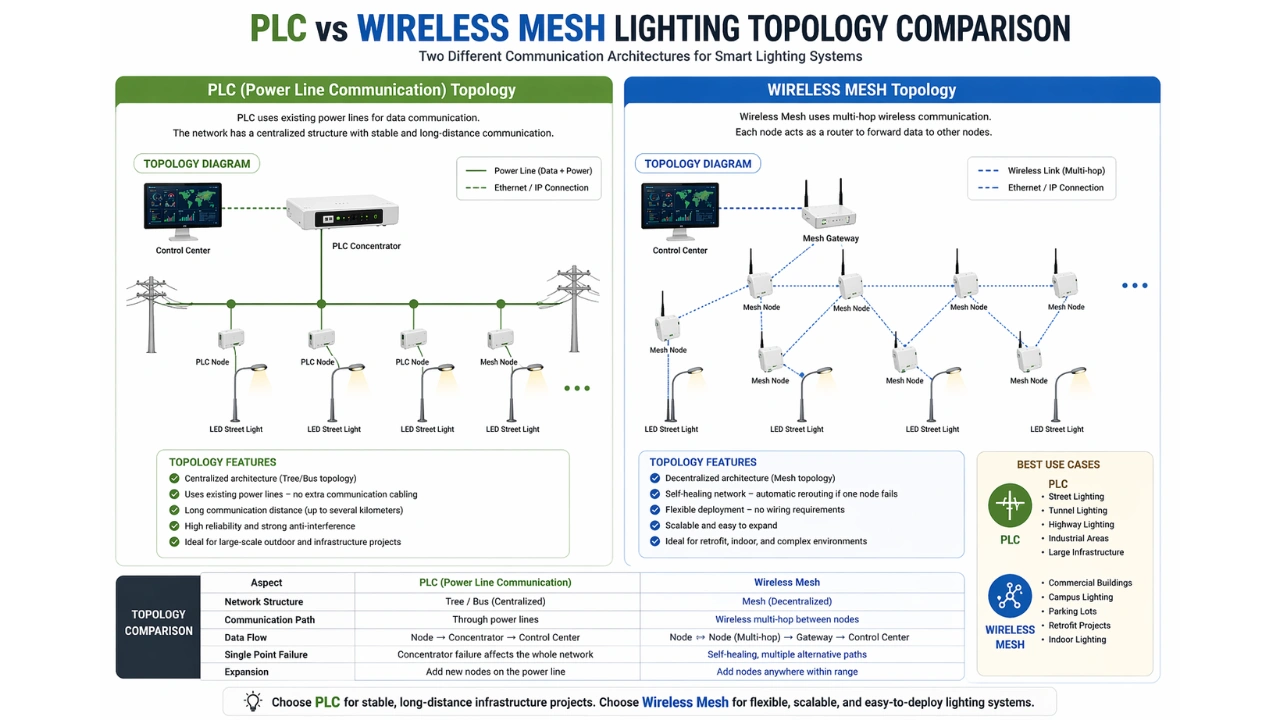
PLC typically uses:
- Central concentrator
- Power-line communication path
- Structured topology
Wireless mesh typically uses:
- Node-to-node communication
- Self-healing mesh paths
- Flexible network routing
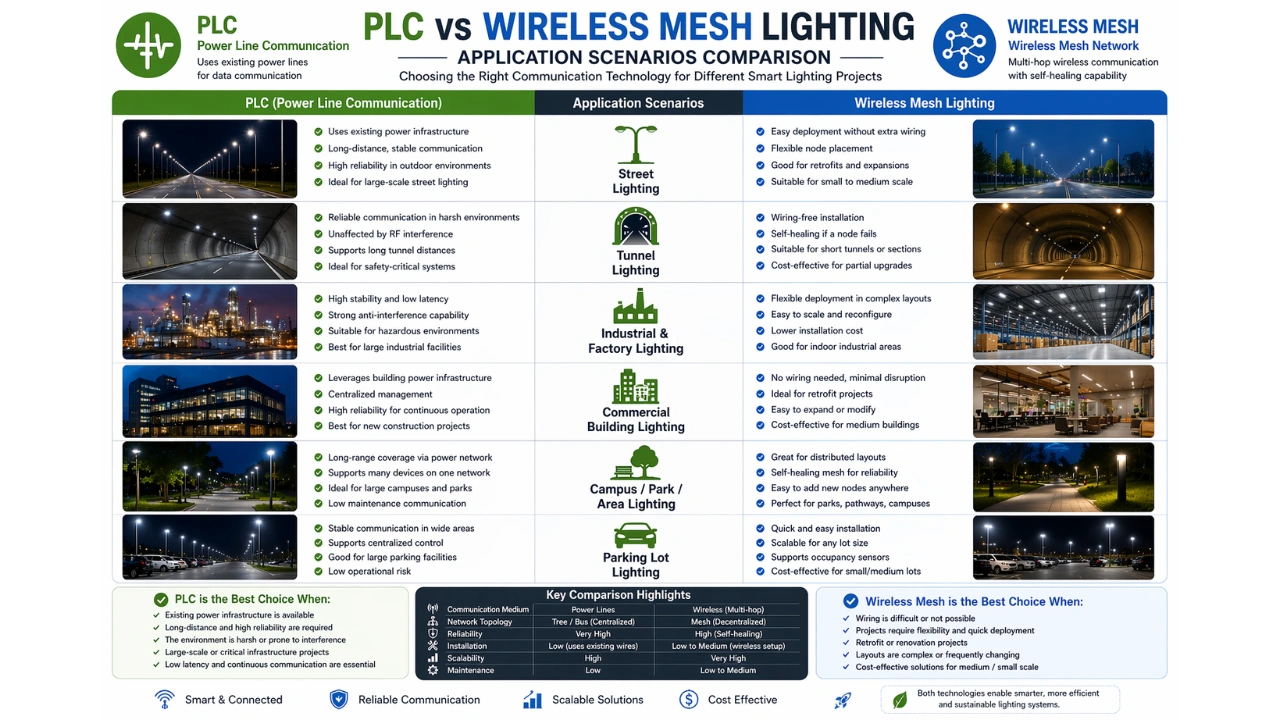
When to Choose PLC Lighting
PLC is recommended when:
- Existing power infrastructure is available
- Reliable communication is critical
- Long-distance communication is required
- Harsh environments exist
- Large infrastructure lighting is deployed
Typical PLC environments:
- Highways
- Tunnels
- Industrial zones
- Smart city lighting
When to Choose Wireless Mesh Lighting
Wireless mesh is recommended when:
- Running communication cables is difficult
- Flexible installation is required
- Indoor or campus environments are used
- Retrofit projects are needed
- Wireless connectivity is acceptable
Typical wireless mesh environments:
- Commercial buildings
- Office complexes
- Smart campuses
- Warehouses
Real-World Application Comparison
| Application | Recommended Technology |
|---|---|
| Street Lighting | PLC |
| Tunnel Lighting | PLC |
| Industrial Lighting | PLC |
| Office Buildings | Wireless Mesh |
| Campus Lighting | Wireless Mesh |
| Retrofit Projects | Wireless Mesh |
Future Trends: Hybrid PLC and Wireless Mesh Networks
Hybrid communication systems are becoming increasingly common in advanced smart lighting projects. Modern hybrid lighting systems increasingly align with TALQ smart lighting interoperability standards for centralized management.
These systems may use:
- PLC for backbone communication
- Wireless mesh for local device connectivity
- IoT cloud platforms
- AI-based predictive maintenance
Hybrid systems provide flexibility while maintaining reliability.