As cities and infrastructure systems move toward intelligent control and energy efficiency, PLC smart lighting is becoming one of the most reliable and scalable communication technologies. By using existing electrical power lines to transmit data, PLC smart lighting enables centralized monitoring, adaptive dimming, and efficient maintenance for large infrastructure lighting projects.
Unlike wireless systems, PLC uses existing power lines to transmit data — eliminating the need for additional communication wiring or unstable RF signals.
This guide explains how PLC smart lighting works, why it matters, and where it performs best in real-world infrastructure projects.
What Is PLC Smart Lighting?
PLC technology is widely standardized in global infrastructure systems. You can learn more about international PLC standards from the International Telecommunication Union (ITU). PLC smart lighting is a lighting control system that uses electrical power lines to transmit communication signals between devices such as:
- PLC concentrator
- Single lamp controllers
- Drivers (PWM/LED)
- Sensors (including AI vision)
👉 In simple terms:
It turns your power grid into a communication network.
How PLC Smart Lighting Works
PLC communication technology is also recognized in smart grid development standards defined by the IEEE organization. A PLC lighting system typically includes:
1. PLC Concentrator
- Acts as a gateway
- Sends commands through power lines
2. PLC Lamp Controller
- Installed on each lighting fixture
- Receives commands and adjusts lighting
3. Communication Layer
- Uses existing electrical wiring
- No additional cabling required
4. Sensors & AI Integration
- Motion detection
- Energy monitoring
- AI vision (vehicle, pedestrian, anomaly detection)
PLC Smart Lighting System Topology
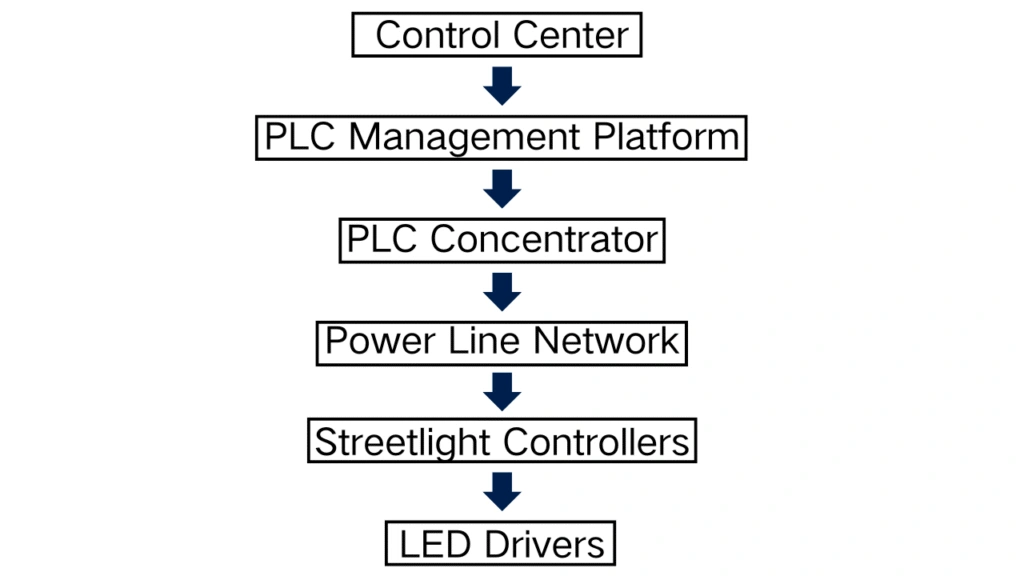
👉 Data Flow:
CMS → Concentrator → Power Line → Lamp Controller → Light Adjustment
Why PLC Smart Lighting Matters
1. No Extra Communication Infrastructure
No need for:
- RF gateways
- SIM cards
- Signal towers
2. Stable Communication in Harsh Environments
Unlike wireless systems, PLC is not affected by:
- Signal interference
- Thick concrete structures
- Underground environments
3. Lower Deployment & Maintenance Cost
- Uses existing power lines
- Fewer components
- Reduced failure points
4. Real-Time Control & Monitoring
- Dimming control
- Fault detection
- Energy analytics
5. Ready for AI Integration
PLC systems can integrate with:
- AI vision sensors
- Traffic detection
- Smart city platforms
Key Applications of PLC Smart Lighting:
🚦 Smart Street Lighting
- Adaptive brightness based on traffic
- Remote monitoring and scheduling
🚇 Tunnel Lighting Systems
- Stable communication underground
- Real-time safety adjustments
🏭 Industrial Facilities
- Reliable in high-interference environments
- Energy optimization
🌞 Solar Street Lighting
- Works with off-grid systems
- Enables remote diagnostics
🧠 Smart City Infrastructure
- Integrated with traffic and surveillance systems
- Supports IoT ecosystem
PLC vs Wireless Lighting Control
| Feature | PLC Lighting | Wireless (Zigbee / LoRa / NB-IoT) |
|---|---|---|
| Infrastructure | Uses power lines | Requires network setup |
| Reliability | Very high | Medium (signal dependent) |
| Interference | Low | High in dense areas |
| Cost | Lower long-term | Higher (maintenance + network) |
| Deployment | Fast | Medium |
| Best Use Case | Infrastructure, tunnels | Open urban areas |
Common Challenges (And Solutions)
1. Signal Noise in Power Lines
Solution:
- Use advanced modulation techniques
- Install filters
2. Compatibility with Old Infrastructure
Solution:
- Upgrade controllers
- Use hybrid systems
Limited Awareness vs Wireless
Reality:
- PLC is widely used in large-scale infrastructure
- Still under-marketed compared to IoT wireless
Future of PLC Smart Lighting
The future is not just smart lighting — it’s intelligent infrastructure.
With integration of:
- AI vision
- Edge computing
- Smart energy systems
PLC lighting is evolving into a data-driven control platform, not just illumination.
Real-World Example
A highway lighting project using PLC can:
- Reduce energy consumption by 30–60%
- Detect vehicle movement in real-time
- Automatically adjust brightness
- Report faults instantly