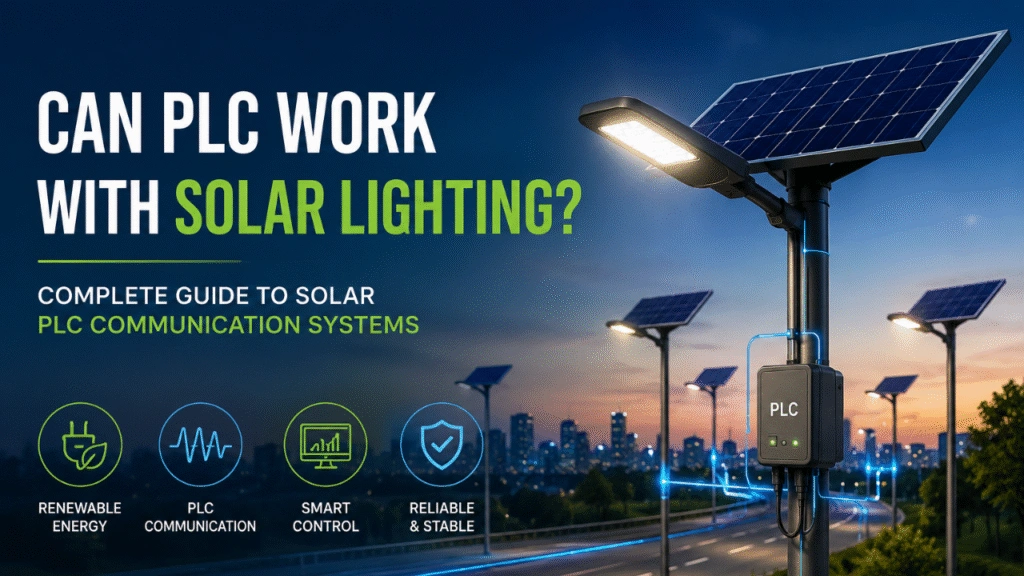
As cities and infrastructure projects move toward renewable energy and smart lighting, many engineers and project planners ask an important question:
Can PLC (Power Line Communication) work with solar lighting systems?
The short answer is yes — but with several technical considerations.
PLC technology has already been widely used in smart street lighting, tunnel lighting, industrial lighting, and utility communication networks. Meanwhile, solar lighting systems are rapidly becoming popular for highways, rural roads, parks, campuses, mining areas, and off-grid smart city projects.
Combining these two technologies creates a highly intelligent and energy-efficient lighting solution. However, because solar systems operate differently from traditional AC grid-powered lighting, PLC deployment requires careful system design.
This article explains how PLC works with solar lighting, the challenges involved, recommended architectures, and where PLC-based solar lighting systems are most effective.
What Is PLC in Smart Lighting?
PLC (Power Line Communication) is a communication technology that transmits data over existing power cables.
Instead of deploying separate communication wiring, PLC allows lighting devices to exchange information directly through the electrical power infrastructure.
In smart lighting systems, PLC is commonly used for:
- Remote ON/OFF control
- Dimming management
- Energy monitoring
- Fault detection
- Group lighting control
- Smart city integration
- Sensor data transmission
Because the same cable carries both power and communication data, PLC significantly reduces infrastructure costs and simplifies installation.
What Is Solar Lighting?
Solar lighting systems use photovoltaic (PV) panels to collect solar energy and store it in batteries for nighttime lighting operation.
A typical solar street lighting system includes:
- Solar panel
- Battery
- Charge controller
- LED luminaire
- Smart controller
- Communication module (optional)
Unlike conventional street lights powered directly by the AC utility grid, solar lighting systems often operate on low-voltage DC power.
This difference is the key technical factor when integrating PLC communication.
Can PLC Work with Solar Lighting?
Yes, PLC can work with solar lighting systems.
However, the implementation method depends on the system architecture:
- AC-coupled solar lighting systems
- DC solar lighting systems
- Hybrid smart lighting networks
- Centralized solar power systems
- Off-grid lighting clusters
PLC compatibility varies across these configurations.
Why Use PLC with Solar Lighting?
Integrating PLC into solar lighting offers several important advantages.
Reduced Communication Infrastructure
PLC eliminates the need for:
- Extra communication cables
- Wireless gateways
- RF repeaters
- Large-scale trenching
This is especially valuable in large outdoor solar lighting projects.
Stable Communication in Harsh Environments
Wireless signals can be affected by:
- Mountains
- Tunnels
- Dense urban structures
- Industrial interference
- Weather conditions
PLC communication through power lines can provide more stable networking in these challenging environments.
Centralized Smart Control
PLC-enabled solar lighting systems can support:
- Remote monitoring
- Adaptive dimming
- Battery status monitoring
- Solar charging analysis
- Predictive maintenance
- Energy optimization
This improves operational efficiency for municipalities and facility operators.
Lower Long-Term Maintenance Cost
With PLC-based monitoring, operators can detect:
- Battery failure
- LED driver issues
- Solar charging abnormalities
- Pole-level faults
- Communication interruptions
This enables proactive maintenance and reduces manual inspections.
Types of Solar Lighting Systems Compatible with PLC
1. Grid-Connected Solar Lighting
This is the easiest environment for PLC deployment.
In grid-connected systems:
- Solar power supplements the AC grid
- Lighting poles remain connected through traditional power cables
- PLC signals travel normally through AC infrastructure
This architecture is common in:
- Smart city street lighting
- Urban roads
- Parking lots
- Industrial parks
PLC performance is generally stable in these systems.
2. Centralized Solar + AC Distribution
Some projects use centralized solar generation combined with AC power distribution networks.
In this setup:
- Solar power feeds a centralized inverter
- AC power distributes to lighting poles
- PLC communication operates on the AC distribution line
This architecture works very well for PLC communication because the inverter outputs standard AC signals.
Challenges of PLC in DC Solar Lighting Systems
The biggest challenge appears in fully off-grid DC solar lighting systems.
In these systems:
- Each lighting pole operates independently
- No continuous shared power line exists
- Communication paths may be isolated
- DC noise characteristics differ from AC systems
Traditional PLC technology was primarily designed for AC power networks.
As a result, deploying PLC directly over standalone DC solar systems can be technically complex.
Key Technical Challenges
1. Electrical Noise from Solar Controllers
Solar charge controllers and DC-DC converters generate switching noise.
This noise can interfere with PLC signal transmission and reduce communication reliability.
2. Isolated Power Systems
In standalone solar poles, each unit may have:
- Independent battery
- Independent solar controller
- Separate DC circuit
Without a shared power network, PLC communication cannot propagate effectively between poles.
3. Signal Attenuation
Long-distance outdoor DC wiring can introduce:
- Signal loss
- Impedance mismatch
- Communication instability
Proper coupling and filtering design becomes critical.
4. Inverter Interference
In hybrid systems, inverters may distort PLC carrier signals depending on:
- Inverter quality
- Switching frequency
- Harmonic characteristics
Not all inverters are PLC-friendly.
Solutions for PLC-Based Solar Lighting
Despite these challenges, several practical solutions exist.
Hybrid PLC + Wireless Architecture
One common approach combines:
- PLC for local pole communication
- Wireless backhaul for central management
This hybrid design balances:
- Communication stability
- Scalability
- Installation flexibility
It is increasingly used in smart city deployments.
Centralized Power Distribution
Instead of fully independent solar poles, some systems use:
- Centralized solar generation
- Shared power distribution
- Battery banks
- AC output infrastructure
This architecture creates a continuous power line suitable for PLC transmission.
Narrowband PLC Optimization
Modern narrowband PLC technologies are better suited for smart lighting applications because they offer:
- Better noise resistance
- Longer transmission distance
- Lower power consumption
- Improved low-speed reliability
These characteristics are important in solar lighting environments.
PLC Filtering and Coupling Design
Professional PLC systems often include:
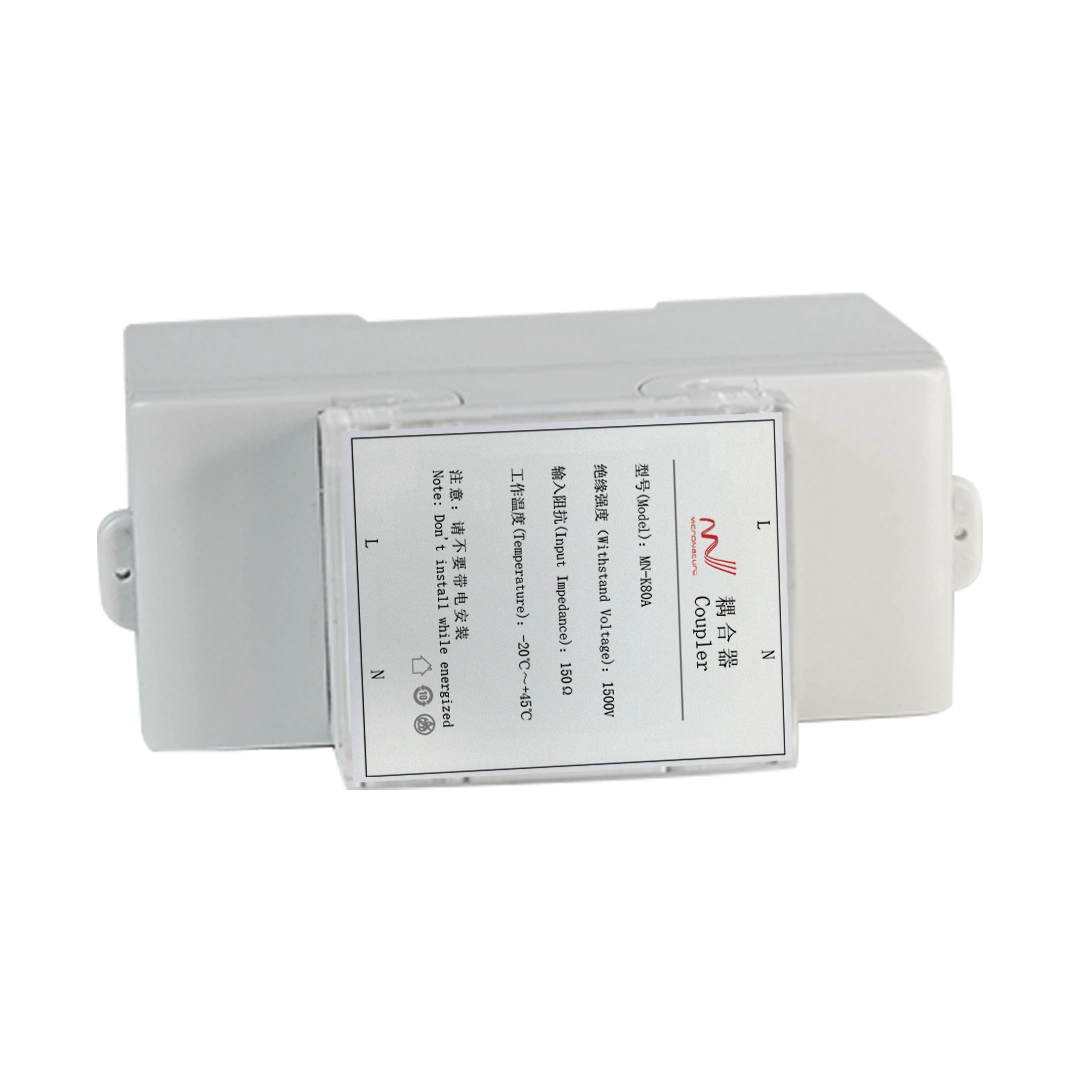
- Signal coupling circuits
- EMI filters
- Surge protection
- Isolation design
These components improve communication stability in solar-powered electrical systems.
PLC vs Wireless in Solar Lighting
| Feature | PLC | Wireless |
|---|---|---|
| Uses Existing Power Cable | Yes | No |
| Extra Infrastructure Needed | Low | Medium |
| RF Interference Risk | None | High |
| Works in Tunnels/Underground | Excellent | Limited |
| Fully Off-Grid Compatibility | Moderate | Excellent |
| Long Distance Stability | High | Depends on Signal |
| Maintenance Complexity | Low | Medium |
In many projects, the best solution is not choosing one technology exclusively, but combining PLC and wireless communication strategically.
Best Applications for PLC Solar Lighting
PLC-enabled solar lighting works particularly well in:
Smart City Roads
Municipal projects often require:
- Centralized control
- Adaptive dimming
- Energy analytics
- Smart infrastructure integration
PLC helps reduce communication infrastructure cost.
Tunnel Solar Emergency Lighting
Tunnel environments are difficult for wireless signals.
PLC can provide reliable communication through existing electrical wiring.
Industrial and Mining Sites
Industrial locations often contain strong RF interference.
PLC communication avoids many wireless reliability issues.
Campus and Park Lighting
Large campuses benefit from centralized smart lighting management while minimizing trenching and communication cable deployment.
Future Trends of PLC in Solar Smart Lighting
The future of solar smart lighting is moving toward fully integrated intelligent infrastructure.
Emerging trends include:
- AI-based lighting optimization
- Edge computing controllers
- Smart sensors
- IoT integration
- Adaptive energy management
- Vehicle-to-infrastructure communication
- Smart grid integration
PLC technology is evolving alongside these trends, especially in applications requiring secure, reliable, and infrastructure-efficient communication.
As smart cities continue to expand renewable energy deployment, PLC may become an increasingly important communication layer between lighting assets, energy systems, and urban management platforms.