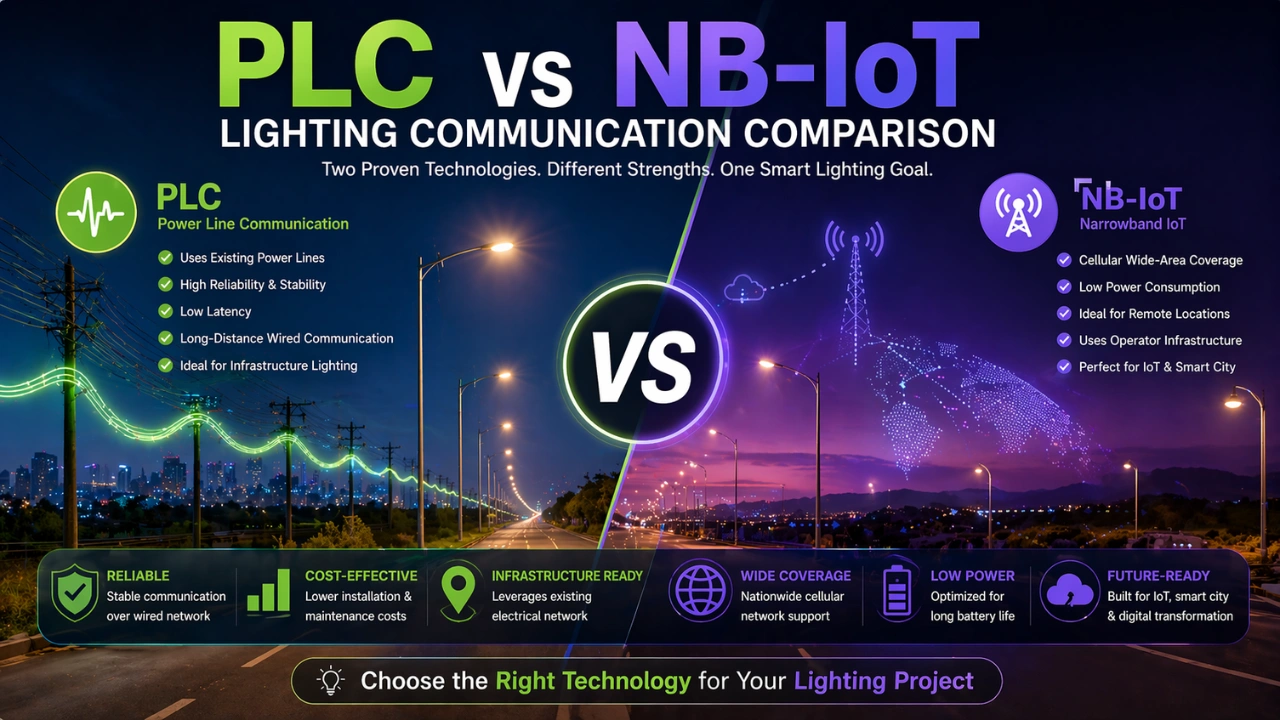
Smart lighting systems rely on reliable communication technologies to connect lighting devices, controllers, and monitoring platforms. Two commonly used technologies are Power Line Communication (PLC) and NB-IoT (Narrowband Internet of Things).
This article provides a detailed comparison of PLC vs NB-IoT lighting communication technologies, helping engineers, municipalities, and system designers select the most suitable solution for smart lighting projects. For other wireless technologies, you can also explore our PLC vs LoRaWAN lighting comparison guide.
What Is PLC Lighting Communication?
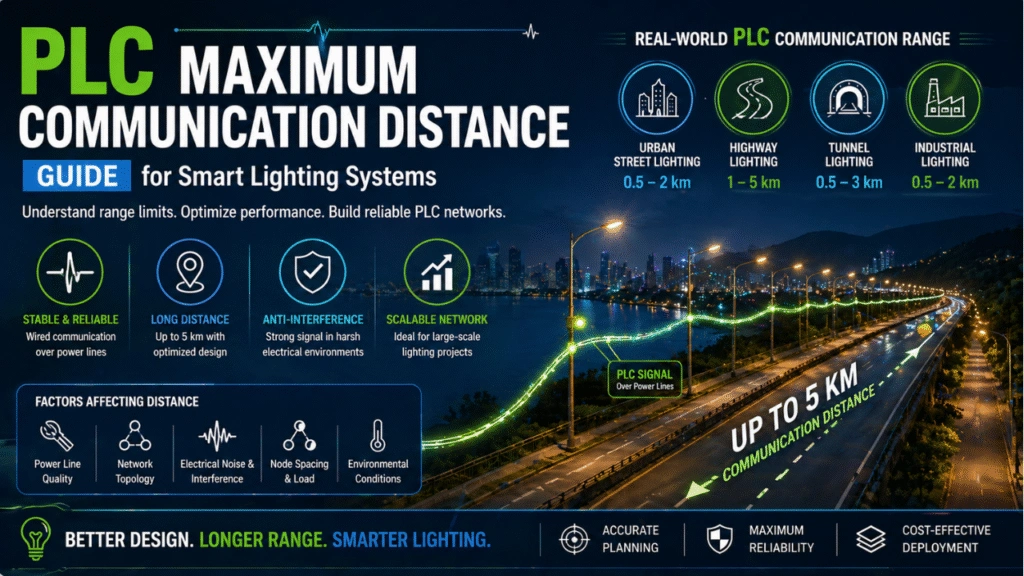
Power Line Communication (PLC) enables data transmission over existing electrical power lines. This allows lighting systems to communicate without requiring additional communication wiring.
PLC is widely used in infrastructure lighting projects due to its reliability and ability to operate across long distances.
Key Characteristics of PLC
- Uses existing power infrastructure
- No additional communication cable required
- Stable and interference-resistant
- Suitable for large-scale deployments
- Supports centralized management
Typical PLC Applications
- Street lighting
- Tunnel lighting
- Industrial lighting
- Highways
- Parking lots
What Is NB-IoT Lighting Communication?
NB-IoT (Narrowband Internet of Things) is a cellular-based wireless communication technology designed for low-power, wide-area IoT communication.
It enables devices to communicate through cellular networks using telecom infrastructure.
Key Characteristics of NB-IoT
- Cellular wireless communication
- Wide-area network coverage
- Low power consumption
- Supports battery-powered devices
- Uses telecom operator infrastructure
Typical NB-IoT Applications
- Smart metering
- Smart city sensors
- Remote asset monitoring
- Environmental monitoring
- Rural lighting
PLC vs NB-IoT Lighting: Key Differences
Understanding the differences between PLC and NB-IoT communication helps determine which technology best suits specific lighting environments.
Communication Medium
| Technology | Medium |
|---|---|
| PLC | Power lines |
| NB-IoT | Cellular wireless network |
PLC uses electrical infrastructure, while NB-IoT relies on telecom cellular networks.
Network Coverage
| Technology | Coverage |
|---|---|
| PLC | Local infrastructure-based |
| NB-IoT | Wide-area cellular coverage |
NB-IoT supports wide geographic coverage using telecom networks.
Installation Complexity
| Technology | Complexity |
|---|---|
| PLC | Low (uses existing wiring) |
| NB-IoT | Medium (requires SIM and network setup) |
NB-IoT devices require cellular provisioning.
Reliability
| Technology | Reliability |
|---|---|
| PLC | Very High |
| NB-IoT | Medium to High |
Cellular coverage conditions may affect NB-IoT performance.
Latency
| Technology | Latency |
|---|---|
| PLC | Low |
| NB-IoT | Medium |
PLC typically offers faster communication response times.
PLC vs NB-IoT Topology Comparison
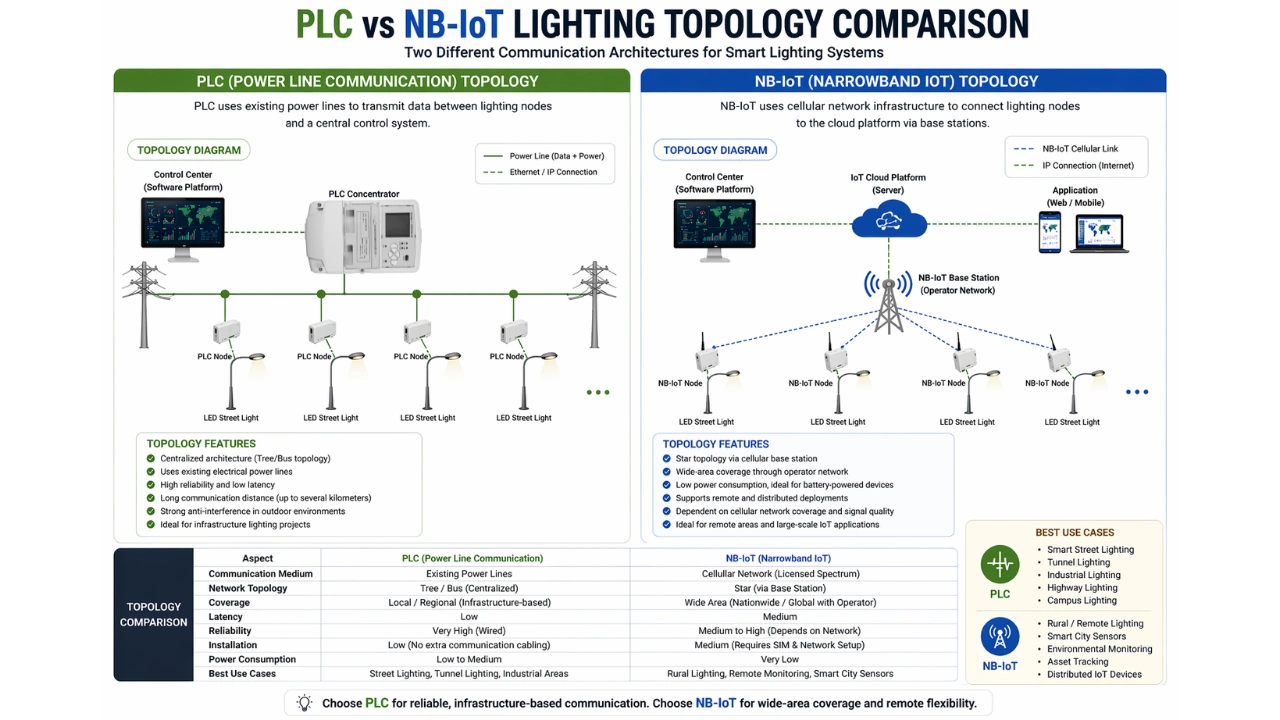
PLC typically uses:
- Centralized concentrator
- Wired communication path
- Structured network topology
NB-IoT typically uses:
- Cellular base station
- Wide-area wireless communication
- Cloud-based device management
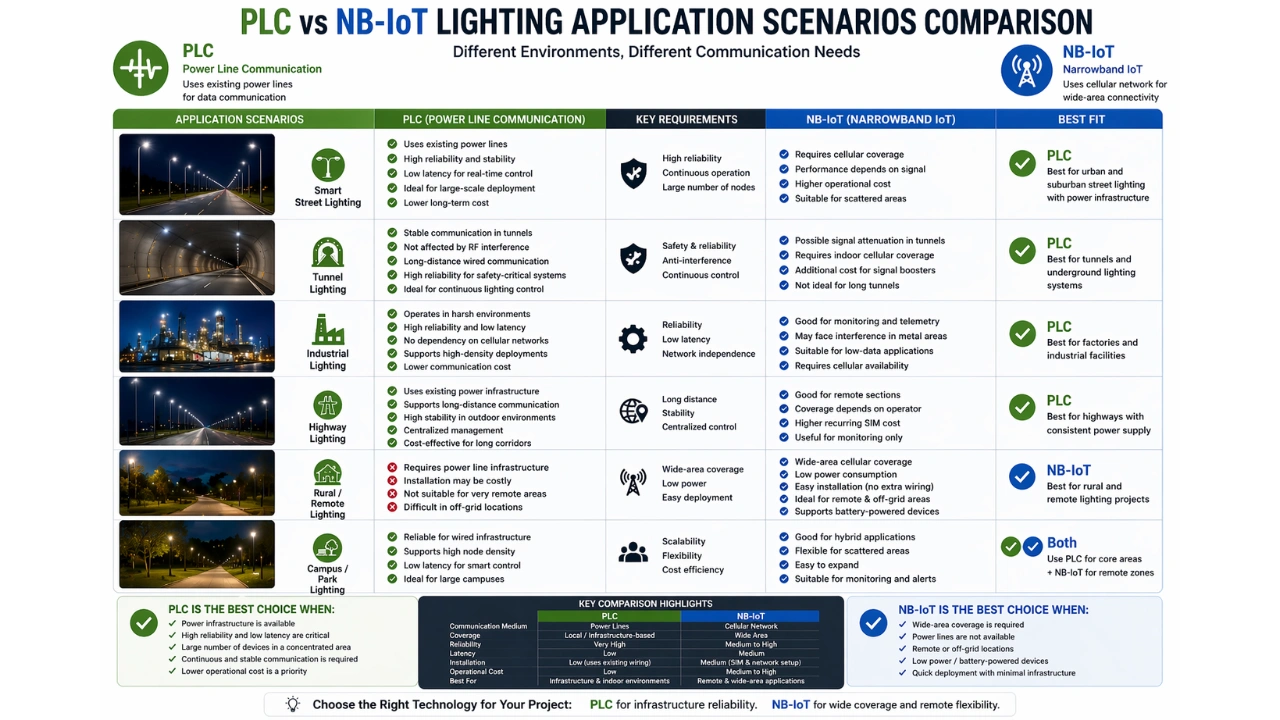
When to Choose PLC Lighting
PLC is recommended when:
- Reliable communication is critical
- Power infrastructure is available
- Continuous lighting operation is required
- Long-distance wired communication is preferred
- Industrial environments exist
Typical PLC environments:
- Street lighting
- Tunnel lighting
- Industrial facilities
- Highway lighting
When to Choose NB-IoT Lighting
NB-IoT is recommended when:
- Wide-area wireless coverage is needed
- Remote locations exist
- Cellular connectivity is available
- Battery-powered devices are used
- IoT integration is required
Typical NB-IoT environments:
- Rural lighting
- Smart agriculture
- Remote infrastructure
- Distributed lighting systems
Real-World Application Comparison
| Application | Recommended Technology |
|---|---|
| Smart Street Lighting | PLC |
| Tunnel Lighting | PLC |
| Industrial Facilities | PLC |
| Rural Lighting | NB-IoT |
| Remote Monitoring | NB-IoT |
| Distributed Sensors | NB-IoT |
Future Trends: Hybrid PLC and NB-IoT Networks
Hybrid communication architectures are increasingly adopted in modern smart lighting systems.
These systems may combine:
- PLC for local infrastructure communication
- NB-IoT for remote monitoring
- Cloud-based analytics
- Smart city management platforms
Hybrid networks provide flexibility and improved scalability.