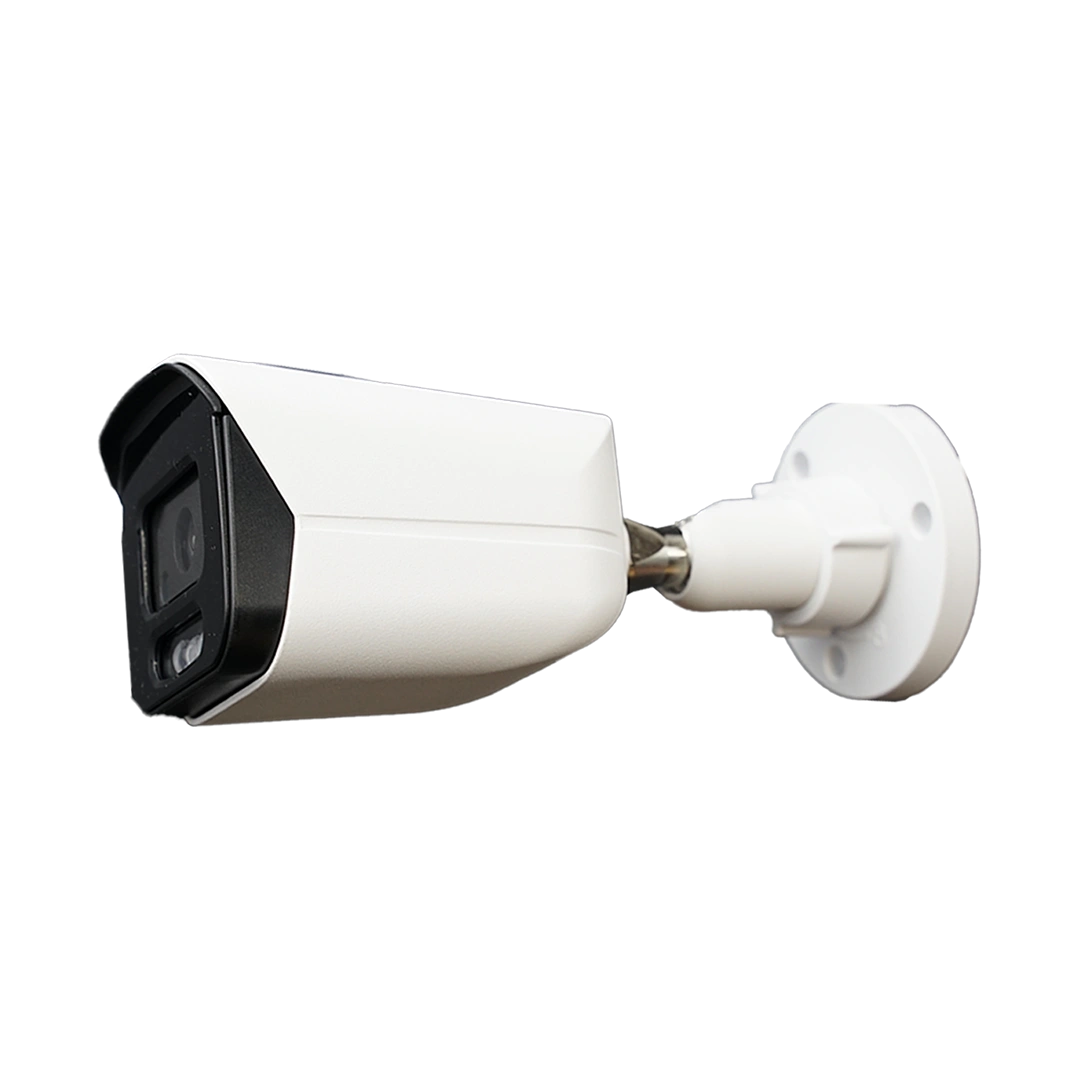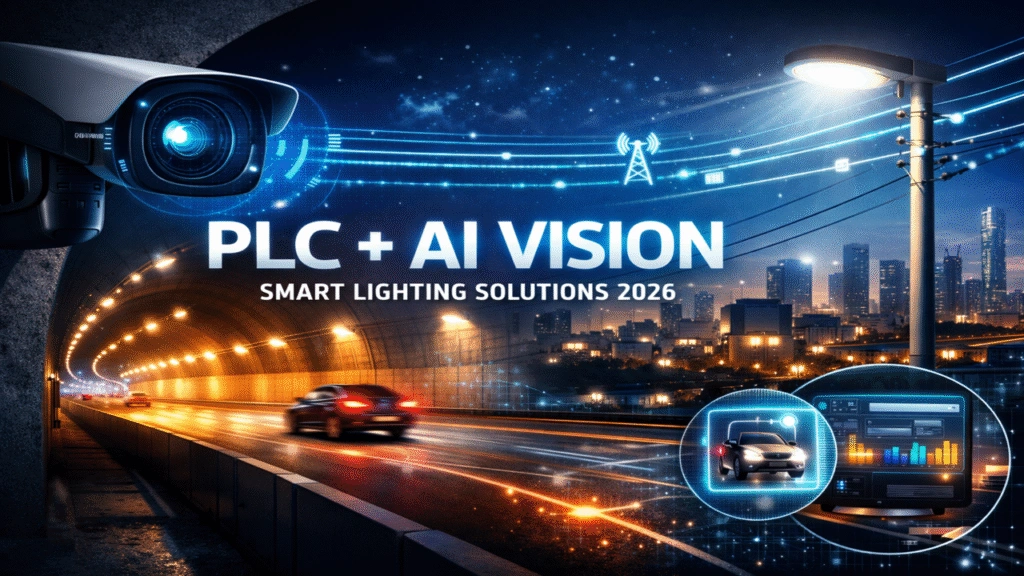
An AI visual sensor is a core technology enabling modern smart lighting and automation systems to detect vehicles, pedestrians, and environmental changes with high precision.
Today, with the rise of Broadband Power Line Communication (PLC) combined with AI visual algorithms, a new generation of intelligent sensing has emerged.
Introducing the AI Visual Sensor—a breakthrough solution delivering true precision, reliability, and industrial-grade performance.
What Is an AI Visual Sensor?
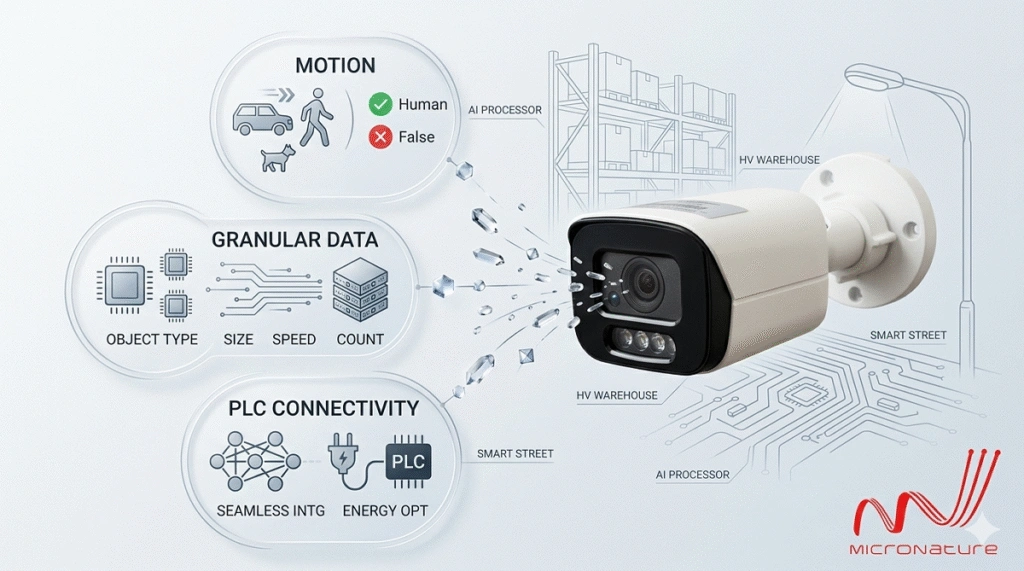
The AI Visual Sensor is an advanced industrial-grade device that uses image recognition technology to detect and classify objects in real time. Instead of relying on traditional motion detection, it identifies:
- People
- Motor vehicles
- Non-motor vehicles
- Animals
- Stationary obstacles
By connecting through gateways, PLC controllers, and existing power lines, it enables intelligent lighting without adding any communication wiring—making deployment faster, simpler, and more cost-effective.
Unlike microwave sensors limited to about 6 meters, AI Visual Sensors deliver a 30–50 meter accurate monitoring range, even from high installation positions such as ceilings, poles, or warehouse frameworks.
How AI Visual Sensors Work in Smart Lighting
AI visual sensors operate by capturing real-time visual data and analyzing it using embedded artificial intelligence algorithms. Artificial intelligence vision technologies are widely standardized and developed through global research initiatives supported by organizations such as the IEEE.
The typical working process includes:
- Image capture using integrated camera modules
- Object detection and classification using AI models
- Data transmission to centralized lighting platforms
- Automated lighting adjustment based on detected activity
- Continuous monitoring and event recording
This process allows lighting systems to respond dynamically to environmental changes, improving both safety and energy efficiency.
AI Visual Sensor Lighting System Architecture
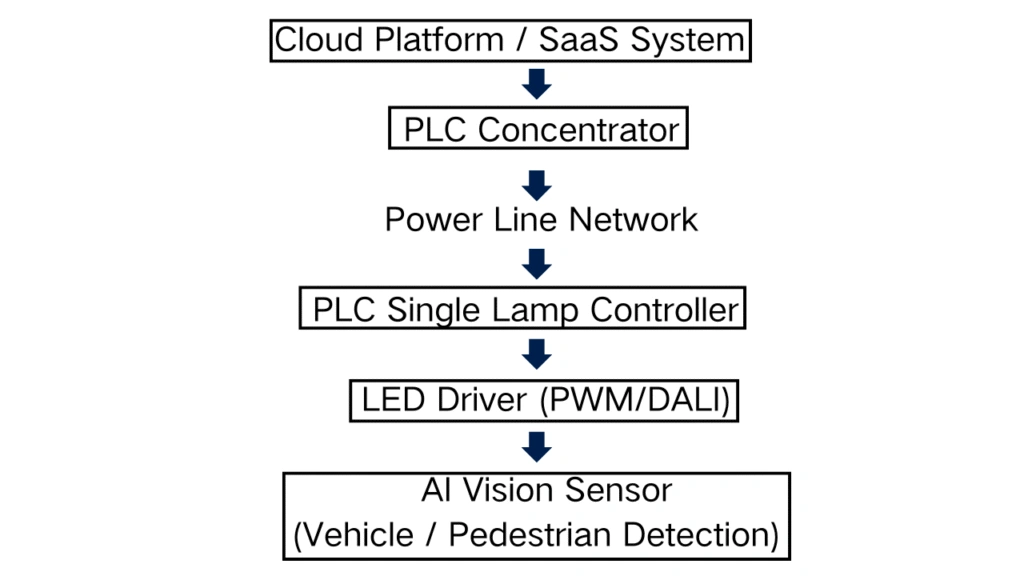
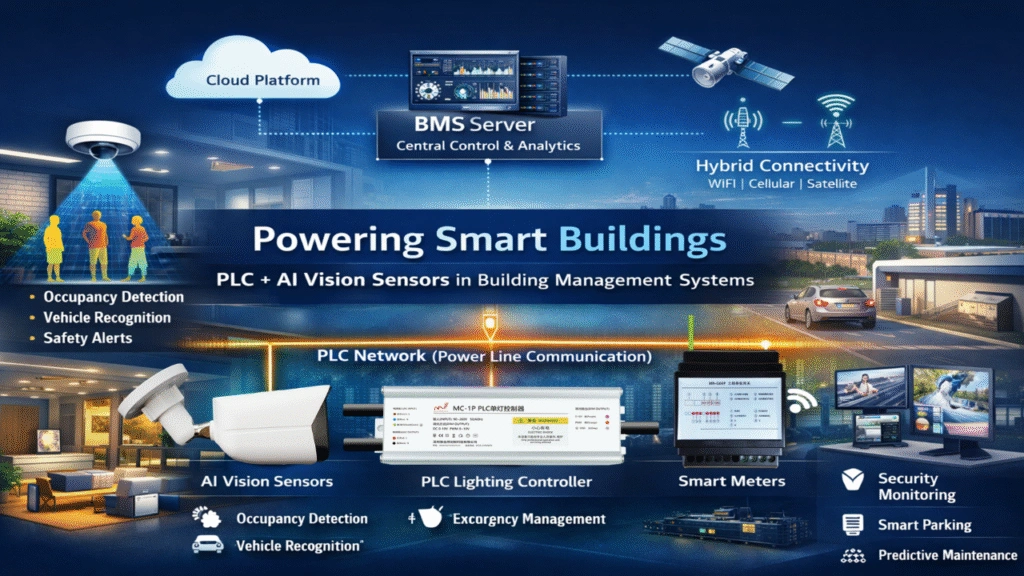
An PLC AI sensor lighting system architecture integrates smart sensors, communication networks, and centralized control platforms.
Key components include:
- AI visual sensor modules
- PLC or wireless communication networks
- Smart lighting controllers
- Centralized management software
- Cloud-based analytics systems
This architecture enables real-time lighting adjustments based on environmental and operational conditions.
Key Benefits of AI Visual Sensors
AI visual sensors provide multiple advantages compared with traditional motion detection technologies.
Key benefits include:
- Accurate object detection and classification
- Real-time monitoring and automated response
- Reduced energy consumption through adaptive lighting
- Improved safety through visual verification
- Enhanced operational data collection
These benefits support intelligent infrastructure management and improved system performance.
AI Visual Sensors vs. Microwave Sensors: A New Level of Precision
1. Zero False Triggers — Accurate Recognition Powered by AI
Microwave Sensors
- Trigger when any motion is detected
- Easily activated by wind, fans, machinery vibration, and swaying objects
- Result in unwanted lighting, energy waste, and maintenance issues
AI Visual Sensors
- Use deep-learning algorithms for object classification
- Trigger only when valid targets (people or vehicles) appear
- Completely eliminate false activations from environmental interference
This ensures lighting responds only to real operational needs.
2. Long-Distance Communication — Beyond the Limits of Traditional Sensors
Microwave sensors offer limited detection coverage and cannot support large-scale industrial networks.
AI Visual Sensors, powered by PLC:
- Monitor 30–50 meters per device
- Achieve over 2 km communication distance through existing power lines
- Support large-scale networking of hundreds to tens of thousands of devices
- Integrate seamlessly with 4G and broadband PLC communication
This makes them ideal for large warehouses, campuses, tunnels, factories, ports, and mine sites.
3. Industrial-Grade Performance for Large-Scale Deployment
Backed by MicroNature’s strong technical foundation—
8 invention patents, 6 software copyrights, 2 design patents—
AI Visual Sensors deliver exceptional industrial reliability:
- Operate stably in -30°C to 75°C
- Tolerant to humidity, dust, vibration
- Support 10,000+ device concurrent management
- Enable zero-wiring deployment using existing power lines
- Reduce wiring cost and time by over 90%
This significantly lowers the complexity and financial burden of installing intelligent lighting.
How the MicroNature AI Visual Sensor System Works
The MicroNature AI sensing lighting solution integrates:
- AI Visual Sensor
- PLC Controller
- PLC Gateway
- Mini Program / App / PC Web Platform
Powered by broadband PLC, the system supports:
- Ultra-long-distance communication
- 0.1-millisecond recognition of high-speed vehicles
- Real-time lighting control
- One-click reporting
- Automatic fault alerts
- Energy consumption statistics
- Smart scene configurations
No additional wiring, no network restructuring—just plug and deploy.
MicroNature AI Sensing Lighting Solution vs. Traditional Solutions
✔ Over 30% comprehensive energy savings
Accurate recognition eliminates unnecessary lighting, reducing operational electricity costs.
✔ Zero-wiring renovation
Uses existing power lines; project time reduced by 70%.
✔ 90% lower maintenance cost
Large-scale manual inspection replaced by cloud-based monitoring.
✔ Centralized platform management
Remote control via App/PC with one-click reporting.
✔ Supports 10,000+ lights in a single network
Ideal for warehouses, factories, tunnels, campuses, ports, and logistics centers.
Applications of AI Visual Sensors in Smart Lighting
AI visual sensors are widely used in infrastructure and industrial environments requiring intelligent monitoring and adaptive lighting.
Typical applications include:
- Urban street lighting systems
- Highway and tunnel lighting
- Industrial facility monitoring
- Parking lot lighting automation
- Security and perimeter lighting
These applications demonstrate how AI-powered vision technology improves operational efficiency and situational awareness.