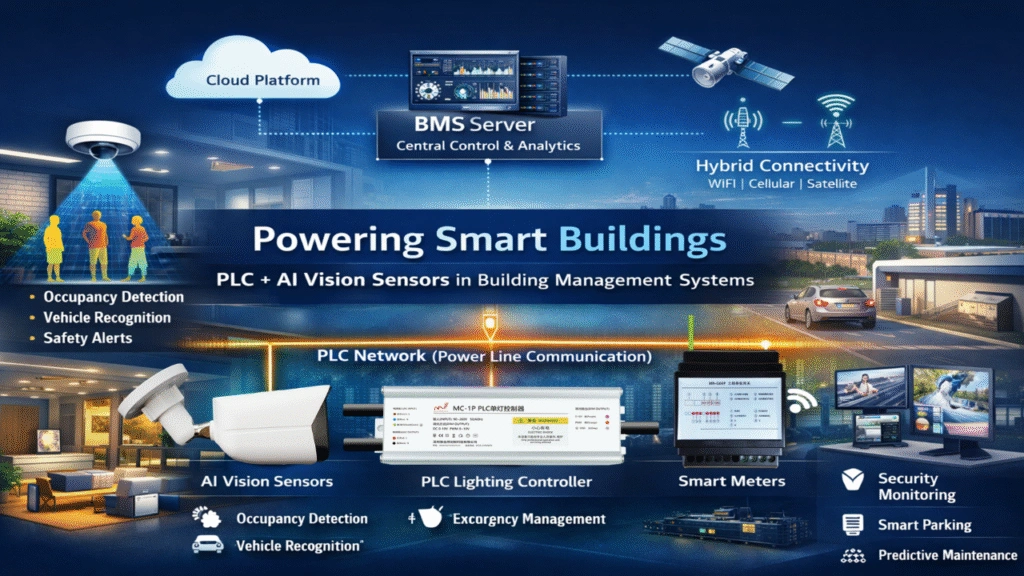
In the evolving landscape of industrial automation and smart city infrastructure, traditional motion detection often falls short, plagued by false triggers and a lack of granular data. Imagine a high-bay warehouse where lights remain at full brightness because a cooling fan moved a hanging sign, or a city street where energy is wasted because sensors cannot distinguish between a falling leaf and a pedestrian. This is the precise pain point where the AI vision sensor emerges as a game-changer. By integrating advanced machine vision with Power Line Communication (PLC), MicroNature has developed a system that doesn’t just “detect”—it “understands” its environment.
What is an AI vision sensor and how does it work?
At its core, an AI vision sensor is not a simple camera, nor is it a basic infrared trigger. It is a sophisticated edge-computing device that integrates image capture with localized artificial intelligence processing. Unlike traditional sensors that rely on heat signatures (PIR) or microwave reflections, an AI vision sensor captures visual data and uses onboard neural networks to identify specific objects or patterns. When you ask how does it work, the answer lies in the synergy between the lens and the processor. The sensor captures a frame, and instead of sending a heavy video stream to a distant server, the internal AI algorithm analyzes the pixels to distinguish between a forklift, a pedestrian, or a vehicle.
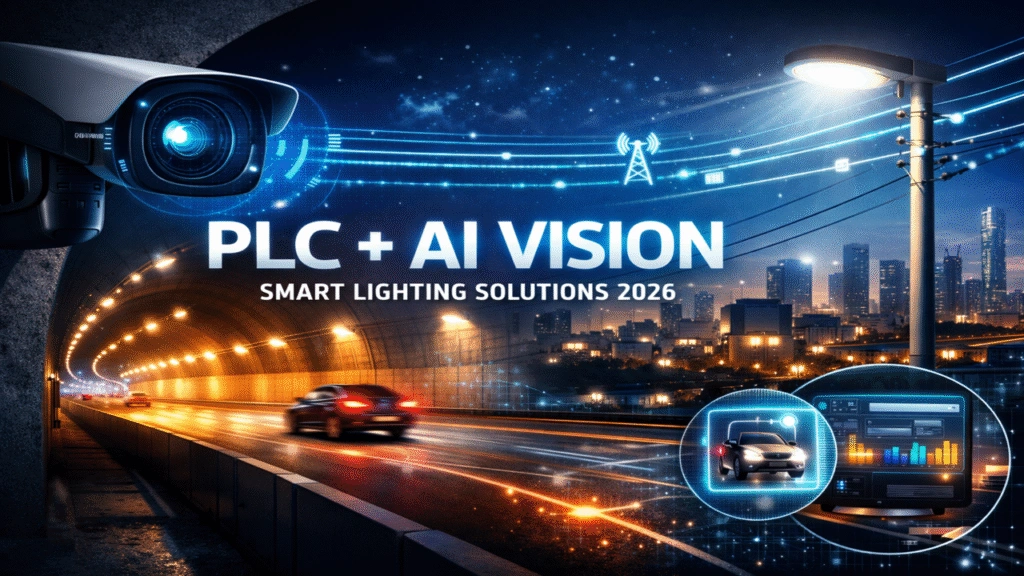
The AI Vision Sensor from MicroNature takes this a step further by embedding these capabilities into a PLC-enabled ecosystem. The sensor captures the scene, identifies a target (such as a forklift entering a logistics zone), and then sends a precise control command through the existing power lines. This synergy ensures that the lighting responds with near-zero latency. Because it relies on visual recognition rather than heat signatures, it remains highly accurate in environments with extreme temperatures or high electromagnetic interference, where traditional sensors typically fail.
By implementing this “Vision-to-Action” workflow, the system effectively acts as a decentralized brain for the lighting network. Each sensor operates independently but contributes to the overall intelligence of the PLC AI Vision Lighting System. This localized intelligence means that even if a central gateway loses connection, the individual AI sensors continue to manage their designated zones based on real-time visual logic, ensuring 99.99% operational reliability.
What is the data processing capability of AI vision sensors?
A frequent question among system integrators is: what is the data processing capability of AI vision sensors when scaled across thousands of nodes? The power of MicroNature’s solution lies in its efficient metadata transmission. Traditional machine vision systems often struggle with bandwidth because they attempt to stream raw video data. In contrast, our AI vision sensors process frames at the edge and only transmit compressed “event triggers” and status updates. This approach is perfectly optimized for CAT.1 and PLC-IoT narrow-band or mid-band frequencies, preventing network congestion.
The processing engine inside these sensors is capable of multi-target tracking and complex behavior analysis. For instance, in a smart city application, the sensor doesn’t just see “motion”; it calculates the trajectory of a vehicle to predict which streetlights need to brighten ahead of its path. This advanced data processing allows for “Dynamic Zone Dimming,” where the system can reduce energy consumption by up to 70% in industrial settings. The sensor filters out over 95% of false triggers caused by shadows, insects, or environmental noise, ensuring that the data reaching the Cloud platform is clean and actionable.
Furthermore, the data processing capability extends to statistical analysis. These sensors can count occupancy and track dwell times in specific areas, providing facility managers with valuable insights into space utilization. All this is achieved while maintaining strict privacy standards; because the AI analyzes the “features” of an image rather than recording the faces of individuals, the system remains compliant with data protection regulations while delivering high-level security and efficiency.
| Feature | AI Vision Sensor (MicroNature) | Standard Microwave/PIR | Traditional CCTV + Server AI |
|---|---|---|---|
| False Trigger Rate | <1% (AI Filtering) | 15% – 30% (High) | <5% |
| Data Transmission | Metadata via PLC (Low Bandwidth) | Analog Signal (None) | Raw Video (High Bandwidth) |
| Edge Processing | Full Onboard AI | None (Simple Trigger) | Remote Server Dependent |
| Installation Cost | Zero Extra Wiring (PLC) | Low | High (Fiber/Cat6 Required) |
How to choose an AI sensor for machine vision tasks?
When determining how to choose an AI sensor for machine vision tasks, project engineers must prioritize integration, environment, and reliability.
1.Prioritize Reliable Communication Protocols
The first criterion is the communication protocol. For industrial projects like shipyards or power plants, where high-strength magnetic fields disrupt wireless signals, choosing a sensor that supports PLC-IoT is essential. Unlike wireless options that require line-of-sight or frequent signal boosting, PLC-based AI sensors utilize the existing copper infrastructure to guarantee stable communication in the most “noisy” electromagnetic environments.
2.Evaluate AI Model Customization and Application Fit
The second factor is the specific AI model’s training. You need a sensor that has been optimized for your specific application—whether that is “Human Detection” for office spaces or “Vehicle Categorization” for tunnels. MicroNature’s R&D team offers hardware and software customization, allowing the AI vision sensors to be fine-tuned for height-specific installations, such as UFO high-bay lights in 15-meter-high warehouses. This ensures the sensor’s focal length and detection algorithms are perfectly matched to the physical constraints of the site.
3.Analyze Long-Term ROI and Ecosystem Support
Finally, consider the long-term ROI. A high-quality AI sensor should offer a comprehensive management ecosystem. Choosing a sensor that connects to a robust App and Cloud platform allows for remote sensitivity adjustment and over-the-air (OTA) firmware updates. This means that as AI algorithms improve, your hardware doesn’t become obsolete; it simply gets smarter. With a 5-year warranty and proven performance in over 30 countries, selecting MicroNature’s AI vision technology ensures that your smart city or industrial project is built on a foundation of professional-grade reliability and cutting-edge intelligence.
The era of simple motion detection is over. To achieve true energy efficiency and operational insight, you must empower your infrastructure with the ability to see and think. Evaluate your current facility’s wiring and identify areas where false triggers are driving up costs. Your next step is to integrate a solution that combines the stability of PLC with the precision of machine vision. Contact Us today to learn how our Browse Our PLC Communication Modules can transform your lighting network into a data-driven asset.