Concept: Defining AI + PLC-IoT Smart Lighting
AI PLC IoT smart lighting represents the next evolution in intelligent lighting systems. By combining artificial intelligence, power line communication technology, and IoT connectivity, modern lighting networks can achieve automated control, real-time monitoring, and intelligent decision-making across large infrastructure environments. Learn more about IoT and smart infrastructure technologies from IEEE.
This approach extends the fundamental benefits of PLC-IoT by adding a layer of intelligent decision-making, eliminating the inefficiencies of traditional motion-sensing triggers.

What is AI PLC IoT Smart Lighting?
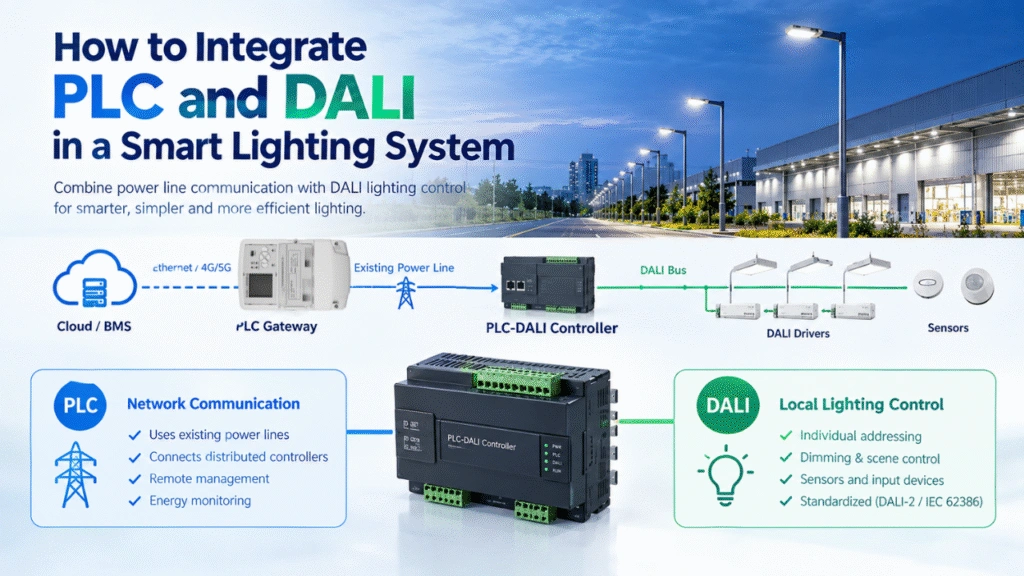
AI PLC IoT smart lighting integrates artificial intelligence algorithms, PLC communication networks, and IoT devices into a unified lighting control system. This architecture enables real-time communication between field devices and cloud platforms, allowing lighting systems to respond automatically to environmental conditions and operational requirements.
AI PLC IoT Smart Lighting Architecture
Typical system components include:
- PLC Data Concentrator Gateway
- PLC Lighting Controllers
- AI Vision Sensors
- IoT Communication Modules
- Cloud Management Platform
These components work together to create a scalable and intelligent lighting network capable of supporting thousands of lighting nodes.
Role of Artificial Intelligence in Smart Lighting
Artificial intelligence enhances smart lighting systems by analyzing operational data and environmental inputs. AI algorithms can predict equipment failures, optimize energy usage, and automatically adjust lighting intensity based on detected activity or ambient light levels.
AI-based control improves operational efficiency while reducing maintenance cost and energy consumption.
Benefits of AI PLC IoT Smart Lighting
AI PLC IoT smart lighting provides:
- Automated lighting control
- Reduced energy consumption
- Predictive maintenance
- Centralized monitoring
- Improved operational reliability
Traditional Lighting vs AI PLC IoT Smart Lighting
| Feature | Traditional Lighting | AI PLC IoT Lighting |
|---|---|---|
| Control | Manual | Automated |
| Monitoring | Limited | Real-time |
| Maintenance | Reactive | Predictive |
| Energy Efficiency | Medium | High |
| Scalability | Limited | Excellent |
Advantages: The Strategic Benefits of AI + PLC-IoT
1. Superior Accuracy, Eliminates False Triggers
Unlike traditional microwave radar sensors, AI vision sensors perform object classification. This prevents false activations caused by small animals (e.g., pigeons in a factory) or environmental debris. Furthermore, they can reliably detect stationary objects and people, a common failure point for radar-based systems (e.g., students sitting still in a classroom).
2. Configurable Detection Zones for Precision
The ability to define specific areas of detection within the sensor’s field of view allows system operators to exclude areas where non-relevant movement occurs, such as roads with parked cars. This granular control further optimizes energy savings.

3. Unmatched Reliability in Challenging Environments
Inheriting the strengths of PLC-IoT, the communication is immune to the radio frequency interference, physical obstructions, and Faraday cage effects common in metal-rich environments like warehouses and factories. The connection is as stable as the power grid itself.
4. Scalable, Centralized Management
A single PLC Gateway can manage hundreds of nodes across vast distances, making this solution ideal for scaling from a small warehouse to a multi-kilometer tunnel system, all managed from a unified software platform.
Application Scenarios: Practical Implementations
Smart Factories & Warehouses: Achieves significant energy savings in high-bay lighting by providing light only in occupied aisles or work zones. AI vision avoids triggers from machinery or wildlife, a critical advantage over radar.
Urban Roads & Tunnels: Zones can be configured to monitor sidewalks and cycling paths while ignoring vehicle lanes, ensuring pedestrian safety without unnecessary activation from stationary traffic. Enables adaptive lighting in tunnels based on real-time traffic density.
Educational Institutions & Offices: Ensures lights remain on in classrooms and meeting rooms even when occupants are relatively stationary, solving a key limitation of passive infrared (PIR) and radar sensors.
Large Venues & Stadiums: Allows for dynamic, zone-based lighting control for enhanced security and operational efficiency, activating areas only when needed, even in complex outdoor settings.
Future Outlook: From Smart Lighting to a Foundational IoT Platform
An AI + PLC-IoT lighting system is more than a method of control; it is a strategic infrastructure investment. The network established for lighting can seamlessly evolve into a backbone for a broader ecosystem of IoT applications. The same PLC infrastructure can carry data from environmental sensors, security cameras, and safety equipment, transforming a facility into a truly intelligent, connected, and data-driven environment.
With the continuous learning capabilities of AI and the rock-solid reliability of PLC-IoT, the future of intelligent lighting is not only bright but also perceptive and proactive.