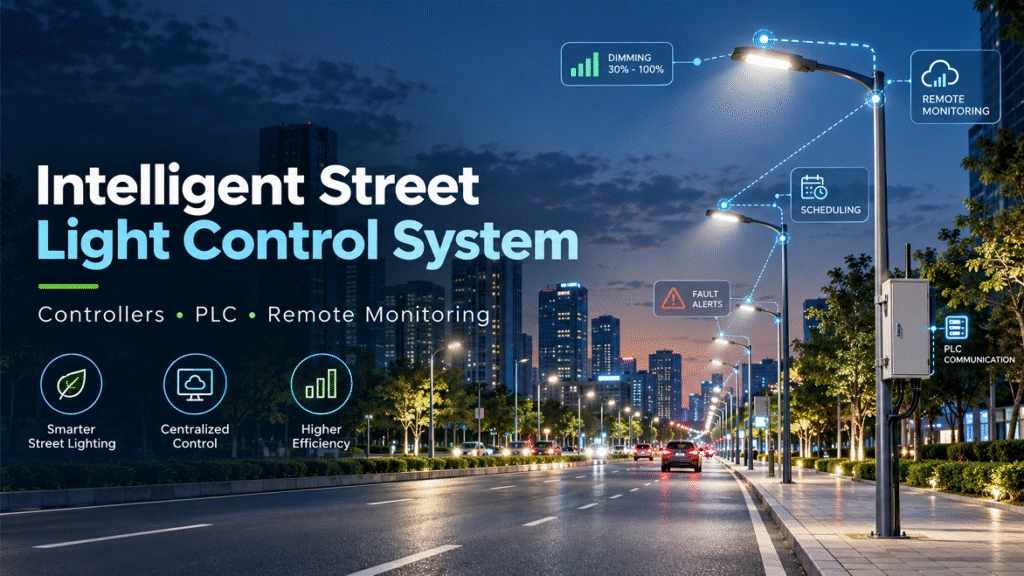

Zhaga Book 18 is an interface specification for connecting sensing and communication modules to outdoor LED luminaires. It helps lighting manufacturers build smart street lights that can accommodate compatible control devices, sensors, and communication nodes through a standardized interface.
For smart city projects, Zhaga Book 18 supports a more modular approach to lighting design. Instead of permanently integrating every smart function into a luminaire, manufacturers can design luminaires with a compatible receptacle and add or replace supported modules as project requirements evolve.
However, Zhaga Book 18, D4i, and Power Line Communication (PLC) serve different purposes. Understanding their roles is important when selecting lighting controllers, designing connected luminaires, or developing smart street lighting systems.
This guide explains how Zhaga Book 18 works, its relationship with Zhaga-D4i certification, its benefits for OEMs, and the key compatibility questions to consider when integrating smart lighting technologies.
1. What Is Zhaga Book 18?
Zhaga Book 18, officially titled “Smart Interface Between Outdoor Luminaires and Sensing/Communication Modules,” defines an interface between an outdoor LED luminaire and an attached sensing or communication module.
The specification addresses the physical connection and relevant electrical and communication requirements needed to support compatible luminaire extension modules.
A typical application consists of three main components:
- Outdoor LED luminaire: The lighting fixture designed to accommodate the interface.
- Zhaga receptacle: The standardized connection point installed on the luminaire.
- Luminaire extension module: A compatible sensor or communication device connected through the receptacle.
Depending on the system design, an extension module may provide ambient-light sensing, motion detection, wireless communication, or connectivity to a wider lighting management network.
Zhaga Book 18 is intended to improve interoperability and make outdoor luminaires easier to upgrade and maintain.
The Zhaga Consortium published Edition 4 of Book 18 in November 2025, extending the specification to support heritage and decorative luminaires, including additional mounting and connection arrangements. Engineers should consult the applicable edition when developing a product or preparing a certification submission.
Official reference: Zhaga Book 18.
2. How Does Zhaga Book 18 Work?
A Zhaga Book 18 lighting system uses a standardized connection between the luminaire and an external extension module.
A simplified architecture is:
Outdoor LED luminaire → Zhaga receptacle → Compatible sensing or communication module → Lighting control network
The receptacle provides the defined physical interface. The attached module uses the supported electrical power and communication arrangements to perform its intended function.
For example, a compatible control node could collect sensor information, communicate with a remote management platform, or participate in a smart street lighting network.
The exact functions depend on the module, luminaire, communication technology, and overall system architecture. Installing a Zhaga receptacle alone does not automatically provide remote monitoring, dimming, or cloud connectivity.
Typical applications
Smart street lighting: A compatible node can provide local sensing, control, or communication functions for a street light.
Connected urban infrastructure: Outdoor luminaires can serve as convenient installation points for compatible sensing and communication devices.
Retrofitting and upgrades: A suitable luminaire may accommodate a compatible module without requiring the complete fixture to be replaced.
Maintenance and replacement: A modular interface can simplify replacement of a supported extension device, provided the product design and installation conditions allow it.
3. What Are the Main Benefits of Zhaga Book 18?
3.1 Interoperability between compatible products
A standardized interface helps luminaire manufacturers and module suppliers develop products around a common specification.
This can reduce dependence on proprietary mechanical interfaces. However, interoperability is not automatic: the products must meet the applicable interface and functional requirements.
3.2 Modular smart lighting design
Luminaire manufacturers can separate the core lighting fixture from certain sensing and communication functions.
This modular approach allows product families to support different control options while retaining a common luminaire platform, subject to electrical, mechanical, thermal, and certification constraints.
3.3 Easier upgrades and maintenance
Where the luminaire and module are designed for field replacement, operators may be able to upgrade the control node without replacing the entire lighting fixture.
This can help municipalities and infrastructure operators plan long-term maintenance and technology upgrades.
3.4 More flexible OEM product development
For lighting OEMs, a standardized interface can help organize product variants and work with multiple compatible device suppliers.
Nevertheless, OEMs still need to validate the complete product configuration, including sealing, environmental resistance, electrical behavior, control functions, and applicable certification requirements.
4. What Is Zhaga-D4i Certification?
Zhaga-D4i is a joint certification program developed by the Zhaga Consortium and the DALI Alliance.
It combines the relevant Zhaga interface requirements with applicable D4i requirements to support interoperability between qualifying outdoor luminaires and control devices.
The two standards have complementary roles:
- Zhaga Book 18 defines the outdoor luminaire interface and relevant requirements for compatible extension modules.
- D4i is a DALI-based specification for intra-luminaire digital communication, including defined power-supply and smart-data capabilities.
- Zhaga-D4i certification provides a framework for verifying that qualifying luminaires and control devices meet the applicable requirements for the certified interface.
A Zhaga socket does not automatically mean that a luminaire is D4i-compatible or Zhaga-D4i-certified. Likewise, a module with a matching connector is not necessarily interoperable with every luminaire.
For procurement, OEM development, and municipal lighting projects, check the certification status of the actual luminaire and control device rather than relying only on connector appearance or marketing descriptions.
Official references:
5. Zhaga Book 18 vs. D4i vs. NEMA: What Is the Difference?
These technologies are related to connected outdoor lighting, but they should not be treated as interchangeable standards.
| Technology | Primary role | Key consideration |
|---|---|---|
| Zhaga Book 18 | Outdoor luminaire interface for sensing and communication modules | Mechanical, electrical, and applicable communication compatibility |
| D4i | DALI-based intra-luminaire control, power, and data requirements | Supported D4i functions and device compliance |
| NEMA/ANSI C136.41 | Socket interface commonly used for outdoor photo-controls and lighting control devices | Socket configuration and applicable electrical and control requirements |
| PLC | Communication over existing power conductors | Coupling circuit, network architecture, signal quality, and compatible PLC devices |
Zhaga Book 18 and NEMA/ANSI C136.41 address different interface approaches for outdoor lighting. Which one is appropriate depends on the target market, luminaire design, control device, and project specifications.
D4i is a digital lighting-control and data specification, whereas PLC is a communication technology that transmits data over power conductors. A project may use more than one of these technologies, but their interfaces and functions must be engineered to work together. For more information, you can see our article PLC vs DALI for Street Lighting: Which Communication Technology Is Better.
6. Can Zhaga Book 18 Work with PLC Smart Lighting?
Yes, a Zhaga-based luminaire design can potentially be integrated into a PLC smart lighting system, but compatibility must be engineered and verified.
Zhaga Book 18 defines an interface for attaching suitable sensing and communication modules. PLC defines a method of transmitting data through electrical power lines. They solve different parts of the system design.
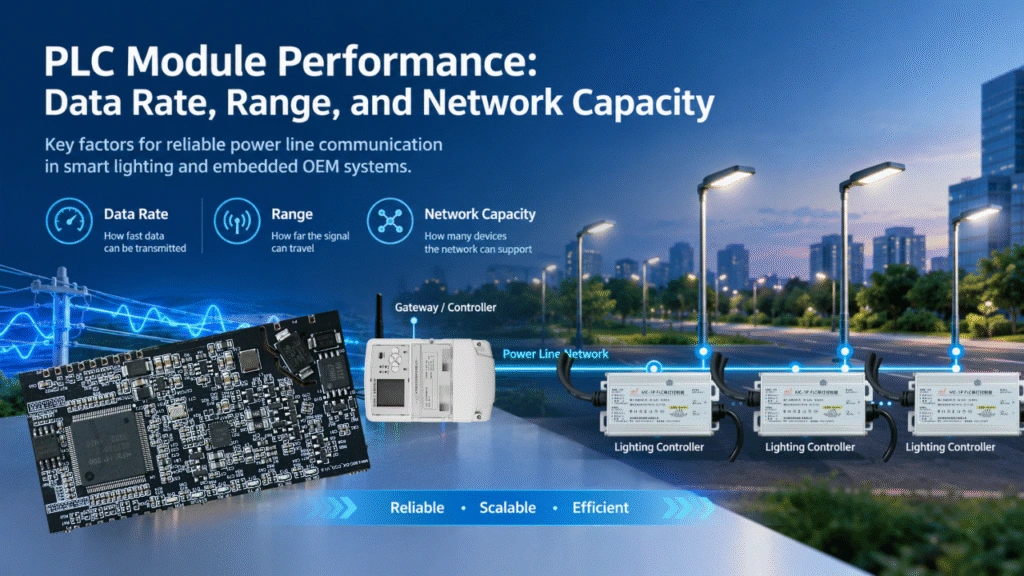
A PLC-enabled outdoor lighting architecture may include:
- LED luminaire and driver: Supplies the required lighting output and supports the intended control method.
- Compatible interface or controller: Connects the selected control device to the luminaire and its supported signals.
- PLC communication device: Sends and receives data over the electrical power network when the hardware is designed for PLC communication.
- PLC gateway or concentrator: Collects field-device communications and connects the lighting network to a management platform.
- Cloud management platform: Supports functions such as scheduling, dimming, device monitoring, and fault reporting when implemented by the system.
The exact architecture depends on where the PLC modem is installed and how the luminaire, driver, controller, and communication module exchange power and data.
For example, a PLC modem integrated into a luminaire controller or driver may communicate through the power-line network, while a Zhaga interface may provide a separate connection for an external control node. These functions should not be assumed to share the same electrical interface.
Before combining the technologies, engineers should verify:
- Whether the selected module supports the required electrical interface and control signals.
- Whether the PLC device has an appropriate power-line coupling circuit and suitable isolation.
- Whether the luminaire driver and controller support the intended dimming and telemetry functions.
- Whether the complete system meets applicable safety, EMC, surge-protection, and environmental requirements.
- Whether the proposed product combination meets the required certification and interoperability conditions.
For projects that prioritize using existing electrical wiring for communication, PLC can be evaluated as part of the wider lighting network design. A Zhaga interface may complement that design, but it does not itself provide PLC communication.
7. What Should OEMs Check Before Selecting Zhaga Book 18 Components?
Selecting a Zhaga Book 18 component involves more than matching the connector.
Mechanical compatibility
Confirm the applicable Book 18 edition, receptacle configuration, module mounting arrangement, dimensions, and installation requirements. Edition 4 includes additional arrangements for heritage and decorative luminaires, so requirements should be checked against the intended product configuration.
Electrical compatibility
Review the specified supply requirements, pin assignments, signal interfaces, loading limits, and protection provisions for the applicable edition and certified product combination.
Do not assume that all Zhaga-compatible-looking modules use identical electrical interfaces.
Communication compatibility
Determine whether the application requires DALI-based communication, a specific sensing interface, wireless connectivity, PLC, or another communication method.
A common physical connector does not guarantee that two devices can exchange data or support the same control functions.
Environmental protection
Outdoor lighting products must be designed for the intended exposure to water, dust, temperature changes, vibration, and electrical surges. Verify the complete assembled configuration rather than considering the connector or module in isolation.
Certification and documentation
Check the relevant certification records, product documentation, installation instructions, and applicable specification edition. Where Zhaga-D4i compliance is required, confirm the status of both the luminaire and the intended control device.
Long-term maintenance
Consider whether the module can be replaced in the field, whether spare parts will remain available, and whether future control-node upgrades can be accommodated without redesigning the complete luminaire. Before you start, you can first see our article PLC Module Design Checklist for OEM Development: Hardware, Firmware & Production Guide for reference.
8. Zhaga Book 18 in Smart City Lighting Projects
Smart city lighting increasingly combines energy-efficient LED fixtures with sensors, communication networks, remote management, and automated control.
Zhaga Book 18 supports modular outdoor luminaire designs by defining a standardized interface for compatible sensing and communication modules. D4i can provide relevant intra-luminaire digital control and data capabilities, while network technologies such as PLC can provide connectivity across a wider electrical infrastructure.
For municipal street lighting, tunnel approaches, industrial outdoor areas, and other infrastructure projects, the most suitable solution depends on the desired control functions and the existing electrical installation.
A well-designed system should consider the complete chain: luminaire, driver, local controller, communication network, gateway, and management software. Standardized interfaces can simplify integration, but system-level testing remains essential.
For manufacturers and project developers, the practical goal is not simply to select a standard. It is to choose compatible components that can be installed, commissioned, monitored, maintained, and upgraded reliably throughout the lighting system’s service life.