Street lighting is becoming more intelligent. Cities and infrastructure operators want to dim lights according to traffic, monitor energy consumption, detect faults, and manage thousands of luminaires remotely. Choosing the right communication technology is therefore an important part of smart street-lighting design.
Two technologies often considered are Power Line Communication (PLC) and Digital Addressable Lighting Interface (DALI). Both support digital lighting control, but they are designed for different communication environments.
For many large-scale street-lighting projects, PLC is the more practical choice when the existing power lines can also carry control data. DALI is often a strong choice for luminaire-level control, especially when a dedicated lighting-control bus or standardized driver interface is already part of the design. The best choice depends on the project’s wiring, control architecture, scale, and integration requirements.
This guide explains the differences between PLC and DALI for street lighting and helps engineers, lighting designers, and project owners choose the right technology.
Quick answer: PLC vs DALI for street lighting
| Comparison | PLC | DALI |
|---|---|---|
| Communication medium | Existing power lines | Dedicated two-wire lighting-control bus |
| Main purpose | Communication over electrical power infrastructure | Digital lighting control between lighting devices |
| Typical street-lighting role | Pole-to-pole or network-level communication | Luminaire-level control and data exchange |
| Additional control wiring | Can use existing power wiring | Requires a DALI bus connection |
| Individual dimming | Supported through compatible controllers and drivers | Supported through addressed DALI control gear |
| Remote monitoring | Can be integrated with gateways and cloud platforms | Requires an appropriate gateway or control system |
| Best fit | Large outdoor networks and retrofit projects | Dedicated lighting-control systems and luminaire-level integration |
| Main design consideration | Power-line communication performance | Bus topology, device compatibility, and system architecture |
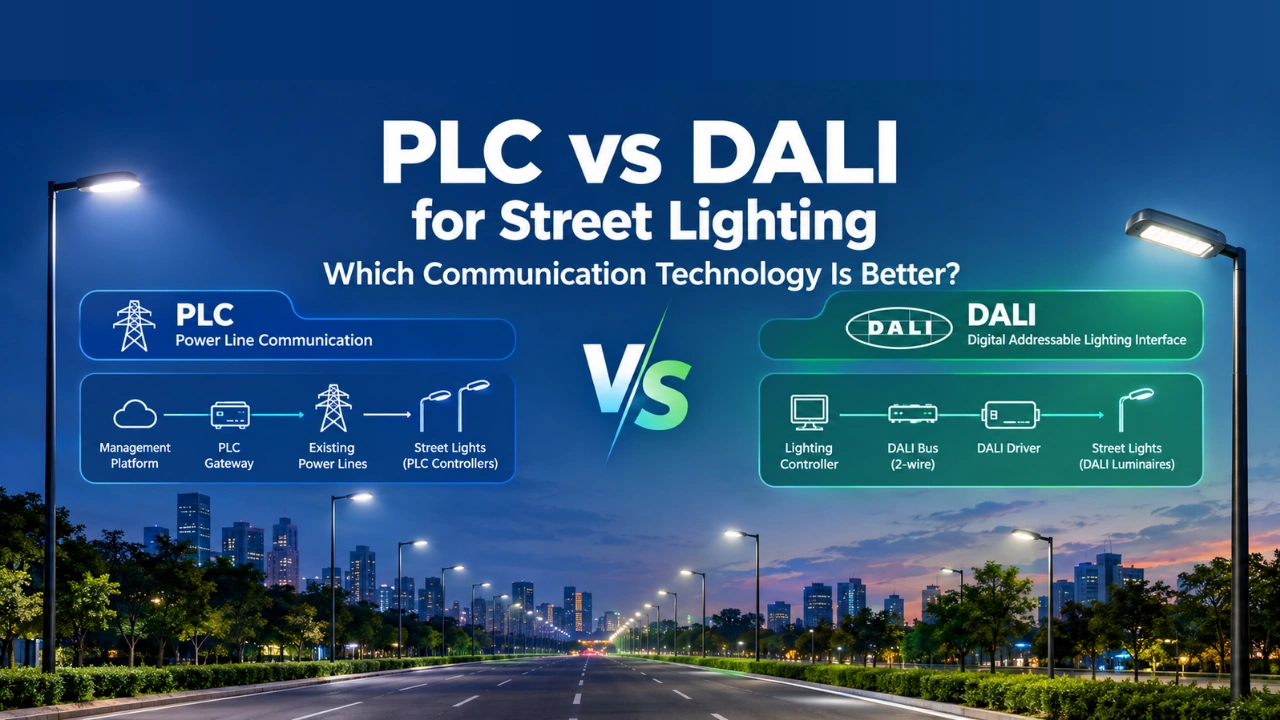
DALI is a standardized digital lighting-control protocol, while PLC is a communication technology that uses power lines to transmit data. These are not direct equivalents: one describes the communication medium and network approach, while the other defines a lighting-control protocol.
What is PLC in street lighting?
Power Line Communication (PLC) transmits digital data over electrical power lines. In a smart street-lighting system, the same infrastructure that supplies electricity to luminaires can also carry communication signals.
A typical PLC street-lighting architecture includes:
- PLC gateway or smart concentrator: Connects the lighting network to a management platform.
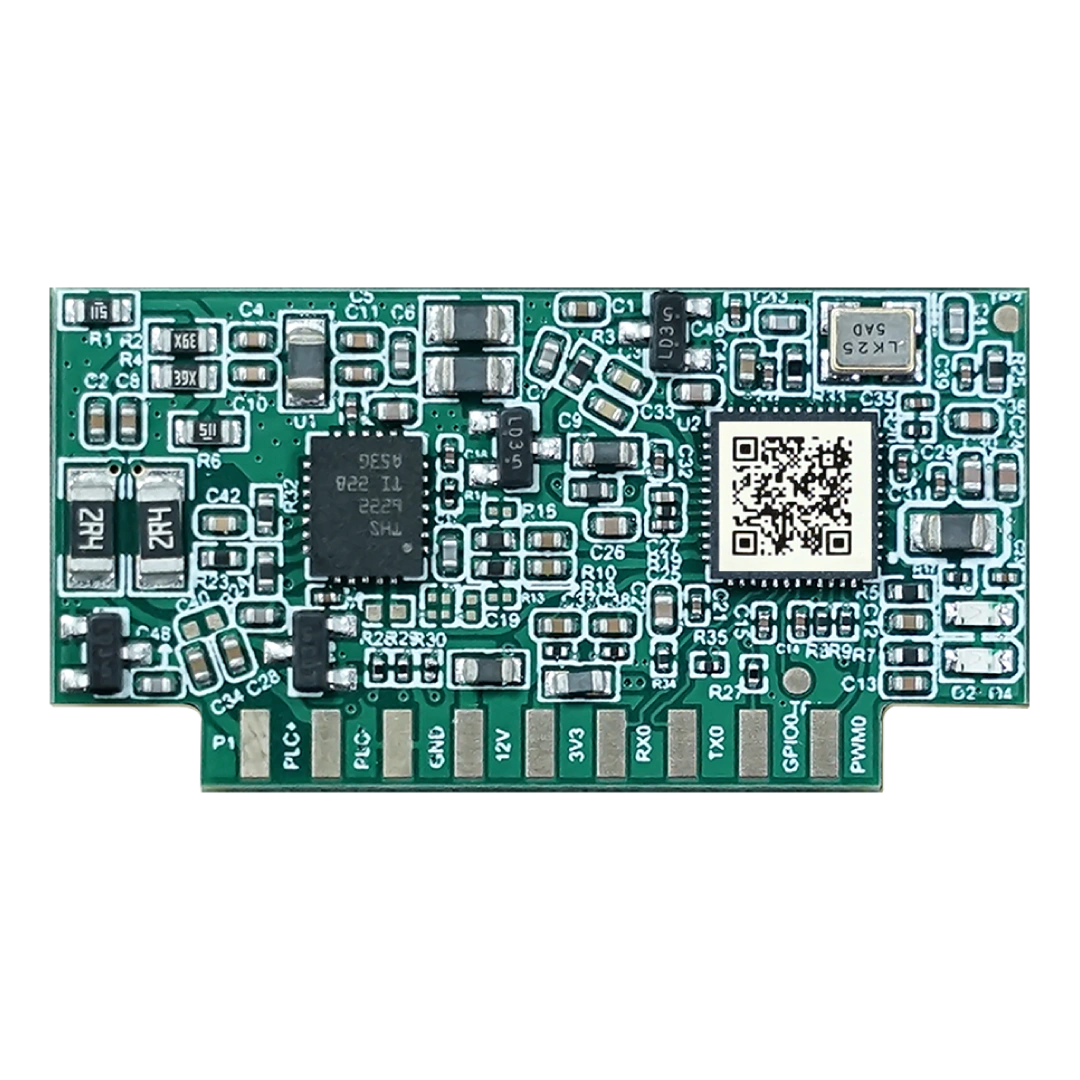
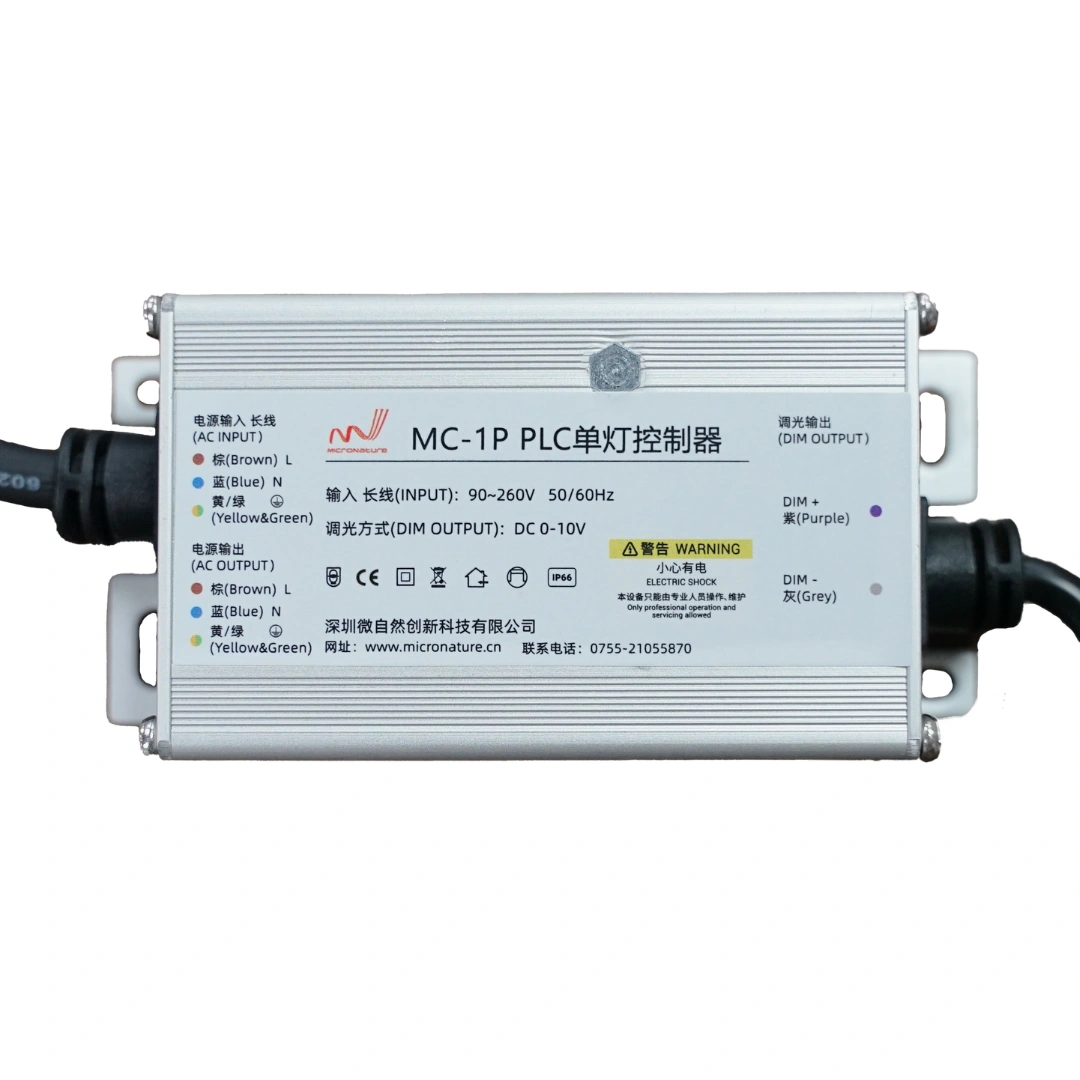
- PLC communication nodes: Installed at luminaires or other network points.
- LED drivers or lighting controllers: Execute dimming, switching, and other control commands.
- Power-line network: Carries both electrical power and communication data.
- Cloud or management software: Provides scheduling, monitoring, and fault-management functions.
For example, a city may use a PLC gateway to communicate with street-light controllers installed along a road. The gateway can receive commands from a central management platform and distribute them through the power-line network.
Why PLC is attractive for street lighting
The main advantage is that communication can use the existing electrical infrastructure. This can reduce the need for additional communication cabling, particularly in retrofit projects where power wiring is already installed.
PLC can also support network-level functions such as:
- Remote switching and dimming
- Energy monitoring
- Fault reporting
- Scheduling
- Network management
- Integration with cloud platforms
However, PLC performance depends on the electrical network and communication design. Engineers must consider factors such as line impedance, electrical noise, signal attenuation, and the actual network topology.
What is DALI in street lighting?
DALI, or Digital Addressable Lighting Interface, is a standardized digital lighting-control protocol. It enables bidirectional communication between lighting-control devices, such as LED drivers, sensors, and application controllers. DALI is specified through the IEC 62386 standard.
A DALI system typically includes:
- DALI LED drivers
- DALI application controllers
- DALI input devices, such as sensors
- DALI bus power supply
- A two-wire communication bus
DALI supports individual addressing, group addressing, broadcast commands, and scene control. This makes it suitable for precise lighting control and configuration.
Why DALI is attractive for lighting control
DALI is designed specifically for lighting applications. It supports functions such as:
- Individual luminaire control
- Group and scene control
- Dimming
- Configuration
- Status queries
- Fault reporting
- Sensor integration
DALI-2 also improves interoperability through a certification program based on the latest version of the DALI protocol.
Is DALI commonly used to connect every streetlight?
Not necessarily. In outdoor lighting, DALI is often used inside or at the luminaire level, while another communication technology connects the streetlights to the central management system. The DALI Alliance describes outdoor applications where a small DALI system is integrated within each streetlight, with other communication technologies used for wider connectivity.
This is an important distinction: DALI can be part of a smart street-lighting system without being the technology that connects every pole.
PLC vs DALI: Key differences
1. Communication medium
The biggest difference is how the technologies transmit data.
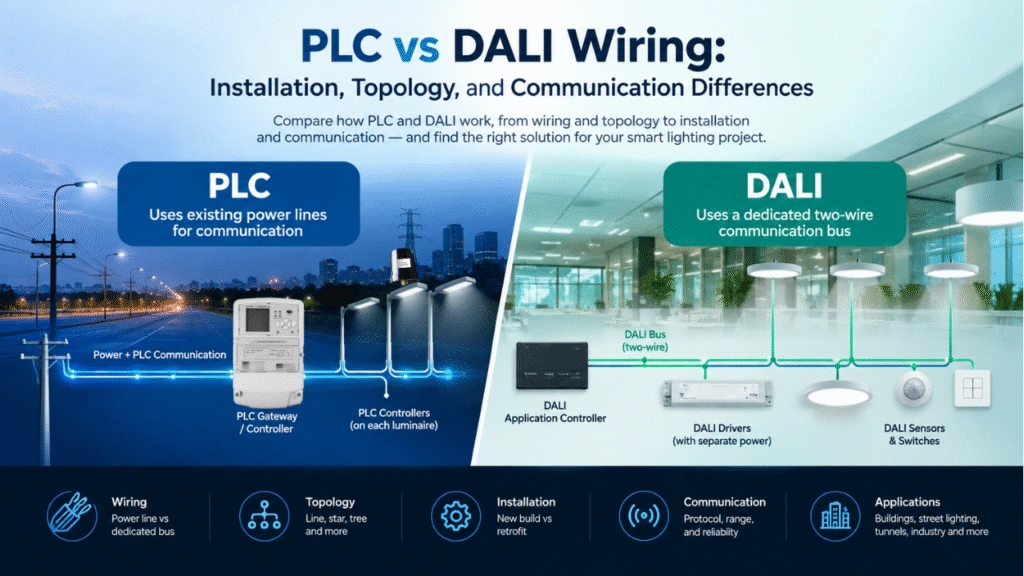
PLC uses power lines as the communication medium. This allows data to travel through electrical wiring that is already supplying power to the lighting system.
DALI uses a dedicated two-wire bus. The same pair of wires carries DALI communication and bus power for the system.
For street lighting, this means PLC may be more attractive when the project is designed around existing power infrastructure, while DALI requires a suitable bus connection to the lighting devices.
2. Network architecture
PLC is commonly used as a network-level communication technology. A gateway can communicate with multiple lighting controllers through the power-line network.
DALI is primarily a lighting-control bus. It is designed to communicate with lighting devices and supports individual, group, and broadcast addressing.
A simplified architecture looks like this:
PLC street-lighting system
Cloud / Management Platform
            │
            ▼
      PLC Gateway
            │
     Power-Line Network
      │       │       │
      ▼       ▼       ▼
   Light 1  Light 2  Light 3
   Controller Controller Controller
DALI lighting-control system
Lighting Management System
            │
            ▼
     DALI Application Controller
            │
        DALI Bus
      │       │       │
      ▼       ▼       ▼
   LED Driver LED Driver LED Driver
The actual architecture can vary, but the key difference is that PLC is often used to connect devices over power infrastructure, while DALI is designed to control lighting devices through a dedicated bus.
3. Wiring and installation
PLC advantage: It can communicate over existing power lines, which can be useful for retrofit street-lighting projects.
DALI advantage: Its dedicated bus provides a structured communication connection for lighting devices.
For a new installation, DALI bus wiring may be straightforward if the luminaires and control system are designed for it. For an existing street-lighting network, adding a separate control bus may require additional cabling or changes to the electrical installation.
However, PLC does not eliminate all wiring considerations. The power network must still be suitable for communication, and the system may require appropriate coupling, filtering, and network design.
4. Scalability
PLC is often attractive for large outdoor lighting networks because it can use the existing power distribution infrastructure.
DALI is also scalable, but its architecture is different. A DALI-2 subnet supports up to 64 control gear devices and 64 control devices, according to the DALI Alliance. Larger systems can be built using multiple subnets and higher-level controllers.
For a city-wide street-lighting network, the important question is not simply how many devices a protocol supports. Engineers should also consider:
- Number of luminaires
- Network topology
- Communication distance
- Gateway capacity
- Fault isolation
- Expansion requirements
- Maintenance and commissioning
5. Dimming and lighting control
Both PLC and DALI can support dimming, but they do so through different architectures.
PLC systems typically use compatible lighting controllers and drivers to execute dimming commands.
DALI is specifically designed for lighting control and supports standardized dimming behavior, scenes, and individual device addressing.
For a street-lighting project, the choice depends on whether the priority is network-level communication over power lines or standardized luminaire-level lighting control.
6. Monitoring and diagnostics
Smart street lighting requires more than switching lights on and off. Operators may need to know:
- Is the luminaire operating?
- What is its current dimming level?
- Is there a driver fault?
- How much energy is being consumed?
- Is communication working correctly?
DALI supports bidirectional communication, including querying lighting devices and retrieving status information. DALI data specifications also support energy reporting and diagnostics.
PLC systems can also support monitoring and diagnostics through compatible controllers, gateways, and management software.
The difference is that DALI provides a standardized lighting-control interface, while PLC provides the communication path over the power network. In many systems, these technologies can complement each other.
Which is better for different street-lighting projects?
PLC is often better when:
- The project uses existing power lines.
- The goal is to control many streetlights across a road, district, or city.
- Additional communication cabling is difficult or expensive.
- The system needs centralized management through a PLC gateway.
- The project requires remote monitoring and scheduling.
- The lighting network is designed around power-line communication.
DALI is often better when:
- The project requires dedicated lighting-control wiring.
- The luminaires already support DALI or DALI-2.
- The main requirement is precise luminaire-level control.
- The system needs standardized lighting-device communication.
- The project uses DALI-compatible sensors and controllers.
- The lighting architecture is designed around DALI bus control.
For large-scale smart street lighting
For many large outdoor networks, PLC is often the more natural choice for connecting streetlights through the existing electrical infrastructure.
For example, a smart street-lighting system may use:
- PLC communication between the gateway and street-light controllers
- DALI communication inside the luminaire
- A cloud platform for remote management
This architecture combines the strengths of both technologies.
Can PLC and DALI work together?
Yes. PLC and DALI can be used together in a hybrid smart-lighting system. If you are a beginner, can first see our article How to Integrate a PLC Module into Embedded Systems.
A typical hybrid architecture may look like this:
Cloud / Smart Lighting Platform
              │
              ▼
        PLC Gateway
              │
       Power-Line Network
        │          │
        ▼          ▼
   Streetlight 1  Streetlight 2
        │          │
        ▼          ▼
   DALI Driver  DALI Driver
        │          │
        ▼          ▼
      LED         LED
In this design:
- PLC provides communication across the power-line network.
- DALI provides local lighting control.
- The gateway or controller manages communication between the two systems.
This can be useful when a project needs both long-distance network communication and standardized luminaire-level control.
The DALI Alliance also documents connectivity options and gateway specifications that support integration with other communication technologies.
How to choose the right technology
Before selecting PLC or DALI, engineers should evaluate the following questions.
1. Is the project new construction or retrofit?
If the project is a retrofit, using existing power lines for communication may reduce the need for additional cabling.
If the project is a new installation, a dedicated DALI bus may be easier to include in the initial design.
2. How many luminaires must be controlled?
A small lighting system may only need a local DALI bus.
A large street-lighting network may require a gateway-based architecture with multiple communication nodes.
3. What is the communication distance?
Street-lighting projects often involve long distances between poles. The communication technology must be selected according to the actual electrical network, topology, and required performance.
4. Is the project mainly about network communication or luminaire control?
This is one of the most important questions.
- If the main requirement is communication across the power infrastructure, PLC may be the better fit.
- If the main requirement is standardized lighting control inside the luminaire, DALI may be the better fit.
5. What type of monitoring is required?
If the project requires energy monitoring, fault detection, and remote management, the selected architecture should support the necessary data and control functions.
6. Does the project require a hybrid architecture?
In some cases, the best solution is not PLC or DALI. It may be PLC + DALI, with PLC providing the network connection and DALI providing local lighting control.
PLC vs DALI for street lighting: Final verdict
PLC is often the better choice for large-scale street-lighting networks that need communication over existing power lines. DALI is often the better choice for dedicated lighting-control systems and luminaire-level integration.
However, there is no universal winner.
The right technology depends on the project’s wiring, network architecture, control requirements, and installation environment.
For many smart street-lighting projects, a hybrid PLC + DALI architecture can provide the best of both worlds: power-line communication for network connectivity and DALI for standardized lighting control.
If you are designing a smart street-lighting system, the first step is to define the communication architecture before selecting the lighting controllers, drivers, and gateways.