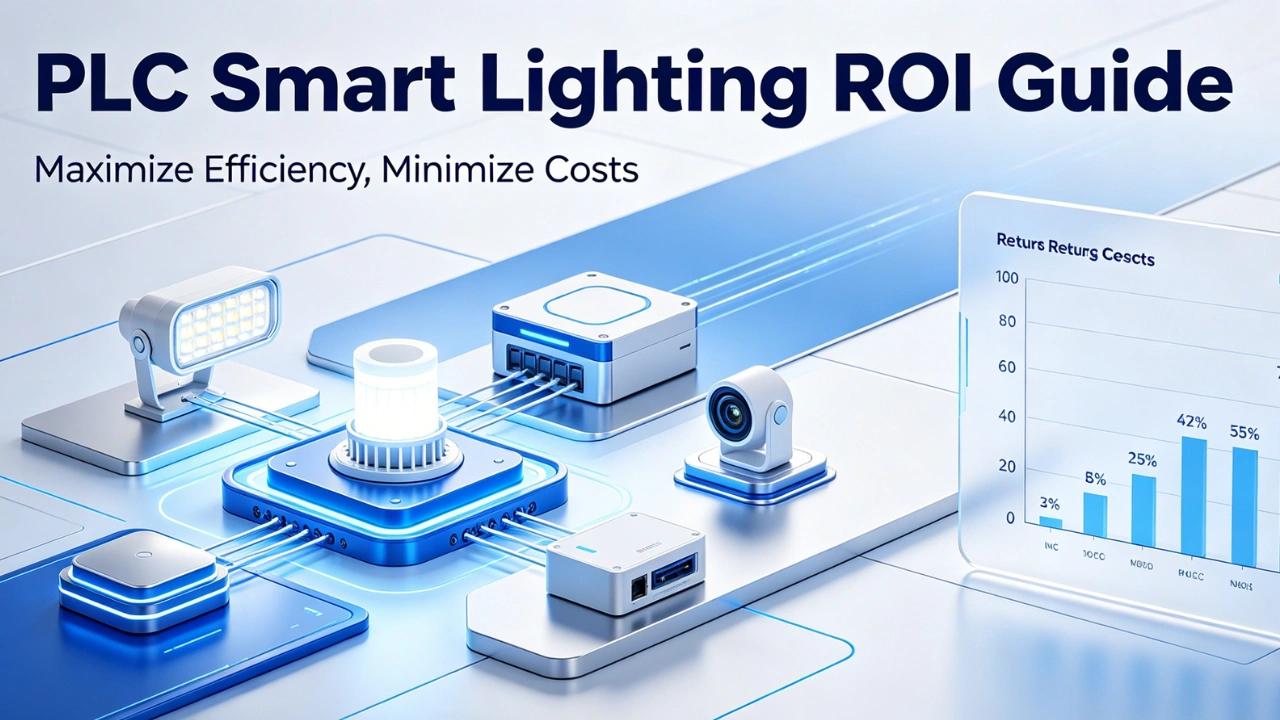
When planning a smart lighting project, cost is only part of the equation.
The real question is:
How long does it take to recover your investment?
PLC (Power Line Communication) smart lighting systems are designed not only to improve operational efficiency but also to deliver measurable financial returns.
This guide explains how to calculate ROI, what factors affect payback, and what results you can expect in real-world projects.
PLC Smart Lighting ROI — Quick Answer
- Typical ROI period: 2–5 years
- Energy savings: 40–60%
- Maintenance cost reduction: 20–50%
- Payback depends on:
- electricity cost
- project size
- operating hours
👉 PLC smart lighting improves ROI by reducing energy consumption and maintenance costs through intelligent control and monitoring.
What Is ROI in PLC Smart Lighting?
Return on Investment (ROI) in PLC smart lighting refers to the time required for energy savings and reduced maintenance costs to recover the initial project investment.
ROI is typically measured in:
- years (payback period)
- percentage return
PLC Smart Lighting ROI Formula
ROI=Annual Savings/Total Investment
And for payback period:
Payback Period=Total Investment/Annual Savings
Step-by-Step: How to Calculate ROI
Step 1 — Calculate Total Investment
For more information, can see the U.S. Department of Energy – Lighting Efficiency
Include:
- lighting fixtures
- PLC controllers
- concentrators
- installation
- software
Typical range:
👉 $2,000 – $7,000 per light
Step 2 — Estimate Annual Energy Savings
Smart lighting reduces power usage through:
- dimming schedules
- adaptive lighting
- remote control
Typical savings:
👉 40–60% energy reduction
Step 3 — Estimate Maintenance Savings
Savings come from:
- reduced manual inspections
- remote fault detection
- longer equipment lifespan
Typical reduction:
👉 20–50% maintenance cost
Step 4 — Calculate Annual Savings
Example:
- Energy savings: $150 per light/year
- Maintenance savings: $80 per light/year
👉 Total: $230 per light/year
Step 5 — Calculate Payback Period
Example:
- Total investment: $3,000 per light
- Annual savings: $230
👉 Payback ≈ 13 years (basic scenario)
BUT in optimized projects:
- higher energy cost
- larger scale
👉 Payback reduces to 2–5 years
ROI Comparison Table
| Factor | Traditional Lighting | PLC Smart Lighting |
|---|---|---|
| Energy Consumption | High | Low |
| Maintenance Cost | High | Low |
| Failure Detection | Manual | Automatic |
| Operating Cost | High | Low |
| ROI Speed | Slow | Fast |
Real Project ROI Scenarios
🔹 Small Project (Parking Area)
- 30 lights
- Moderate usage
👉 ROI: 4–6 years
🔹 Medium Project (Urban Street)
- 200 lights
- Daily operation
👉 ROI: 3–5 years
🔹 Large Project (Highway / Smart City)
- 1000+ lights
- High electricity cost
👉 ROI: 2–4 years
Key Factors That Affect ROI
1. Electricity Price
Higher electricity cost = faster ROI
2. Operating Hours
Longer lighting hours increase savings.
3. System Design
Efficient topology reduces:
- energy loss
- communication issues
4. Installation Cost
Lower installation cost improves ROI significantly.
5. Control Strategy
Advanced features like:
- dimming schedules
- motion-based control
increase savings.
How to Improve ROI
Use Existing Infrastructure
PLC reduces installation cost by using existing power lines.
Optimize Lighting Design
Avoid over-lighting.
Use Smart Dimming
Reduces energy usage significantly.
Scale the Project
Larger projects:
👉 lower cost per unit
👉 faster ROI
Key Takeaways
- PLC smart lighting ROI is typically 2–5 years
- Energy savings reach 40–60%
- Maintenance cost drops significantly
- Larger projects achieve faster ROI
- Smart control strategies improve financial returns