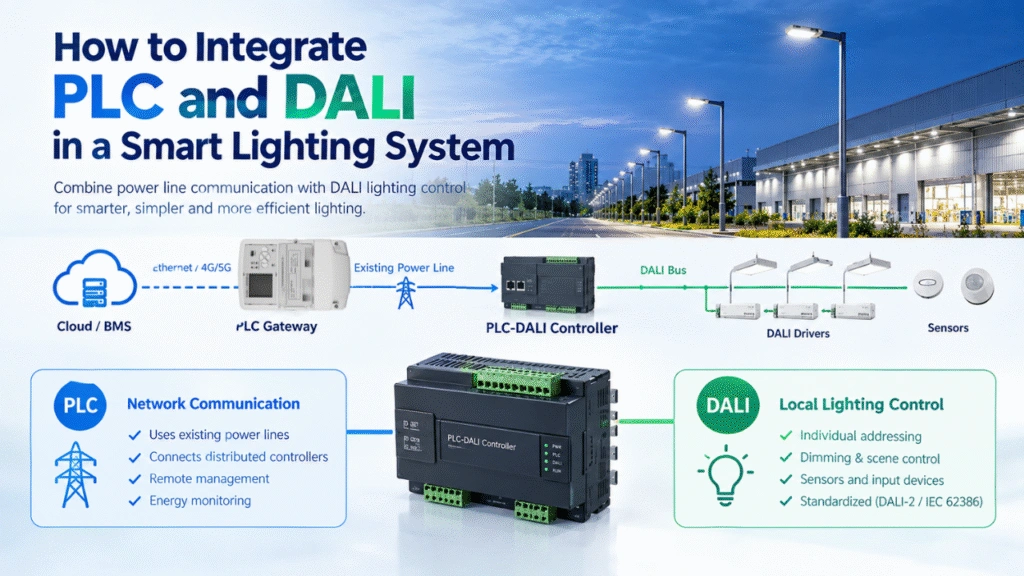
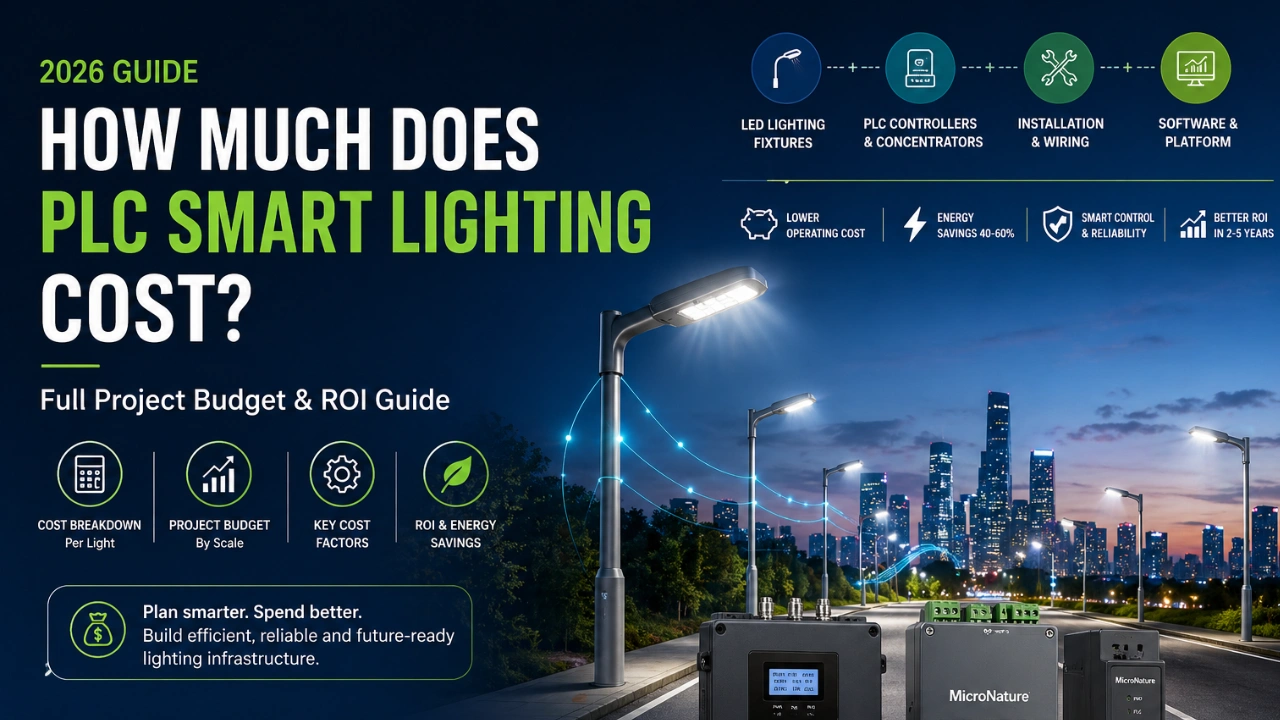
Smart lighting projects are becoming a core part of modern infrastructure, PLC smart lighting systems rely on existing power lines for communication. To understand how this works in detail, see our PLC smart lighting infrastructure guide. But one of the most common questions engineers and project planners ask is:
What Is PLC Smart Lighting Cost?
PLC smart lighting cost refers to the total investment required to deploy a smart lighting system using power line communication (PLC) technology, including hardware, installation, software, and long-term operation costs.
How much does PLC smart lighting cost?
The answer depends on several factors, including system scale, hardware configuration, installation conditions, and long-term operating costs. This guide explains the real cost structure of PLC smart lighting projects and helps you estimate a practical project budget.
PLC Smart Lighting Cost — Quick Answer
- Average cost per light: $2,000 – $7,000
- Small projects (20–50 lights): $40,000 – $250,000
- Medium projects (100–500 lights): $300,000 – $2,000,000
- Large projects (1000+ lights): $2M – $10M+
- Typical ROI period: 2–5 years
Main cost factors:
- installation complexity
- infrastructure conditions
- number of lighting points
- communication distance
👉 PLC systems reduce cost by using existing power lines and lowering maintenance needs.
What Is Included in a PLC Smart Lighting Project Budget?
A complete PLC smart lighting system typically includes multiple cost components beyond just lamps.
These include:
- LED lighting fixtures
- PLC lamp controllers
- PLC concentrators
- Communication infrastructure
- Installation labor
- Software platform
- Maintenance costs
Understanding these categories helps prevent under-budgeting and project delays.
Typical PLC Smart Lighting Cost Per Light
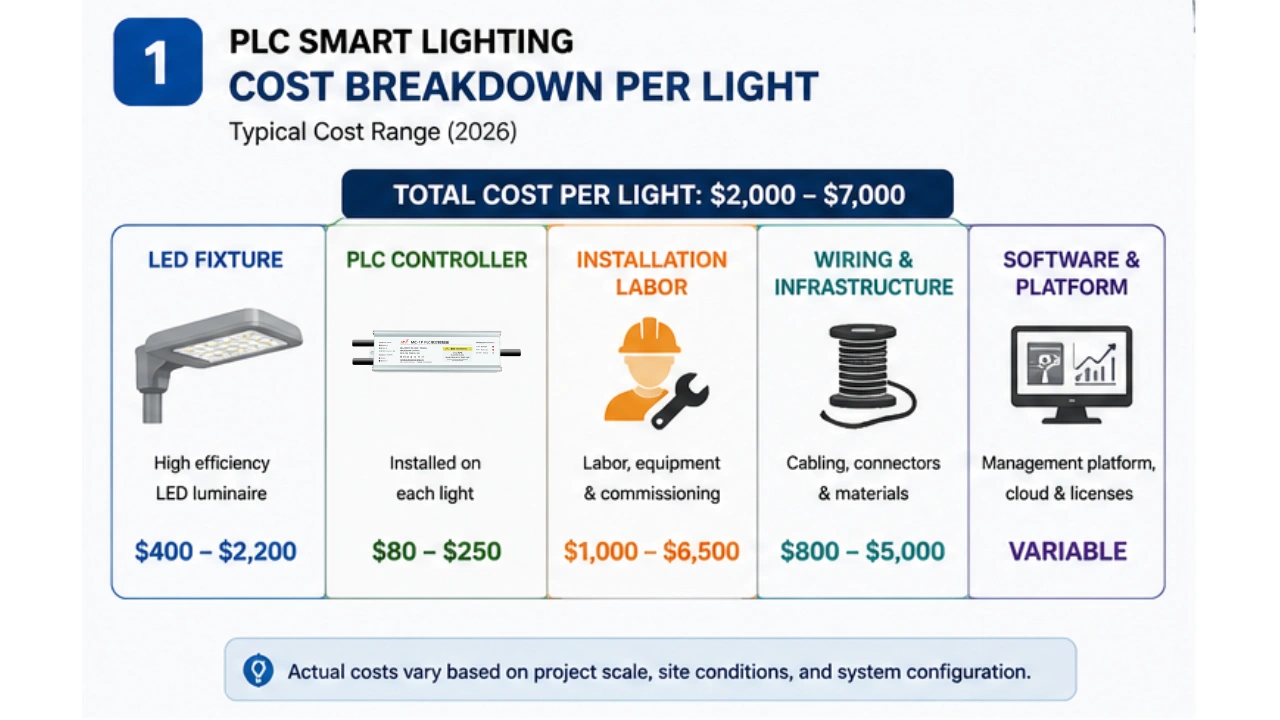
In most infrastructure projects, the cost per lighting point includes equipment, installation, and configuration.
Typical ranges:
| Component | Typical Cost Range |
|---|---|
| LED Fixture | $400 – $2,200 |
| Lighting Pole | $600 – $3,000 |
| Electrical Wiring | $800 – $5,000 |
| Installation Labor | $1,000 – $6,500 |
| Permit & Inspection | $100 – $2,000 |
Average total:
Actual costs vary depending on project size and infrastructure conditions.
PLC-Specific Equipment Cost Breakdown
Unlike traditional lighting systems, PLC smart lighting includes communication components.
Typical PLC hardware includes:
1. PLC Lamp Controller
Installed on each lighting fixture.
Typical cost depends on:
- communication standard
- control features
- sensor integration
Used for:
- remote dimming
- fault detection
- energy monitoring
2. PLC Concentrator
Acts as the central communication gateway.
Typical quantity:
- 1 per 100–500 lights
Cost depends on:
- network size
- communication range
- cloud platform support
Installation Cost Factors
Installation is often one of the largest cost components.
Major factors:
Site Conditions
Costs increase when:
- trenching is required
- underground cabling is needed
- road cutting is required
- heavy machinery is needed
Existing Infrastructure
PLC systems can reuse existing power lines.
This reduces:
- wiring cost
- installation time
- infrastructure complexity
PLC systems are widely used because they eliminate additional communication cables, reducing deployment complexity and installation cost.
Software and Platform Cost
Most PLC smart lighting projects include:
- central management system
- monitoring dashboard
- analytics tools
Typical software costs include:
- licensing
- server hosting
- maintenance
These costs depend on:
- system size
- cloud vs local server
- cybersecurity features
Operating Cost and Energy Savings
Operating costs include:
- electricity
- maintenance
- system support
One of the biggest financial advantages of PLC smart lighting is energy savings.
Smart dimming and monitoring can:
- reduce electricity usage
- extend equipment life
- reduce maintenance visits
Real-world PLC projects commonly achieve:
👉 40–60% energy savings through intelligent dimming and monitoring.
Typical PLC Smart Lighting Project Budget Examples
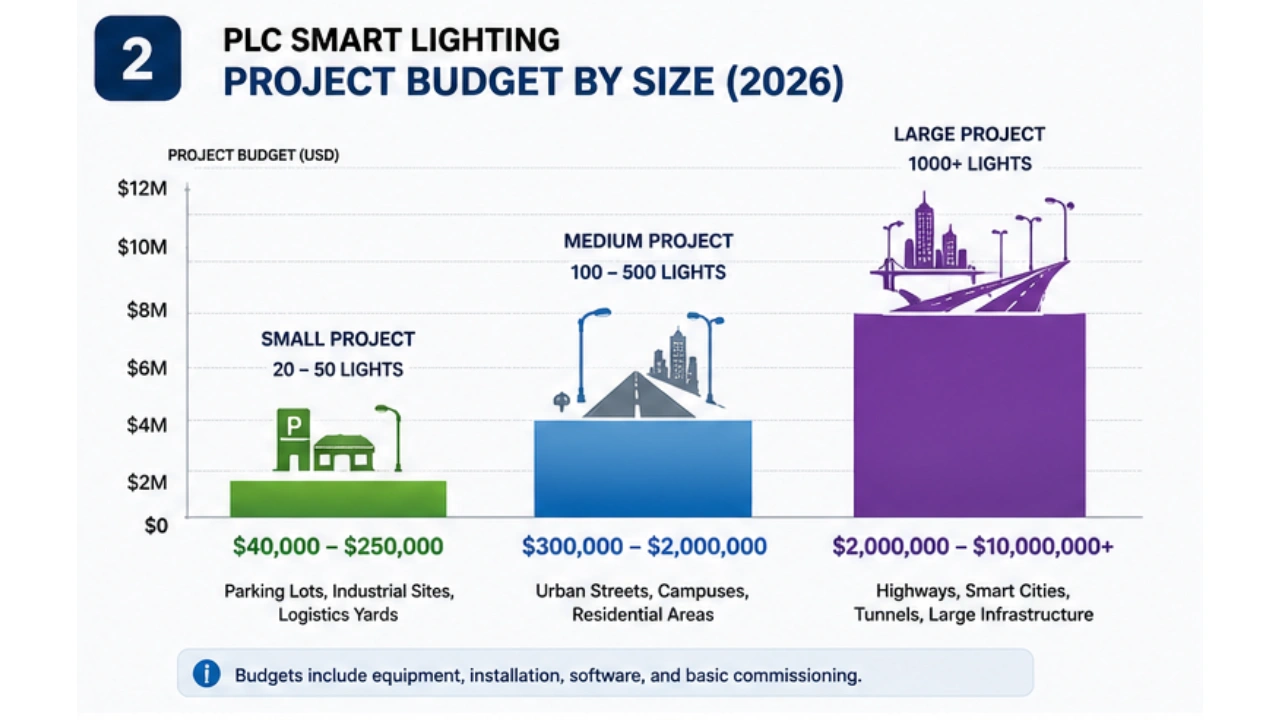
Below are realistic project estimates.
Small Project (Parking Lot)
Scale:
- 20–50 lights
Estimated Budget:
👉 $40,000 – $250,000
Typical applications:
- logistics yards
- commercial parking
- industrial sites
Medium Project (Urban Street)
Scale:
- 100–500 lights
Estimated Budget:
👉 $300,000 – $2,000,000
Typical applications:
- municipal streets
- campuses
- residential roads
Large Infrastructure Project
Scale:
- 1,000+ lights
Estimated Budget:
👉 $2,000,000 – $10,000,000+
Typical applications:
- highways
- smart cities
- tunnels
Key Factors That Affect PLC Smart Lighting Cost
Understanding these variables helps optimize project budgets.
1. Number of Lights
Larger projects reduce:
- per-unit cost
- installation cost
- commissioning time
Bulk deployment improves efficiency.
2. Communication Distance
Long distances may require:
- repeaters
- signal filtering
This slightly increases hardware cost.
3. Lighting Type
Costs vary depending on:
- street lighting
- tunnel lighting
- industrial lighting
High-power lighting increases equipment cost.
4. Installation Complexity
Higher complexity increases:
- labor time
- material usage
- equipment rental
This is often the biggest variable.
Total Cost of Ownership (TCO)
Smart infrastructure decisions should consider long-term cost, not just initial investment.
TCO includes:
- initial installation
- maintenance cost
- energy consumption
- system upgrades
PLC systems reduce long-term operating costs through:
- predictive maintenance
- remote monitoring
- automatic fault detection
These features significantly improve maintenance efficiency and reduce downtime.
PLC vs Traditional Lighting Cost Comparison
| Technology | Initial Cost | Operating Cost | Maintenance |
|---|---|---|---|
| Traditional Lighting | Medium | High | High |
| Wireless Smart Lighting | Medium | Medium | Medium |
| PLC Smart Lighting | Medium | Low | Low |
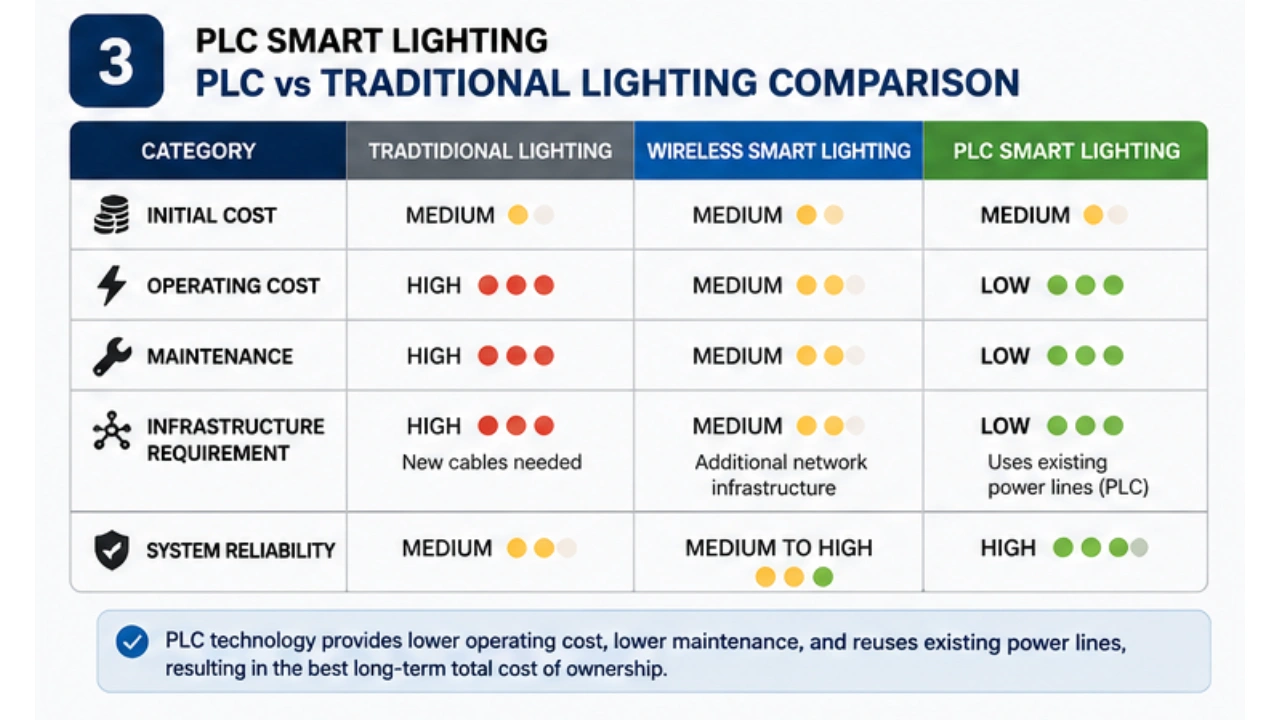
PLC systems typically reduce infrastructure complexity by using existing power lines for communication.
How to Reduce PLC Smart Lighting Project Cost
Practical strategies:
Use Existing Infrastructure
Reuse:
- poles
- wiring
- electrical panels
This reduces installation cost.
Optimize Network Design
Proper topology reduces:
- repeaters
- installation labor
Use Energy-Efficient Fixtures
Higher efficiency:
- lowers electricity cost
- extends lifespan
ROI: How Long Does PLC Smart Lighting Pay Back?
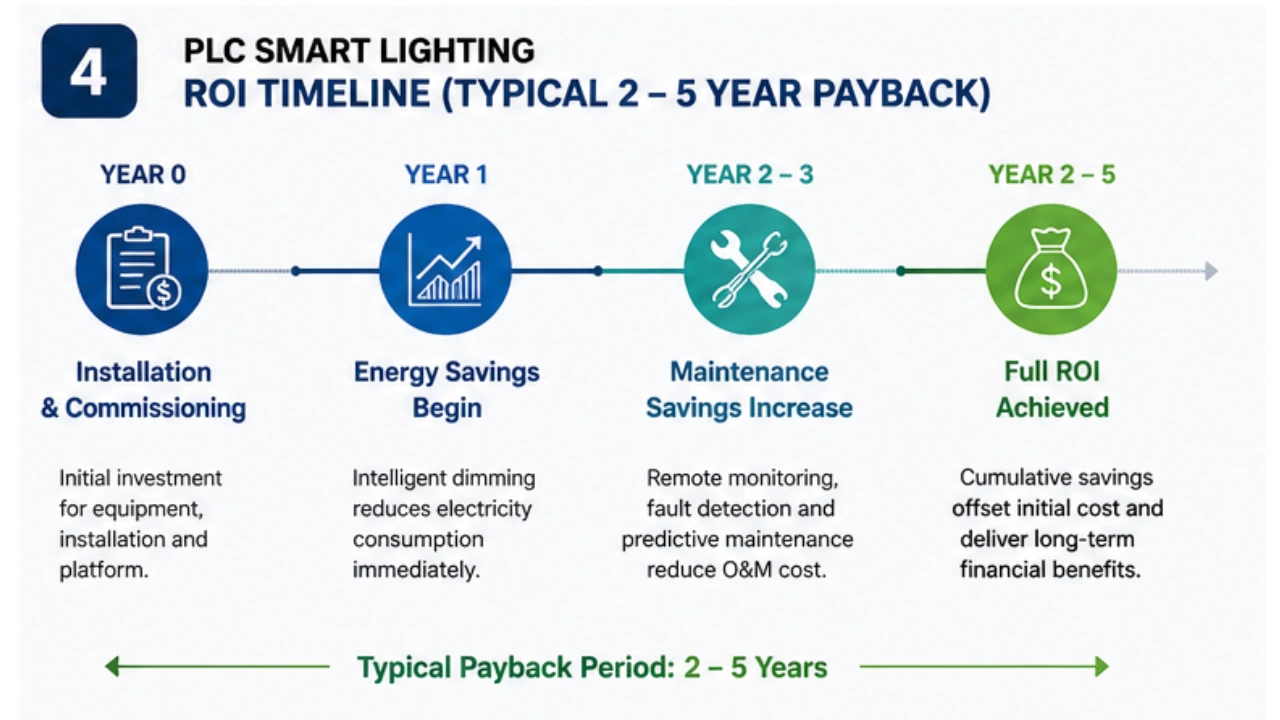
👉 2–5 years
This depends on:
- electricity cost
- project scale
- energy savings rate
Energy optimization and intelligent dimming significantly improve long-term project economics.
Final Thoughts
PLC smart lighting projects require careful planning, but they provide long-term financial and operational advantages.
Understanding cost structure helps project planners:
- control budget
- improve ROI
- reduce risk
For large infrastructure systems, PLC technology offers a balanced solution between installation cost, performance, and long-term savings.
Key Takeaways
- PLC smart lighting costs range from $2,000–$7,000 per light
- Installation is the largest cost factor
- PLC reduces infrastructure cost by using existing power lines
- Energy savings can reach 40–60%
- Typical ROI is 2–5 years