For cities, industrial facilities, ports, airports, campuses, and commercial parks, maintenance costs often exceed the initial investment over a lighting system’s lifetime.
Many organizations focus on fixture prices during procurement, but the real expense comes from:
- Routine inspections
- Lamp failures
- Driver replacement
- Wiring troubleshooting
- Manual labor
- Traffic control during maintenance
- Equipment rental
- Energy waste caused by unnoticed failures
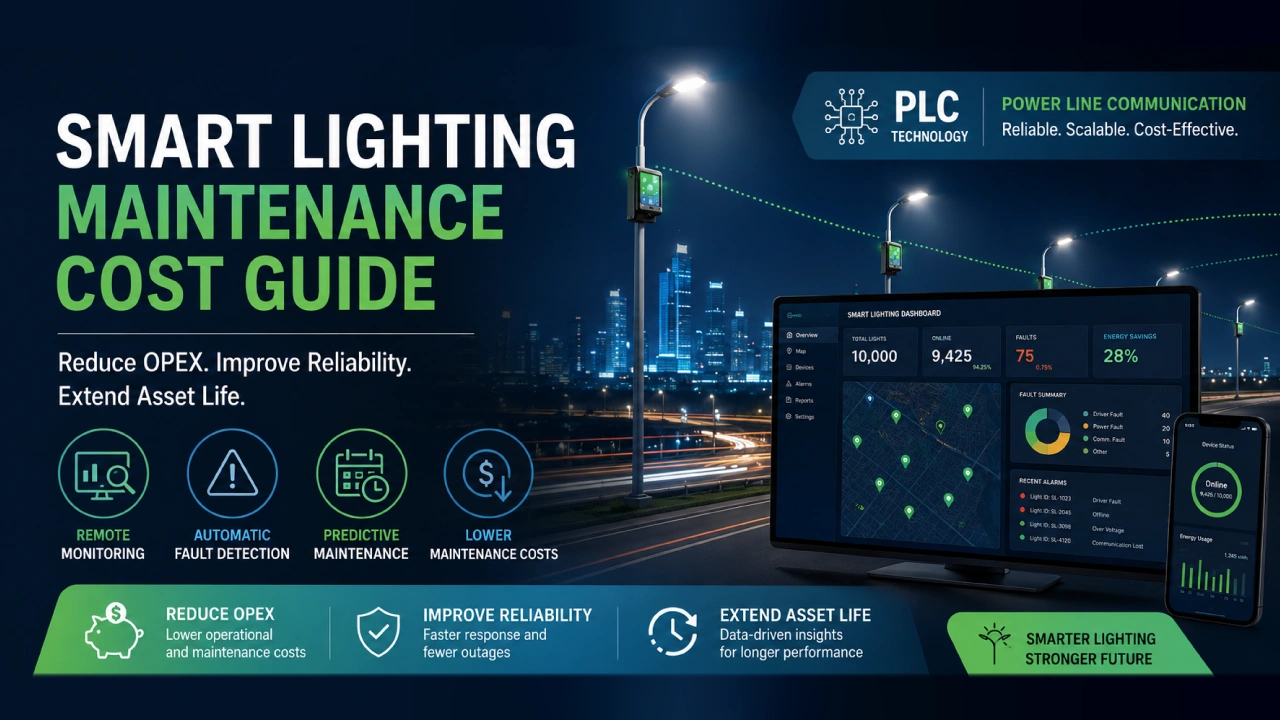
Modern smart lighting systems significantly reduce these ongoing operational costs by enabling remote monitoring, predictive maintenance, and automated fault detection.
In this guide, we’ll explain the major maintenance cost factors, compare traditional and smart lighting systems, and show how PLC (Power Line Communication) technology helps reduce total ownership costs.
What Makes Up Smart Lighting Maintenance Costs?
Maintenance costs include much more than replacing failed luminaires.
Typical maintenance expenses include:
| Cost Item | Traditional Lighting | Smart Lighting |
|---|---|---|
| Manual inspections | High | Low |
| Fault detection | Manual | Automatic |
| Technician labor | High | Reduced |
| Lift truck rental | Frequent | Less frequent |
| Emergency repairs | Common | Rare |
| Driver replacement | Reactive | Predictive |
| Energy waste | High | Low |
| Maintenance planning | Manual | Automated |
For many municipalities, labor accounts for the largest portion of maintenance expenses.
Hidden Costs of Traditional Lighting Systems
Traditional lighting systems usually require scheduled inspections.
Maintenance teams often drive long distances only to discover that most lights are operating normally.
Common hidden costs include:
- Vehicle fuel
- Staff travel time
- Night inspections
- Traffic management
- Road closures
- Lift equipment
- Paper-based maintenance records
- Missed failures between inspections
As the lighting network grows, these costs increase every year.
How Smart Lighting Reduces Maintenance Costs
Smart lighting changes maintenance from reactive to proactive.
Instead of waiting for citizen complaints or scheduled inspections, operators receive automatic alerts when problems occur.
Benefits include:
- Remote monitoring
- Automatic fault notifications
- Real-time device status
- Power consumption monitoring
- Driver health monitoring
- Maintenance scheduling
- Remote dimming
- Remote firmware upgrades (when supported)
This significantly reduces unnecessary site visits.
PLC Smart Lighting Offers Additional Maintenance Advantages
Unlike wireless lighting systems, PLC communication uses existing power cables for data transmission.
This offers several maintenance benefits.
No Wireless Signal Problems
Wireless systems may experience:
- RF interference
- Signal blockage
- Network congestion
- Gateway failures
PLC avoids many of these issues because communication travels through the existing electrical infrastructure.
Fewer Communication Devices
Wireless deployments typically require:
- Routers
- Repeaters
- Gateways
- Antennas
- SIM cards (for some systems)
PLC networks usually require fewer communication devices, reducing equipment failures and maintenance work.
Automatic Fault Location
Modern PLC systems can quickly identify:
- Offline luminaires
- Driver failures
- Communication interruptions
- Voltage abnormalities
- Power outages
Maintenance crews know exactly which fixture requires service before leaving the office.
Typical Maintenance Workflow Comparison
Traditional Lighting
- Citizen reports outage
- Maintenance team schedules inspection
- Technician visits site
- Diagnose issue
- Return with replacement parts if necessary
- Complete repair
- Update maintenance records
This process may require multiple trips.
Smart PLC Lighting
- System detects fault automatically
- Cloud platform generates alarm
- Maintenance team identifies exact fixture
- Technician brings correct replacement parts
- Single repair visit
- System automatically confirms recovery
This greatly improves maintenance efficiency.
Cost Comparison Example
Consider a city operating 10,000 street lights.
| Maintenance Activity | Traditional | Smart Lighting |
|---|---|---|
| Scheduled inspections | Monthly | Minimal |
| Emergency call-outs | High | Lower |
| Fault detection | Manual | Automatic |
| Repair visits | Multiple | Usually one |
| Maintenance planning | Reactive | Predictive |
| Annual operating cost | Higher | Lower |
Actual savings vary depending on labor costs, travel distances, lighting density, and maintenance practices.
Predictive Maintenance Extends Equipment Life
Smart lighting systems continuously collect operational data such as:
- Operating hours
- Voltage
- Current
- Power factor
- Energy consumption
- Temperature (if supported)
- Communication quality
By analyzing these parameters, maintenance teams can identify components that are likely to fail and replace them during planned maintenance instead of after unexpected outages.
This helps extend equipment life and reduce emergency repairs.
Industries That Benefit Most
Smart lighting maintenance delivers the greatest value in large-scale installations.
Typical applications include:
- Smart street lighting
- Industrial parks
- Ports
- Airports
- Warehouses
- Logistics centers
- University campuses
- Large commercial parks
- Manufacturing facilities
- Oil & gas sites
The larger the lighting network, the greater the potential maintenance savings.
Best Practices for Reducing Maintenance Costs
To maximize long-term savings:
- Deploy remote monitoring from day one.
- Use automatic fault reporting.
- Schedule preventive maintenance based on operating hours.
- Monitor energy consumption for abnormal behavior.
- Keep firmware up to date.
- Standardize lighting controllers and drivers.
- Maintain detailed maintenance records.
- Integrate lighting with centralized management platforms.
Why PLC-Based Smart Lighting Is Cost-Effective
PLC-based smart lighting is particularly attractive because it:
- Uses existing power lines for communication
- Reduces communication infrastructure
- Simplifies installation
- Supports reliable large-scale deployment
- Enables remote diagnostics
- Improves maintenance efficiency
- Reduces operational expenditure (OPEX)
- Helps extend system lifespan
For municipalities and industrial operators, these advantages contribute to a lower total cost of ownership over the lifetime of the lighting system.