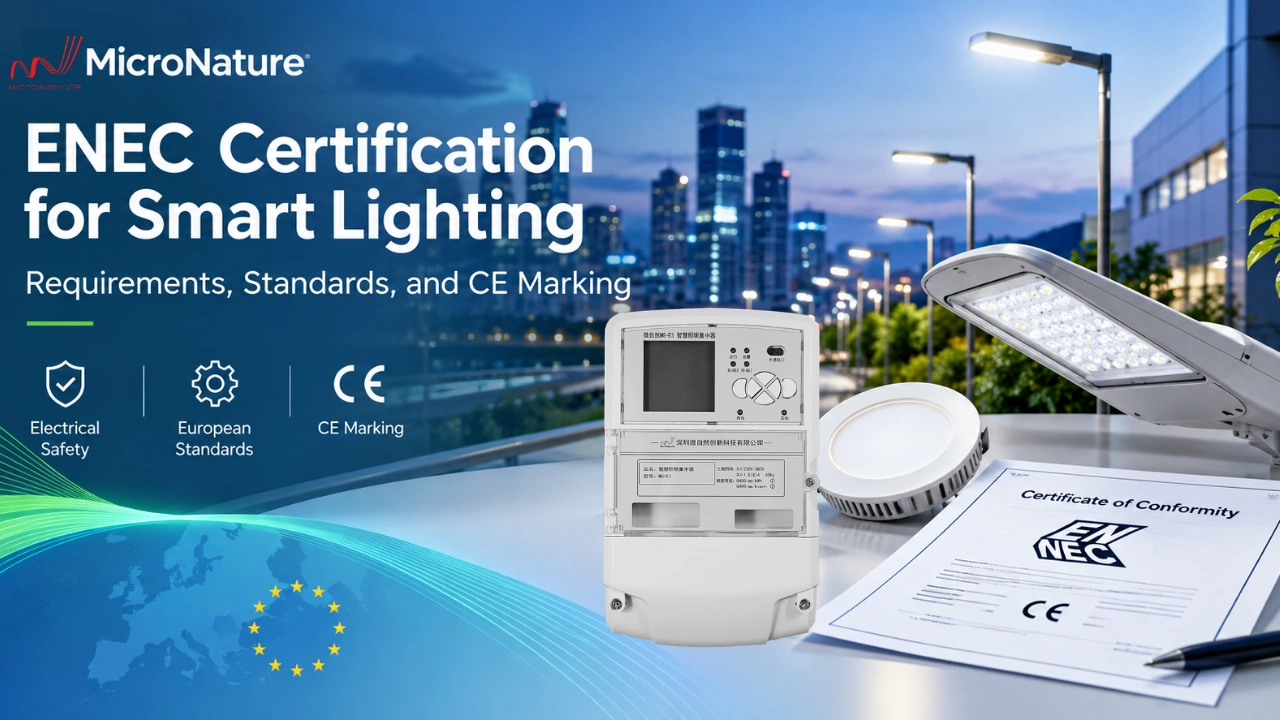
As smart lighting technology develops, manufacturers must consider more than energy efficiency, dimming performance, and communication capabilities. Electrical safety, product compliance, and manufacturing consistency are also essential when bringing lighting products to the European market.
ENEC certification is a voluntary European third-party product certification scheme that demonstrates conformity with applicable European safety standards. The ENEC mark is used for eligible electrical products, including luminaires, LED-related products, and lighting control equipment.
For manufacturers developing LED luminaires, smart street lighting systems, industrial lighting, and connected lighting controls, understanding ENEC certification can help clarify product development requirements and support discussions with European customers.
This guide explains what ENEC certification means, how it differs from CE marking, which lighting products may be covered, and how smart lighting manufacturers can prepare for the certification process.
1. What Is ENEC Certification?
ENEC stands for European Norms Electrical Certification. The ENEC mark is a recognized European certification mark for electrical products that have been independently assessed against applicable European standards.
Unlike a manufacturer’s own declaration of conformity, ENEC certification involves independent testing and certification by an authorized certification body within the scheme.
The ENEC scheme uses a Type 5 product certification model based on ISO/IEC 17067. This model includes product testing and ongoing assessment of production consistency, with factory surveillance and product retesting as applicable under the scheme.
The scope of ENEC certification includes several categories of electrical products, such as:
- LED luminaires and other lighting equipment
- LED modules and related components
- Lighting controls and switches
- Power supplies and transformers
- Connectors and other electrical installation products
The exact eligibility and applicable standards depend on the product category and its design.
For smart lighting manufacturers, ENEC certification can provide independent evidence that a covered product meets relevant safety requirements. It can also strengthen confidence among distributors, project owners, electrical contractors, and procurement teams.
Important: ENEC certification is generally voluntary. Whether a product needs ENEC certification depends on customer specifications, tender requirements, market expectations, and the product’s applicable regulatory obligations.
2. Why Is ENEC Certification Important for Smart Lighting?
Smart lighting systems combine conventional electrical equipment with electronic controls, communication interfaces, sensors, and software-based management functions.
Although these features improve lighting control and operational efficiency, they can also introduce additional engineering considerations.
Electrical safety
Lighting equipment must be designed to address applicable electrical hazards, including electric shock, insulation failure, overheating, and fire risks.
The relevant requirements depend on the product’s construction, rated voltage, installation environment, and intended use.
Product reliability and production consistency
An independently certified product is evaluated against defined requirements, while the ENEC scheme also includes production surveillance.
This is particularly relevant to manufacturers supplying products for long-term infrastructure projects, where consistent product construction and quality are important.
Market acceptance and procurement
European distributors, lighting consultants, and project owners may prefer or specifically request independently certified products.
Some tenders and purchasing specifications explicitly require ENEC certification. Others accept alternative evidence of compliance. Manufacturers should confirm the requirements for each project rather than assume the mark is mandatory everywhere.
Customer confidence
ENEC certification provides an independent reference for product safety, helping manufacturers communicate product quality to professional buyers.
For smart lighting suppliers, it can complement technical documentation covering dimming, energy consumption, communication performance, environmental protection, and system integration.
3. ENEC vs. CE Marking: What Is the Difference?
ENEC certification and CE marking serve different purposes. They should not be treated as interchangeable.
CE marking is a regulatory conformity marking used for products covered by applicable EU legislation. The manufacturer is responsible for determining the relevant legislation, completing the required conformity assessment, preparing technical documentation, and issuing an EU Declaration of Conformity where required.
ENEC is a voluntary third-party product certification mark based on applicable European standards.
| Comparison | ENEC certification | CE marking |
|---|---|---|
| Nature | Voluntary third-party certification | Regulatory conformity marking where applicable |
| Assessment | Independent certification under the ENEC scheme | Assessment route depends on applicable EU legislation |
| Product testing | Required under the relevant certification scheme | Depends on the legislation and conformity assessment procedure |
| Production surveillance | Included in the ENEC Type 5 scheme | Depends on applicable legislation and assessment requirements |
| Main purpose | Demonstrate independently assessed conformity with relevant European safety standards | Indicate conformity with all applicable EU requirements covered by the CE marking |
| Replaces the other? | No | No |
For a lighting product, ENEC certification does not automatically satisfy every legal obligation associated with CE marking. Similarly, CE marking does not automatically mean that a product has been ENEC certified.
Manufacturers should identify all applicable EU requirements for their products. Depending on the product, these may include electrical safety, electromagnetic compatibility (EMC), hazardous substances restrictions, and ecodesign or energy-labelling requirements where applicable.
For more information, consult the European Commission’s CE marking guidance and the official ENEC website.
4. Which Smart Lighting Products Can Be ENEC Certified?
ENEC certification is not limited to traditional lamps. Eligible products can include various lighting fixtures, LED components, and electrical control devices.
However, eligibility must be confirmed for the specific product and its intended certification scope.
LED luminaires
LED street lights, tunnel lights, industrial high-bay luminaires, office lighting, and other professional lighting fixtures may be considered for ENEC certification.
The applicable requirements depend on the luminaire type and construction.
LED modules and associated components
LED modules and associated electrical components may fall within the ENEC scheme’s scope. The certification route depends on the component category and relevant standards.
A component certificate does not automatically certify the complete luminaire into which it is installed.
Lighting controls and power supplies
Eligible electrical controls, switches, power supplies, and related products may also be covered.
For smart lighting systems, the manufacturer should establish whether the certification applies to an individual controller, a power supply, a luminaire, or a complete assembly.
PLC smart lighting equipment
Power Line Communication (PLC) technology uses existing electrical conductors to transmit communication signals, reducing the need for separate communication wiring in suitable system designs.
PLC technology itself does not automatically make a product ENEC eligible or certified. Certification depends on the finished product, its electrical construction, intended function, and the applicable standards.
For example, a PLC-enabled LED luminaire may require evaluation as a complete lighting product. An embedded PLC communication module may instead be assessed as a component, depending on its intended use and the certification route.
When integrating a PLC module into a luminaire driver or lighting controller, manufacturers should consider insulation, electrical clearances, temperature rise, electromagnetic compatibility, and the effect of the integration on the finished product’s safety assessment.
5. Which European Standards May Apply to Smart Lighting?
The applicable standards depend on the product category and its intended use. The following are examples of standards that manufacturers may need to review.
| Standard | General scope |
|---|---|
| EN IEC 60598-1 | General requirements and tests for luminaires |
| EN IEC 60598-2 series | Particular requirements for specific types of luminaires |
| EN IEC 61347-1 | General and safety requirements for lamp controlgear |
| EN IEC 61347-2-13 | Particular safety requirements for electronic controlgear for LED modules |
| EN IEC 62031 | Safety specifications for LED modules |
| EN 55015 | Radio disturbance characteristics of electrical lighting and similar equipment |
| EN IEC 61547 | EMC immunity requirements for lighting equipment |
These are examples, not a universal checklist. The latest applicable editions, amendments, harmonized standards, and ENEC scheme requirements should be confirmed with the chosen certification body.
Other requirements may apply depending on whether the product is a complete luminaire, a controlgear, a standalone controller, or a communication module.
Smart lighting products with wireless interfaces may also need additional assessment for their radio functions. PLC products require particular attention to their connection to mains wiring and the way communication circuitry is integrated into the electrical design.
A key engineering principle: Communication performance and electrical safety are separate assessment areas. A PLC controller that communicates reliably on a power line must still meet the safety and compliance requirements applicable to the complete product.
6. How Does the ENEC Certification Process Work?
The exact process varies by product and certification body, but manufacturers can generally prepare through the following stages.
Step 1: Define the product and certification scope
Identify the exact product model, intended use, rated voltage, electrical configuration, and market.
Determine whether the application concerns a complete luminaire, LED module, controlgear, or other eligible electrical product.
Step 2: Select the applicable standards
Work with the certification body to identify the standards and editions relevant to the product.
Do not assume that every LED luminaire follows an identical test plan. Outdoor luminaires, industrial high-bay products, and electronic lighting controls may have different requirements.
Step 3: Prepare technical documentation
Typical preparation materials may include:
- Product specifications and model information
- Circuit diagrams and PCB layouts
- Bill of materials and critical component information
- Mechanical drawings and enclosure details
- Electrical ratings and installation instructions
- Existing test reports and certificates, where relevant
- Manufacturing and quality-control documentation
The certification body will confirm the exact documents needed.
Step 4: Submit product samples for testing
Samples are evaluated against the applicable standards. Testing may cover electrical safety, insulation, temperature rise, mechanical construction, and other requirements relevant to the product.
Any failures or design concerns must be addressed before certification can proceed.
Step 5: Complete factory assessment
The ENEC Type 5 certification model includes production assessment and surveillance. Initial factory inspection and subsequent surveillance requirements are determined by the scheme and certification body.
Manufacturers should establish procedures to keep certified production consistent with the approved product construction.
Step 6: Obtain the certification and maintain compliance
If the product meets the requirements, the certification body can issue the applicable certificate and license to use the ENEC mark.
After certification, manufacturers must continue to meet surveillance requirements and manage product changes appropriately.
Changes to critical components, PCB layouts, power supplies, enclosures, or production processes may need to be reviewed by the certification body before implementation.
7. How Should Smart Lighting Manufacturers Prepare?
Preparation is particularly important for smart lighting products that combine a luminaire, driver, controller, sensors, and communication technology.
Review the complete electrical architecture
Map the power input, LED driver, control electronics, communication circuitry, sensors, and external interfaces.
For PLC-enabled products, identify how the PLC circuit couples to the power line and how safety isolation and protective measures are implemented.
Check critical component selection
Use components appropriate for their intended electrical and environmental conditions.
Review the documentation and certification status of relevant power supplies, capacitors, insulation materials, connectors, and protective devices. A component’s existing certification does not automatically certify the final assembly.
Verify thermal and environmental performance
Industrial and outdoor lighting products may operate under high ambient temperatures, humidity, dust, vibration, or other demanding conditions.
Ensure the design and test plan reflect the product’s intended operating environment and applicable standards.
Plan EMC testing and communication validation
Electronic lighting equipment can generate or be affected by electrical interference.
For PLC systems, the design team should assess conducted emissions, immunity, power-line noise, communication stability, and the impact of the communication circuit on the lighting driver.
These checks support product development, but they do not replace the formal testing required by the applicable certification scheme.
Control engineering changes
Maintain version-controlled drawings, component lists, PCB revisions, firmware information where relevant, and manufacturing records.
For OEM and ODM products, define responsibilities for design changes and certification maintenance before mass production begins.
8. ENEC Certification and the ENEC+ Mark
Manufacturers should distinguish between ENEC safety certification and ENEC+ performance certification.
The ENEC mark focuses on product safety against relevant European standards.
The ENEC+ scheme adds independent assessment of lighting performance. For eligible lighting products, this can help substantiate performance claims such as luminous flux, energy efficiency, and related characteristics under the applicable performance standards.
ENEC+ requires the product to carry the ENEC safety mark. It is therefore not simply an alternative to ENEC certification.
For manufacturers of professional LED lighting, the two marks address different questions:
- ENEC: Has the product’s safety been independently assessed against the applicable standards?
- ENEC+: Has the eligible product’s lighting performance also been independently assessed?
The need for either mark depends on product positioning, customer requirements, and target markets.
For official scheme details, see How the ENEC+ mark works.
9. What Does ENEC Certification Mean for PLC Smart Lighting Projects?
PLC smart lighting can simplify communication infrastructure by transmitting control data over existing electrical wiring. This can be valuable for street lighting, tunnels, industrial facilities, warehouses, and other infrastructure applications.
Nevertheless, system-level communication benefits should not be confused with product certification.
A typical PLC smart lighting system may include:
- A gateway or data concentrator
- PLC communication modules
- LED drivers and luminaires
- Single-light controllers
- Sensors and dimming interfaces
- A cloud platform for remote monitoring and control
Each item has a distinct role. The appropriate compliance assessment depends on which product is being placed on the market and how it is intended to be installed.
For example, integrating a PLC module into an LED driver may affect the finished product’s electrical design and EMC characteristics. A module that has been evaluated independently may still require additional assessment when integrated into a luminaire.
Manufacturers should therefore coordinate the communication design, power electronics, mechanical construction, and certification plan early in product development.
At MicroNature, PLC lighting technology is designed for smart lighting applications that use existing power lines for communication. For OEM developers, the integration process should account for both communication requirements and the applicable product safety standards.
Explore our PLC communication modules and PLC lighting solutions to learn more about PLC-based lighting system architectures.
10. How to Choose a Certification Partner
Selecting an appropriate certification body early can help reduce unnecessary redesign and clarify testing requirements.
Before starting an ENEC project, consider the following:
- Product scope: Confirm that the certification body covers the product category and relevant standards.
- Testing capability: Check whether the required testing can be performed by approved laboratories within the scheme.
- Technical support: Ask for guidance on product classification, documentation, and the certification process.
- Factory requirements: Understand initial inspections, ongoing surveillance, and production-control obligations.
- Design changes: Establish how component substitutions and hardware revisions will be reviewed.
- Project requirements: Confirm whether the customer or tender specifies ENEC, ENEC+, or another form of compliance evidence.
Manufacturers can consult the official ENEC website to learn about the scheme and identify participating certification bodies and testing laboratories.