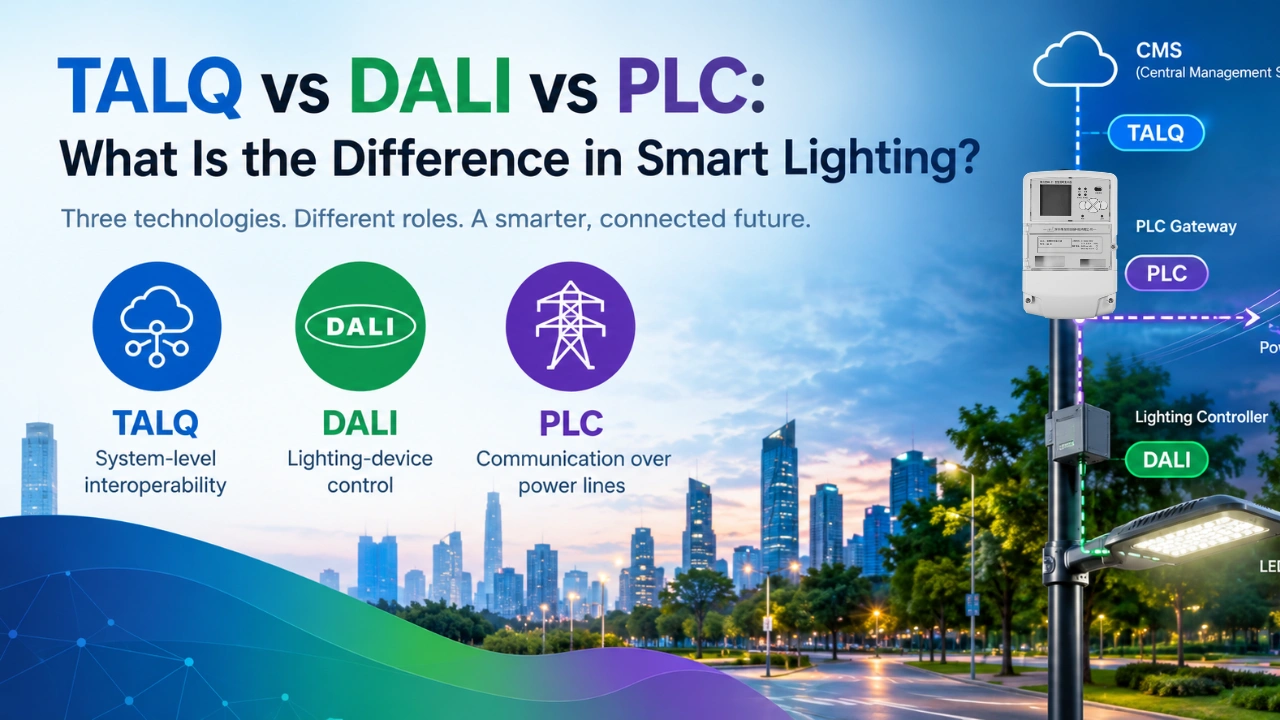
TALQ, DALI, and PLC are three technologies frequently discussed in smart lighting and smart city projects. However, they are not three interchangeable communication technologies.
They operate at different levels of a smart lighting architecture:
- TALQ provides an application-level interface for interoperability between Central Management Software (CMS) and Outdoor Device Networks (ODN).
- DALI / DALI-2 provides standardized digital lighting control between lighting devices and control equipment.
- PLC (Power Line Communication) provides a communication method that can transmit data over electrical power lines.
Understanding this distinction is important when designing street lighting, tunnel lighting, industrial lighting, warehouse lighting, and other connected lighting systems.
In many projects, TALQ, PLC, and DALI can even work together rather than compete with one another.
TALQ vs DALI vs PLC at a Glance
| Feature | TALQ | DALI / DALI-2 | PLC |
|---|---|---|---|
| Technology type | Application-level interface protocol | Digital lighting-control protocol | Communication technology |
| Primary role | System interoperability | Lighting-device control | Network communication |
| Typical level | CMS ↔ Outdoor Device Network | Controller ↔ lighting devices | Gateway ↔ distributed controllers |
| Communication medium | Software/API interface | Dedicated DALI bus | Electrical power lines |
| Main application | Smart city and outdoor device networks | Lighting control and device communication | Distributed infrastructure communication |
| Individual lighting control | Supported through connected ODN | Yes | Through compatible controllers |
| Remote management | Yes, through CMS/ODN architecture | Requires an upper-level system | Yes, through gateway/cloud architecture |
| Can work with the others? | Yes | Yes | Yes |
The key point is simple:
TALQ defines how systems communicate at the management level, DALI defines how lighting devices communicate at the lighting-control level, and PLC provides a communication path over power lines.
This means they can occupy different layers of the same smart lighting system.
What Is TALQ?
TALQ is a Smart City Protocol developed to enable interoperability between Central Management Software (CMS) and Outdoor Device Networks (ODN) from different vendors. PLC Lighting Stardard Explained this article may help you know more about it.
The TALQ Consortium describes TALQ as a software protocol for configuring, controlling, commanding, and monitoring heterogeneous outdoor device networks. It does not prescribe the communication technology used inside the outdoor network.
A simplified TALQ architecture is:
Central Management Software (CMS)
↓
TALQ interface
↓
Outdoor Device Network / Gateway
↓
Lighting controllers and other outdoor devices
This means TALQ is primarily concerned with interoperability between systems, rather than defining the physical communication medium between every streetlight.
The TALQ specification can support different network technologies, including wired and wireless networks as well as power-line-based networks.
What does TALQ do?
Depending on the supported profiles and implementation, TALQ can be used for functions such as:
- Device configuration
- Lighting control
- Monitoring
- Status reporting
- Asset management
- Energy-related data
- Group management
- Dynamic control programs
- Firmware management
- Smart city applications
TALQ has expanded beyond street lighting to cover additional smart city applications and uses a profile-based approach for different application requirements.
Why is TALQ important for smart lighting?
A city may have lighting equipment supplied by several manufacturers.
Without a common management interface, the city may need different software systems to manage different outdoor lighting networks.
TALQ is designed to provide a common application interface between the CMS and different outdoor device networks.
This can support:
- Multi-vendor system integration
- Interoperable outdoor lighting networks
- More flexible equipment selection
- Reduced dependence on a single proprietary management interface
- Integration of different outdoor smart-city applications
The TALQ Consortium’s current Smart City Protocol is Version 2.7.0, released in February 2026. This version added DALI D4i-related functionality through collaboration with the DALI Alliance and Zhaga Consortium.
What Is DALI?
DALI stands for Digital Addressable Lighting Interface.
DALI is a standardized digital lighting-control technology designed specifically for lighting applications. DALI-2 extends the ecosystem to include standardized control devices, input devices, application controllers, and other lighting-system components.
DALI is typically used closer to the lighting equipment than TALQ.
A simplified architecture is:
Lighting Management / Application Controller
↓
DALI bus
↓
DALI LED Drivers / Control Devices / Sensors
DALI can provide functions such as:
- Individual device addressing
- Group control
- Dimming
- Scene control
- Configuration
- Status information
- Lighting-device monitoring
- Sensor and control-device integration
For example, a DALI-compatible LED driver can receive lighting-control commands through the DALI bus.
Where is DALI commonly used?
DALI can be used in:
- Office lighting
- Commercial buildings
- Industrial buildings
- Hotels
- Schools
- Hospitals
- Smart luminaires
- Outdoor lighting systems
DALI can also be used as a local lighting-control layer within a larger outdoor lighting architecture.
This is important because a streetlight does not necessarily need to use DALI as its long-distance communication network.
DALI can instead operate locally inside the luminaire while another communication technology connects the streetlight to the central system.
What Is PLC in Smart Lighting?
PLC stands for Power Line Communication.
Unlike TALQ, which defines an application-level interface, and DALI, which defines a lighting-control system, PLC describes a communication technology that uses electrical power lines to transmit data.
A simplified PLC lighting architecture is:
Cloud / Central Management Platform
↓
PLC Gateway / Concentrator
↓
Existing Power Line
↓
PLC Lighting Controllers
↓
LED Drivers / Luminaires
The major characteristic of PLC is that the existing electrical power infrastructure can also serve as the communication path.
This can be useful for distributed infrastructure such as:
- Street lighting
- Tunnel lighting
- Industrial lighting
- Parking-area lighting
- Ports
- Airports
- Large outdoor facilities
- Smart city infrastructure
PLC systems can support functions such as:
- ON/OFF control
- Dimming
- Scheduling
- Energy monitoring
- Fault reporting
- Device status monitoring
- Sensor integration
- Remote configuration
- Centralized management
The exact performance and architecture depend on the PLC technology, electrical network, coupling design, network topology, noise environment, and hardware implementation.
The Most Important Difference: They Work at Different Layers
The easiest way to understand TALQ vs DALI vs PLC is to look at the architecture.
TALQ: Management and interoperability layer
TALQ primarily connects:
CMS ↔ Outdoor Device Network
It provides a standardized application interface so different systems can exchange information.
PLC: Network communication layer
PLC can connect:
Gateway ↔ Distributed lighting controllers
The communication travels through the electrical power infrastructure.
DALI: Local lighting-control layer
DALI can connect:
Lighting controller ↔ DALI drivers / devices
It provides standardized digital lighting control at the device level.
Therefore:
TALQ ≠ PLC ≠ DALI
They solve different engineering problems. For more information, you can first see this article PLC VS Dali wiring.
TALQ vs DALI vs PLC Architecture
A modern smart street-lighting system can potentially combine all three.
For example:
Cloud / Central Management Software
↓
TALQ Interface
↓
PLC Gateway / Outdoor Device Network
↓
Power Line Communication
↓
PLC Lighting Controller
↓
DALI Interface
↓
DALI LED Driver
↓
LED Luminaire
In this architecture:
- TALQ handles interoperability between the CMS and the outdoor device network.
- PLC provides communication across the electrical infrastructure.
- DALI provides local communication with the lighting driver.
- The LED driver controls the luminaire.
This architecture is only one possibility. A project does not automatically need all three technologies.
Can TALQ and PLC Work Together?
Yes.
TALQ does not require one specific communication technology inside the Outdoor Device Network.
This means a PLC-based outdoor lighting network can potentially expose a TALQ-compatible interface toward the CMS.
For example:
TALQ-compatible CMS
↓
TALQ interface
↓
PLC Gateway
↓
PLC Network
↓
Streetlight Controllers
Here, TALQ provides the standardized management interface while PLC provides the underlying network communication.
The TALQ specification specifically states that its interface does not constrain the network implementation within the ODN.
This separation is useful because cities and system operators can evaluate the management interface and the underlying network technology as separate architectural decisions.
Can TALQ and DALI Work Together?
Yes.
TALQ and DALI can operate at different levels.
DALI can provide lighting-device information and control at the luminaire level, while TALQ can provide interoperability at the outdoor-network and CMS level.
This relationship has become even more explicit through collaboration between the TALQ Consortium, DALI Alliance, and Zhaga Consortium.
In 2026, TALQ Version 2.7.0 introduced DALI D4i-related profiles for DALI D4i luminaires and sensors within the TALQ ecosystem.
A simplified architecture can therefore be:
CMS
↓
TALQ
↓
Outdoor Lighting Gateway
↓
DALI D4i
↓
Luminaire / Sensor
This helps connect higher-level outdoor lighting management with standardized luminaire and sensor information.
Can PLC and DALI Work Together?
Yes.
PLC and DALI are particularly suitable for a layered architecture because they can perform different communication functions. Before you start, can first see this article PLC and Dali integration.
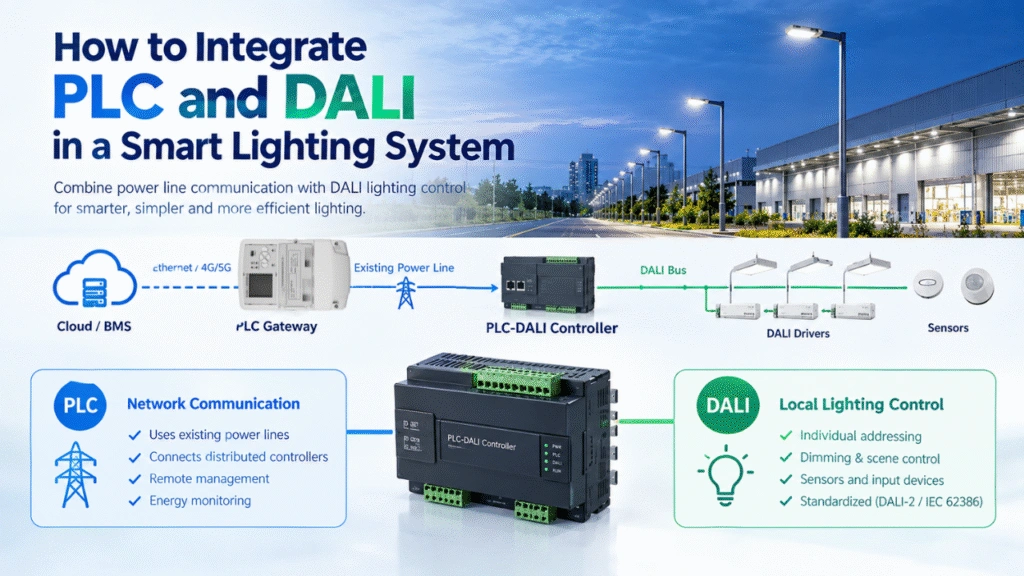
A typical hybrid system could be:
Cloud Platform
↓
PLC Gateway
↓
Power Line Network
↓
PLC-DALI Controller
↓
DALI Bus
↓
DALI LED Drivers
In this architecture:
- PLC provides network communication over the power infrastructure.
- The PLC-DALI controller acts as the local interface.
- DALI provides communication with compatible lighting devices.
- The DALI driver controls the LED luminaire.
This type of architecture can be useful when a project needs both distributed network communication and standardized local lighting control.
Your existing PLC + DALI integration architecture covers this subject in more detail.
TALQ vs DALI vs PLC: What Is the Difference?
The distinction can be summarized in three questions.
1. How does the central system communicate with different outdoor networks?
TALQ addresses this problem.
It provides a standardized application interface between CMS and Outdoor Device Networks.
2. How does a lighting controller communicate with a compatible lighting driver?
DALI addresses this problem.
It provides standardized digital lighting control.
3. How can distributed lighting controllers communicate over existing electrical infrastructure?
PLC addresses this problem.
It uses power lines as the communication medium.
This is why asking which one is “better” is often the wrong starting point.
The better question is:
Which communication layer does the project need?
TALQ vs DALI vs PLC Comparison Table
| Requirement | TALQ | DALI / DALI-2 | PLC |
|---|---|---|---|
| CMS interoperability | Strong | Not its primary purpose | Not its primary purpose |
| Outdoor network management | Yes | Limited/local | Through system architecture |
| Luminaire-level control | Through connected ODN | Yes | Through compatible controller |
| Uses power lines for communication | No | No | Yes |
| Dedicated local lighting bus | No | Yes | No |
| Multi-vendor CMS/ODN interoperability | Core purpose | Not its primary purpose | Depends on system |
| Individual lighting control | Via ODN | Yes | Via compatible controller |
| Dimming | Supported at application level | Yes | Through compatible hardware |
| Energy/status data | Supported | Supported through compatible devices | Supported through compatible controllers |
| Smart city integration | Core focus | Can participate | Can participate |
| Can be combined with other technologies | Yes | Yes | Yes |
Which Technology Should You Use?
There is no universal architecture for every smart lighting project.
Instead, start with the project requirements.
Choose a TALQ-based architecture when:
- A city needs interoperability between different outdoor device networks.
- Multiple vendors need to connect to one CMS.
- The project requires a standardized management interface.
- The system may expand to additional smart city applications.
- Vendor interoperability is an important procurement requirement.
TALQ is especially relevant when the main problem is system-level interoperability.
Consider DALI when:
- The project requires standardized lighting-device control.
- DALI-compatible LED drivers are already being used.
- Individual luminaire control is required.
- Local lighting control and device data are important.
- Sensors and other DALI-compatible control devices are part of the design.
DALI is especially relevant when the main problem is lighting-device control.
Consider PLC when:
- Existing electrical power lines are available.
- A large number of distributed lighting devices must communicate.
- Installing separate communication cables is undesirable or difficult.
- The project covers streets, tunnels, industrial facilities, or other infrastructure.
- A gateway-based network architecture is required.
- The electrical network is suitable for PLC communication.
PLC is especially relevant when the main problem is network communication over existing power infrastructure.
When Should You Combine TALQ, PLC and DALI?
A combined architecture may make sense when each layer solves a different requirement.
For example:
Layer 1 — Cloud and city management
TALQ
Provides interoperability between the CMS and outdoor device network.
Layer 2 — Infrastructure communication
PLC
Provides communication between the gateway and distributed lighting controllers through the power network.
Layer 3 — Local lighting control
DALI
Provides communication between the local controller and compatible lighting devices.
The complete architecture becomes:
CMS
↓
TALQ
↓
PLC Gateway
↓
Power Line Network
↓
PLC-DALI Controller
↓
DALI Driver
↓
LED Luminaire
This is not the only possible design, but it demonstrates why these technologies should not automatically be treated as competitors.
Example: Smart Street Lighting
Consider a city with thousands of LED streetlights. If you are a new beginner, can first see this article PLC vs Dali for Street Lighting.
The city wants:
- Centralized management
- Individual lamp control
- Energy monitoring
- Fault reporting
- Multi-vendor interoperability
- Minimal additional communication cabling
One possible architecture is:
Central Management Software
TALQ provides the standardized interface between the CMS and the outdoor lighting network.
↓
PLC Gateway
The gateway connects the management platform with the PLC network.
↓
PLC Network
PLC communication travels through the existing electrical infrastructure.
↓
PLC Lighting Controller
Each lighting controller receives commands and reports device information.
↓
DALI Driver
If the luminaire uses a DALI-compatible driver, the local controller can communicate with the driver through DALI.
↓
LED Luminaire
The driver controls the LED output.
This architecture separates the system into different functional layers instead of trying to make one protocol perform every task.
TALQ vs DALI vs PLC: Common Misconceptions
Is TALQ a replacement for PLC?
No.
TALQ is an application-level interface for managing Outdoor Device Networks. PLC can be one of the technologies used inside an Outdoor Device Network.
Is TALQ a replacement for DALI?
No.
TALQ and DALI can operate at different levels and can be integrated in the same smart outdoor lighting ecosystem.
The TALQ-DALI-Zhaga collaboration further demonstrates that these technologies can be combined.
Is PLC a lighting-control protocol?
Not by itself.
PLC describes the communication technology used to transmit data over power lines. The actual lighting-control functions depend on the PLC system, controller, driver, and application software.
Can DALI be used with PLC?
Yes.
A PLC-DALI controller or gateway can translate between commands received through a PLC network and DALI commands for local lighting devices.
Does every smart streetlight need TALQ, DALI, and PLC?
No.
A project may use:
- TALQ + wireless communication
- TALQ + PLC
- PLC + direct driver control
- PLC + DALI
- TALQ + PLC + DALI
- DALI without TALQ or PLC
The appropriate architecture depends on the project requirements.
How to Design a Smart Lighting Communication Architecture
Before selecting TALQ, DALI, PLC, or a combination, define the system from the top down.
Step 1: Define the management requirements
Determine what the CMS needs to control and monitor.
Examples include:
- ON/OFF
- Dimming
- Scheduling
- Energy data
- Fault alarms
- Device status
- Configuration
- Asset management
Step 2: Define the network layer
Determine how the distributed devices will communicate.
Possible technologies include:
- PLC
- Cellular
- Ethernet
- Wireless mesh
- Other wired or wireless networks
For large infrastructure projects, evaluate the existing electrical network, communication distance, noise environment, topology, and installation requirements before selecting PLC.
Step 3: Define the local lighting-control layer
Determine how the controller communicates with the LED driver.
Possible interfaces may include:
- DALI / DALI-2
- 0–10 V
- PWM
- Relay
- Proprietary digital interfaces
- Other supported control methods
Step 4: Define interoperability requirements
If different vendors, gateways, or outdoor device networks need to communicate with one CMS, evaluate whether TALQ is appropriate.
Step 5: Validate the complete architecture
Test the complete system rather than evaluating each protocol independently.
The test should include:
- Communication reliability
- Device discovery
- Dimming response
- Status reporting
- Fault reporting
- Power cycling
- Network recovery
- Driver compatibility
- Gateway performance
- Cloud communication
- Long-term operation
The Future of Smart Lighting Is Layered
Modern smart lighting systems increasingly combine multiple standards and communication technologies rather than relying on one technology for every function.
A system may use:
TALQ for interoperability,
PLC for infrastructure communication,
DALI / DALI-2 for local lighting control,
and a cloud platform for centralized monitoring and management.
The ongoing collaboration between TALQ, DALI, and Zhaga illustrates this trend toward interoperability across different layers of the smart outdoor lighting ecosystem.
For system designers, the important question is therefore not simply “TALQ vs DALI vs PLC.”
It is:
Which technology should operate at each layer of the smart lighting architecture?