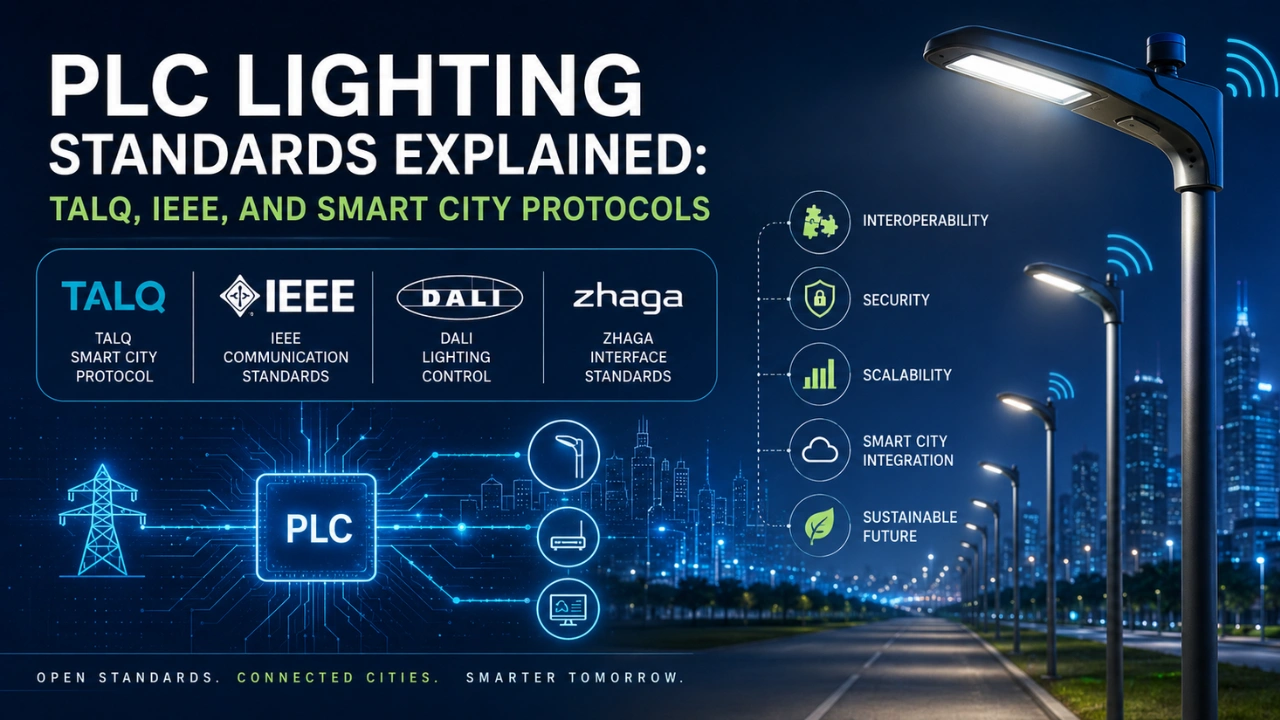
Power Line Communication (PLC) technology is becoming a key foundation for modern smart lighting systems. As cities, airports, ports, highways, and industrial facilities move toward intelligent infrastructure, understanding PLC lighting standards is essential for ensuring interoperability, scalability, cybersecurity, and long-term investment protection.
For smart lighting manufacturers, system integrators, and city planners, standards such as TALQ, IEEE, DALI, Zhaga, and smart city communication protocols help create connected lighting ecosystems that work seamlessly across different devices and platforms.
In this guide, we explain the most important PLC lighting standards, how they work together, and why they matter for future-ready smart lighting deployments.
What Are PLC Lighting Standards?
PLC lighting standards are technical specifications and communication frameworks that define how lighting devices communicate, exchange data, and integrate into smart city systems using power line communication networks.
These standards help ensure:
- Interoperability between vendors
- Stable communication performance
- Scalable smart city deployment
- Cybersecurity and data protection
- Easier maintenance and upgrades
- Long-term infrastructure compatibility
Without standardized communication, smart lighting systems can become isolated, difficult to expand, and expensive to maintain.
Why Standards Matter in Smart Lighting Projects
Smart lighting infrastructure often operates for 10–20 years. Cities and infrastructure operators need systems that remain compatible with future technologies.
Standardized PLC lighting systems provide:
Vendor Flexibility
Cities are not locked into a single supplier.
Easier Integration
Lighting can connect with:
- Traffic systems
- Environmental sensors
- EV charging infrastructure
- Smart parking systems
- Security platforms
- Building management systems
Lower Maintenance Costs
Standardized systems simplify troubleshooting and replacement.
Better Scalability
Future expansion becomes easier without rebuilding communication infrastructure.
Understanding TALQ Smart Lighting Standard
What Is TALQ?
The TALQ Consortium developed the TALQ Smart City Protocol to standardize communication between smart city applications and central management software (CMS).
TALQ Consortium
TALQ enables interoperability between:
- Central management systems
- Outdoor lighting networks
- Smart city devices
- IoT applications
The protocol allows cities to manage equipment from multiple vendors within one unified platform.
Key Features of TALQ Protocol
Multi-Vendor Compatibility
TALQ-certified devices can operate together across different manufacturers.
Standardized APIs
TALQ uses standardized interfaces for data exchange and remote management.
Smart City Expansion Support
Beyond lighting, TALQ supports:
- Waste management
- Environmental monitoring
- Parking systems
- Traffic sensors
- EV infrastructure
Cloud and Edge Integration
Modern TALQ implementations support both cloud-based and edge-controlled smart city architectures.
How TALQ Works with PLC Lighting
PLC networks provide the communication backbone, while TALQ standardizes higher-level system management.
Typical structure:
- PLC communication transmits data through power lines
- Streetlight controllers collect operational data
- Gateways connect local networks to central platforms
- TALQ protocol standardizes communication with CMS software
This combination enables centralized monitoring and control of large lighting networks.
IEEE Standards Relevant to PLC Lighting
The IEEE organization develops many communication and networking standards relevant to smart lighting systems.
Institute of Electrical and Electronics Engineers
IEEE 1901 – Broadband over Power Line
What Is IEEE 1901?
IEEE 1901 defines broadband communication over power lines.
It supports:
- High-speed data transmission
- Smart grid communication
- Industrial networking
- Smart infrastructure systems
For PLC lighting, IEEE 1901 can support:
- Real-time monitoring
- Video-capable infrastructure
- Edge analytics
- Large-scale IoT communication
IEEE 802 Standards in Smart Lighting
Several IEEE 802 standards support connected smart city infrastructure:
IEEE 802.15.4
Widely used for low-power IoT communication.
IEEE 802.3
Ethernet networking integration for gateways and controllers.
IEEE 802.11
Wi-Fi connectivity for hybrid smart lighting systems.
These standards often coexist alongside PLC communication networks.
DALI and PLC Lighting Integration
What Is DALI?
DALI (Digital Addressable Lighting Interface) is a lighting control protocol used for fixture-level communication.
DALI Alliance
DALI focuses on:
- Individual luminaire control
- Dimming
- Diagnostics
- Scene management
- Energy monitoring
DALI vs PLC Communication
| Feature | DALI | PLC |
|---|---|---|
| Communication Scope | Fixture-level | Network-level |
| Transmission Medium | Dedicated control wiring | Existing power lines |
| Primary Use | Lighting control | Data communication |
| Infrastructure Cost | Additional wiring | Minimal extra wiring |
| Smart City Integration | Limited alone | High |
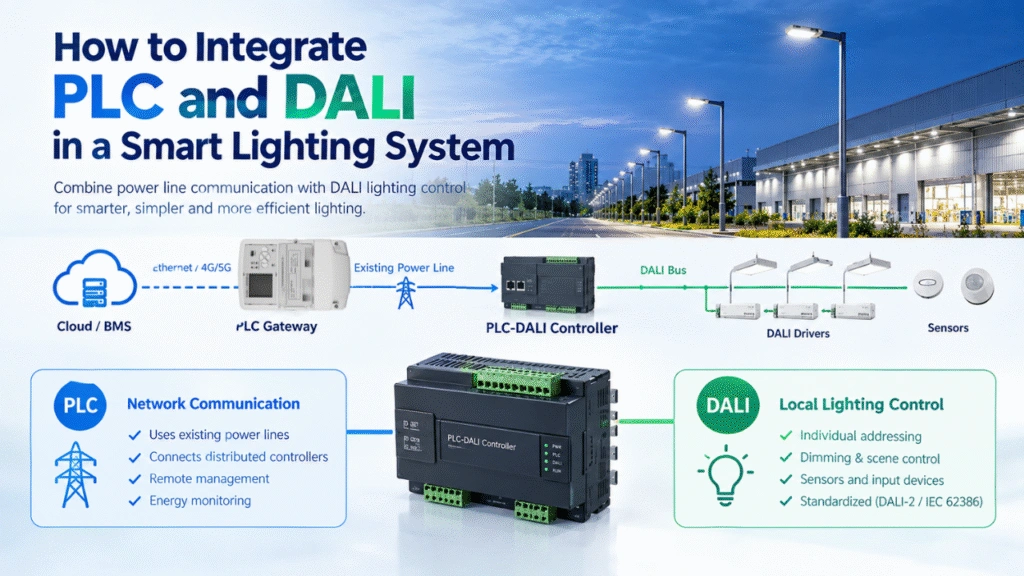
In many deployments, DALI and PLC work together rather than compete.
Example:
- DALI controls luminaires locally
- PLC connects streetlights to central systems
Zhaga Standards in Smart Lighting
What Is Zhaga?
Zhaga standardizes interfaces for LED lighting components and smart lighting modules.
Zhaga Consortium
Zhaga standards help ensure compatibility between:
- Sensors
- Controllers
- LED drivers
- Smart modules
Zhaga Book 18 and Smart Controllers
Zhaga Book 18 defines standardized smart lighting connectors for outdoor luminaires.
Benefits include:
- Plug-and-play smart nodes
- Easier upgrades
- Reduced maintenance
- Faster deployment
Many PLC smart lighting systems now support Zhaga-compliant hardware.
Comparison of Major PLC Lighting Standards
| Standard | Primary Purpose | Main Application | Communication Scope | Smart City Integration | Key Advantage |
|---|---|---|---|---|---|
| TALQ | Smart city interoperability | Central management systems | Platform-level | Very High | Multi-vendor compatibility |
| IEEE 1901 | Power line communication | Broadband PLC networking | Network-level | High | High-speed PLC data transmission |
| DALI | Lighting control | Luminaire management | Fixture-level | Medium | Precise lighting control |
| Zhaga | Hardware interface standardization | Smart lighting modules | Device-level | Medium | Plug-and-play compatibility |
Smart City Communication Protocols Used with PLC Lighting
Modern smart lighting systems often combine multiple protocols.
MQTT
MQTT is a lightweight IoT messaging protocol commonly used in smart city platforms.
Benefits:
- Low bandwidth usage
- Real-time messaging
- Cloud compatibility
- Efficient IoT communication
BACnet
BACnet is widely used in building automation systems.
ASHRAE
It helps integrate:
- HVAC
- Lighting
- Energy systems
- Security systems
Modbus
Modbus remains popular in industrial automation and infrastructure control systems.
PLC lighting gateways may support Modbus integration for industrial environments.
IPv6 for Smart Lighting Networks
IPv6 enables large-scale device addressing in smart cities.
Benefits include:
- Massive scalability
- Improved routing
- Better IoT compatibility
- Future-ready infrastructure
Cybersecurity Standards for PLC Smart Lighting
As lighting systems become connected infrastructure, cybersecurity becomes critical.
Important security measures include:
- Encrypted communication
- Secure authentication
- Role-based access control
- Firmware update security
- Network segmentation
Cities increasingly require compliance with cybersecurity frameworks during procurement.
Open Standards vs Proprietary Smart Lighting Systems
Open Standards Advantages
- Multi-vendor compatibility
- Long-term flexibility
- Lower risk of vendor lock-in
- Easier expansion
Proprietary Systems Advantages
- Faster initial deployment
- Simplified ecosystem management
- Vendor-specific optimization
Most modern smart city projects now prefer open or hybrid architectures.
PLC vs Wireless Smart Lighting Communication
| Feature | PLC Lighting | Wireless Lighting |
|---|---|---|
| Communication Medium | Existing power lines | RF/Wi-Fi/LoRa/Zigbee |
| Additional Wiring | Minimal | None |
| Signal Stability | High in infrastructure environments | Can face RF interference |
| Installation Cost | Lower for retrofit projects | Lower for isolated deployments |
| Scalability | Excellent for large infrastructure | Excellent for flexible layouts |
| Maintenance | Centralized infrastructure | Battery/network management required |
| Smart City Integration | Strong | Strong |
| Best Use Cases | Roads, ports, airports, tunnels | Campuses, temporary systems, flexible deployments |
How PLC Lighting Standards Support Smart Cities
Standardized PLC lighting infrastructure enables cities to build broader smart city ecosystems.
Applications include:
- Adaptive street lighting
- Traffic optimization
- Environmental sensing
- Public safety monitoring
- EV charging integration
- Smart parking systems
- Infrastructure analytics
Lighting poles increasingly become multifunction smart city nodes.
Future Trends in PLC Lighting Standards
AI-Driven Lighting Networks
Future standards may support AI-powered predictive maintenance and adaptive lighting optimization.
Edge Computing Integration
More processing will move closer to devices for faster response times.
Digital Twin Infrastructure
Smart lighting systems may integrate into city-wide digital twins.
Unified Smart City Platforms
Standards will increasingly focus on interoperability across all urban infrastructure systems.
Choosing Standards-Compliant PLC Lighting Solutions
When evaluating PLC smart lighting systems, consider:
Standards Compatibility
Verify support for:
- TALQ
- IEEE communication standards
- DALI
- Zhaga
- MQTT
- IPv6
Upgrade Flexibility
Choose systems designed for future expansion.
Cybersecurity Features
Ensure strong encryption and secure remote management.
Vendor Ecosystem
Prefer solutions with proven interoperability.