
Modern airports operate 24/7, requiring highly reliable, energy-efficient, and intelligent lighting systems across runways, taxiways, terminals, parking areas, and service zones. Traditional lighting control methods often struggle with:
- Complex infrastructure
- Long-distance communication
- High maintenance costs
- Reliability issues in critical environments
This is where PLC (Power Line Communication) smart lighting becomes a game-changing solution.
By using existing electrical power lines to transmit control signals, PLC lighting eliminates the need for additional communication wiring while delivering stable, real-time lighting control across large airport environments.
Why Airports Need Advanced Lighting Systems
Airport lighting is not just about illumination — it is directly linked to aviation safety, operational efficiency, and regulatory compliance.
Key Challenges in Airport Lighting
- Large-scale infrastructure (runways, terminals, parking, logistics zones)
- Long-distance communication requirements
- Harsh environments (EMI, weather, electrical noise)
- Strict reliability standards (zero failure tolerance)
- High energy consumption
Wireless lighting systems (e.g., RF, Zigbee, 4G) often face signal interference and stability issues, especially in complex or enclosed environments.
What Is PLC Lighting for Airports?
PLC lighting systems use power lines as both energy and communication channels, enabling seamless control without additional communication infrastructure.
👉 In simple terms:
The same cable powering airport lights also carries control data.
Core Components
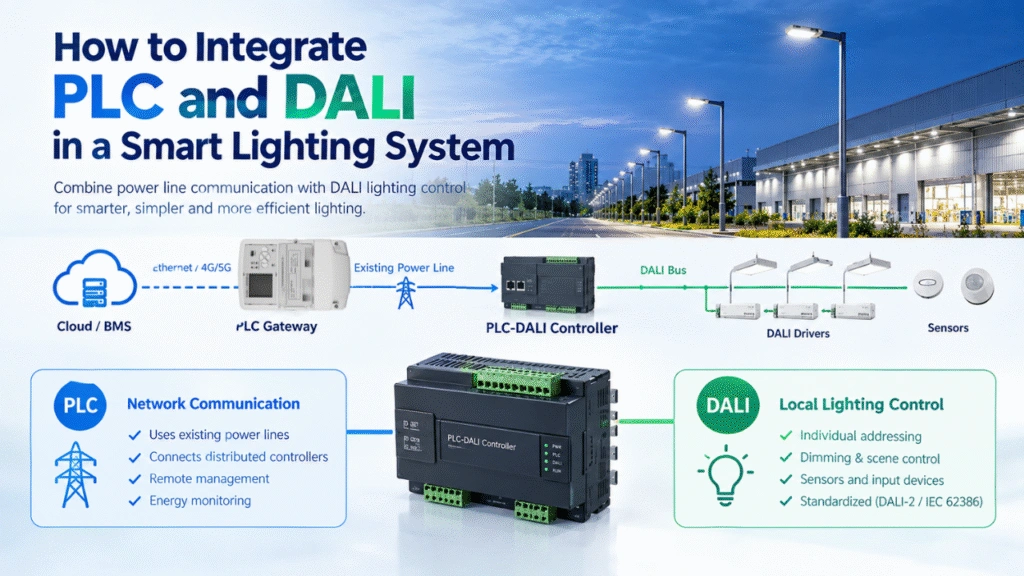
A typical airport PLC lighting system includes:
-
Central Management System (CMS)
Real-time monitoring, automation, and control -
PLC Concentrator (Gateway)
Sends commands through power lines -
Lamp Controllers (per fixture)
Enable dimming, switching, and status reporting -
Power Line Communication Network
Uses existing electrical wiring -
Sensors & AI Systems (optional)
Motion detection, daylight sensing, traffic analytics
This architecture enables two-way communication and centralized control across thousands of lighting points.
Key Advantages of PLC Lighting in Airports
1. No Additional Communication Cabling
Airports are complex environments where installing new communication lines is costly and disruptive.
✔ PLC uses existing power infrastructure
✔ Ideal for retrofit and expansion projects
✔ Faster deployment, lower CAPEX
2. Ultra-Reliable Communication
Airport environments are filled with:
- Metal structures
- Electrical interference
- Long-distance circuits
PLC avoids wireless instability by operating directly over power lines, providing consistent communication even in harsh conditions.
3. Long-Distance Control Capability
Airports often span kilometers of lighting networks.
✔ PLC supports long-distance communication without repeaters
✔ Suitable for runways, taxiways, and perimeter lighting
✔ No signal attenuation issues like RF systems
4. Centralized Monitoring & Smart Control
Operators can manage all lighting from a single platform:
- Remote ON/OFF and dimming
- Scheduling (day/night/flight-based)
- Zone/group control
- Emergency lighting scenarios
5. Energy Efficiency & Cost Savings
PLC enables intelligent lighting strategies:
- Adaptive dimming based on activity
- Daylight harvesting
- Occupancy-based control (parking, terminals)
👉 Real-world PLC projects show significant energy savings through automation and dimming strategies.
6. Real-Time Fault Detection
Airport maintenance is critical.
PLC systems provide:
- Instant fault alerts
- Exact luminaire location
- Predictive maintenance data
✔ Reduced downtime
✔ Lower maintenance cost
✔ Improved safety compliance
Airport Application Scenarios
✈️ Runway & Taxiway Lighting
- Long-distance, high-reliability control
- Adaptive brightness based on visibility
🏢 Terminal & Apron Lighting
- Centralized scheduling and energy optimization
- Integration with building management systems
🚗 Parking & Ground Transport Areas
- Occupancy-based lighting
- Smart dimming and energy analytics
🚧 Service Roads & Logistics Zones
- Robust communication in industrial conditions
- Scalable infrastructure for expansion
PLC vs Wireless Lighting in Airports
| Feature | PLC Lighting | Wireless (Zigbee / 4G / RF) |
|---|---|---|
| Communication Medium | Power lines | Air (RF signal) |
| Reliability | Very high | Medium (interference-prone) |
| Infrastructure Cost | Low | Medium–High |
| Long-Distance Performance | Excellent | Limited |
| Maintenance | Low | Medium |
| Suitability for Airports | ⭐⭐⭐⭐⭐ | ⭐⭐ |
👉 In critical environments like airports, reliability outweighs convenience, making PLC the preferred choice.
Why PLC Lighting Is Ideal for Airport Infrastructure
PLC lighting aligns perfectly with airport requirements:
- ✔ Mission-critical reliability
- ✔ Large-scale scalability
- ✔ Low installation complexity
- ✔ Smart energy management
- ✔ Future-ready integration (AI, IoT, smart airport systems)
It essentially turns the airport’s electrical network into a fully intelligent lighting control system.
Future Trends: Smart Airports with PLC
As airports evolve into smart infrastructure hubs, PLC lighting will play a key role in:
- AI-driven adaptive lighting
- Integration with airport IoT platforms
- Energy optimization and carbon reduction
- Predictive maintenance systems
PLC is not just a lighting solution — it is a foundation for smart airport ecosystems.