PLC lighting is widely used in smart lighting systems, but understanding PLC lighting limitations is critical before choosing it for your project. In some scenarios, PLC is not the right choice and may lead to communication issues, higher costs, or reduced system performance.
Quick Answer
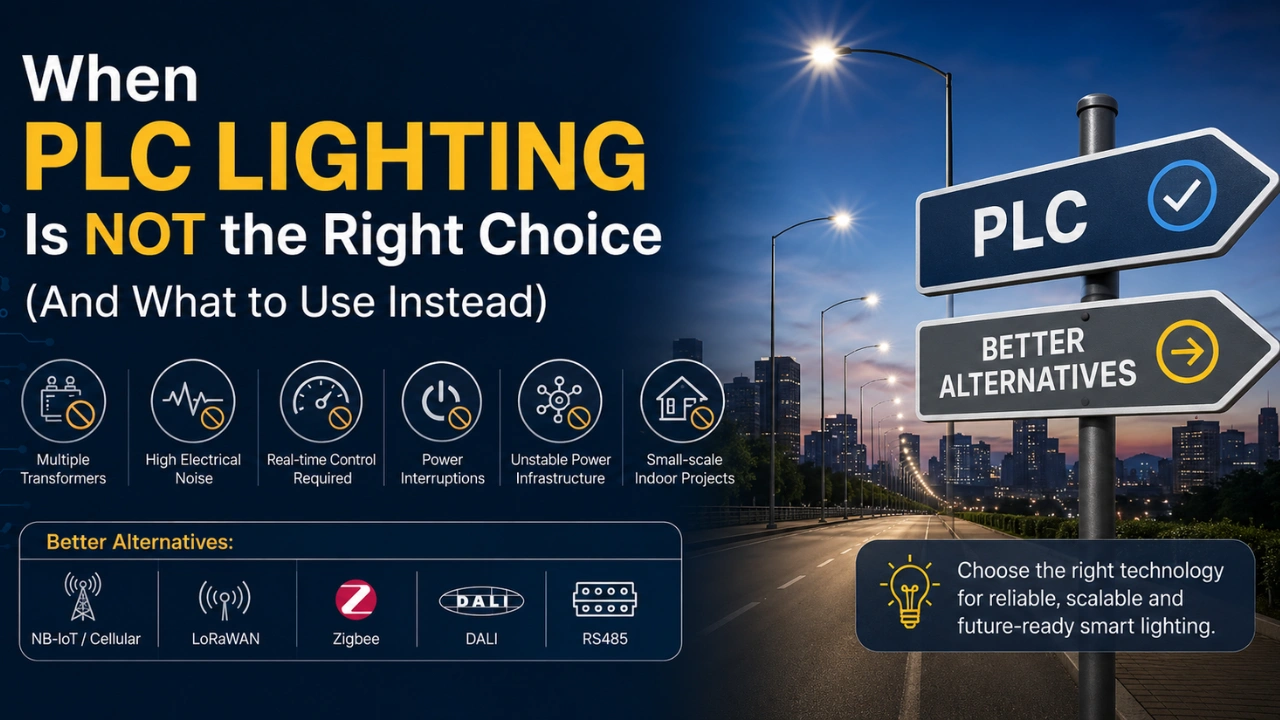
PLC lighting is NOT the right choice when:
- Power networks are separated by transformers
- Electrical noise is high (industrial environments)
- Real-time control (<100 ms) is required
- Communication must work during power outages
- Projects are small-scale or indoor
- Power infrastructure is unstable or incomplete
Better alternatives include:
RS485 → noise-resistant wired systems
NB-IoT / Cellular → wide-area, independent communication
LoRaWAN → long-range, low power
Zigbee → indoor or mesh networks
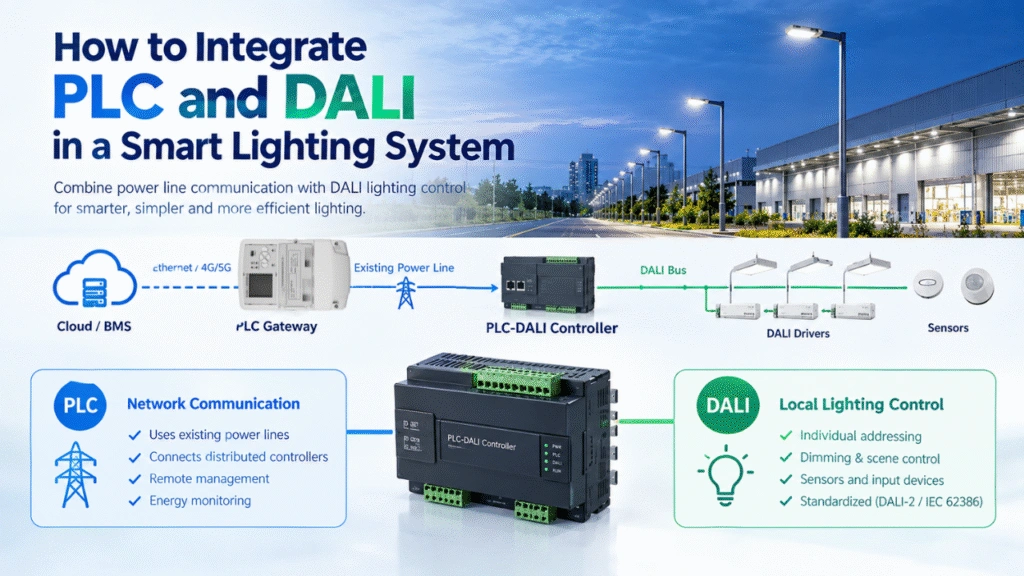
DALI → real-time lighting control
What This Means in Real Projects
Power Line Communication (PLC) lighting is widely used in:
- Street lighting
- Tunnel lighting
- Industrial parks
- Retrofit infrastructure
Because it delivers:
- No extra communication wiring
- Centralized control
- High reliability over long distances
However, PLC is infrastructure-dependent.
When the electrical environment changes, its performance can drop significantly.
This guide helps engineers and decision-makers quickly determine when PLC should NOT be selected.
1. PLC Lighting Limitations in Multi-Transformer Networks
Problem
PLC signals typically cannot pass through transformers, which creates isolated communication zones.
Result
- Devices cannot communicate across sections
- System becomes fragmented
- Additional hardware increases cost and complexity
Best Alternative
- NB-IoT / Cellular lighting control
- LoRaWAN networks
👉 These technologies ignore power topology and connect directly to the cloud.
2. PLC Lighting Limitations in High Electrical Noise Environments
Problem
In industrial environments, power lines carry interference from:
- Motors
- Inverters
- Heavy equipment
Result
- Signal attenuation
- Packet loss
- Unstable communication
Best Alternative
- RS485 (shielded communication)
- Zigbee mesh networks
👉 Separating communication from power lines improves reliability.
3. When Real-Time Control Is Required
Problem
PLC is not designed for ultra-low latency communication.
Result
- Delays in command execution
- Inconsistent synchronization
Best Alternative
- DALI systems
- Ethernet/IP-based lighting control
👉 These systems provide deterministic and fast response times.
4. When Communication Must Work During Power Outages
Problem
PLC depends entirely on active power lines.
Result
- No communication when power is off
- No remote monitoring during outages
Best Alternative
- NB-IoT / 4G / 5G controllers (battery-supported)
👉 Enables continuous connectivity for critical systems.
5. When Power Infrastructure Is Unstable or Incomplete
Problem
PLC requires stable and continuous wiring.
Result
- Difficult deployment
- Frequent communication failures
Best Alternative
- LoRaWAN + solar lighting systems
- Cellular smart controllers
👉 Ideal for rural or early-stage infrastructure projects.
6. When the Project Is Small or Indoor
Problem
PLC is optimized for large-scale infrastructure, not compact environments.
Result
- Higher cost than necessary
- Over-engineered system
Best Alternative
- Zigbee / Bluetooth Mesh
- DALI (commercial buildings)
👉 Simpler and more cost-effective for indoor use.
When PLC Lighting IS the Right Choice
PLC is highly effective when:
- Power network is continuous (no transformer barriers)
- Projects are large-scale (roads, tunnels, industrial zones)
- Existing wiring must be reused
- High reliability is required with minimal installation cost
This is why PLC is commonly used in:
- Smart street lighting
- Tunnel lighting systems
- Industrial facility lighting
PLC vs Other Technologies
| Scenario | PLC | Better Option |
|---|---|---|
| Continuous power network | ✅ Best choice | — |
| Multiple transformers | ❌ | NB-IoT / LoRaWAN |
| High EMI environment | ⚠️ | RS485 / Zigbee |
| Real-time control | ❌ | DALI / Ethernet |
| Power outages | ❌ | Cellular |
| Indoor small projects | ❌ | Zigbee / DALI |
Final Answer
PLC lighting is best used in stable, large-scale infrastructure with continuous power networks.
It should be avoided when:
- Power topology is complex
- Communication reliability is affected by interference
- Real-time performance is required
- Or independent connectivity is needed
👉 In these cases, wireless or dedicated control protocols provide better performance and flexibility.