Emergency lighting systems are essential for ensuring safe evacuation during power failures, fire incidents, and other emergency situations. However, traditional emergency lighting installations often rely on manual inspections, periodic maintenance checks, and standalone monitoring systems, making fault detection slow and labor-intensive.
Power Line Communication (PLC) technology offers a smarter solution by utilizing existing power cables for both power delivery and data communication. This eliminates the need for additional communication wiring while enabling centralized monitoring and automatic fault detection.
At MicroNature, our PLC Emergency Lighting Solution integrates the MN-L80A PLC Module into emergency lighting systems, allowing operators to monitor every emergency light and exit sign remotely through a cloud-based management platform.
What Is a PLC Emergency Lighting System?
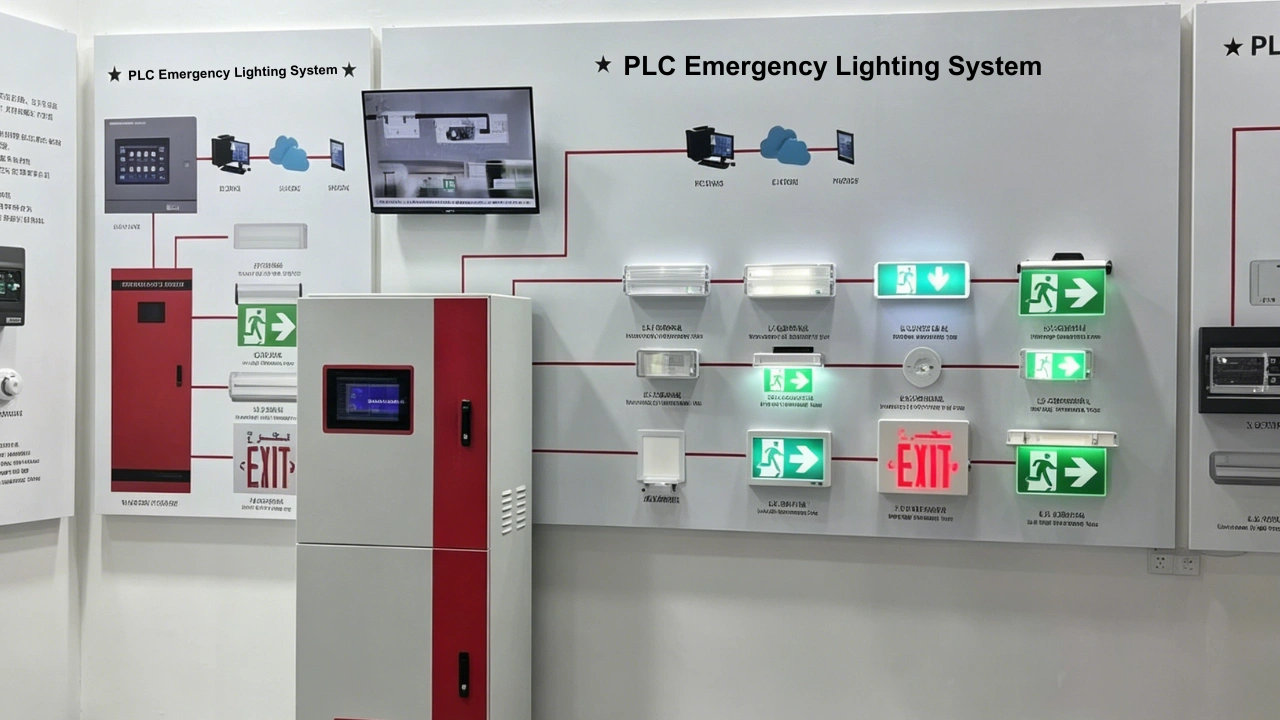
A PLC Emergency Lighting System combines:
- Central Battery System (CBS)
- Emergency Exit Signs
- Emergency Luminaires
- PLC Communication Modules
- Cloud Monitoring Platform
- Central Management Software
The system uses existing power lines as the communication medium, enabling two-way communication between the central control unit and every emergency lighting fixture.
Instead of sending technicians to inspect each emergency light manually, the system automatically performs health checks and reports the operational status of every fixture in real time.
System Architecture
Central Control Unit (MCU)
The Main Control Unit (MCU) serves as the system’s communication and management center.
Inside the MCU:
- MN-L80A PLC Module operates as the CCO (Central Coordinator)
- Connects to the cloud platform through Ethernet, Wi-Fi, or 4G/5G
- Manages all emergency lighting nodes
- Executes automatic inspection routines
- Stores alarm and operation records
Emergency Lights
Each emergency luminaire or exit sign contains:
- PLC Module operating as STA (Station)
- Emergency driver
- Battery monitoring interface
- Status reporting function
Every emergency light becomes an intelligent network node connected through the existing power cable.
How PLC Emergency Lighting System Works
The communication architecture follows a CCO-STA topology.
CCO Node
Installed inside the central battery control cabinet.
Functions include:
- Network management
- Device registration
- Device polling
- Fault detection
- Data collection
- Cloud communication
STA Nodes
Installed inside emergency lights and exit signs.
Functions include:
- Receiving commands from the CCO
- Reporting operating status
- Reporting battery condition
- Reporting lamp failures
- Responding to self-test requests
Because communication occurs through existing power lines, no additional RS485, Ethernet, Zigbee, LoRaWAN, or wireless infrastructure is required.
Automatic 30-Minute Inspection Process
One of the most important features of the PLC Emergency Lighting System is automated inspection.
Inspection Workflow
Every 30 minutes:
- The CCO inside the MCU initiates a system-wide inspection.
- Polling commands are transmitted through power lines.
- Each STA node receives the command.
- Emergency lights perform self-diagnosis.
- Operational data is collected.
- Status reports are sent back to the CCO.
- Data is uploaded to the cloud software platform.
Parameters Checked
The system can detect:
- Lamp operating status
- LED failure
- Driver failure
- Battery charging status
- Battery health condition
- Communication status
- Emergency mode functionality
- Power supply abnormalities
- Device offline conditions
If any abnormal condition is detected, the cloud platform immediately generates an alarm notification.
Real-Time Fault Detection
Traditional emergency lighting systems often discover failures only during scheduled inspections.
With PLC communication, faults are identified automatically.
Typical Fault Alarms
| Fault Type | Description |
|---|---|
| Lamp Failure | LED module damaged or not operating |
| Battery Failure | Battery capacity below threshold |
| Communication Failure | Device disconnected from PLC network |
| Driver Failure | Emergency driver malfunction |
| Charging Failure | Battery not charging properly |
| Power Supply Failure | Input power abnormal |
| Emergency Test Failure | Fixture unable to enter emergency mode |
Maintenance personnel receive immediate notifications through the cloud platform, reducing response time and improving system reliability.
Cloud-Based Emergency Lighting Management
The PLC Emergency Lighting System supports cloud-based management and remote monitoring.
Cloud Platform Functions
Real-Time Monitoring
Operators can view:
- Online devices
- Offline devices
- Alarm status
- Battery status
- Network health
Remote Testing
The platform can initiate:
- Functional tests
- Duration tests
- Emergency mode tests
- Communication diagnostics
Historical Data Records
The system automatically records:
- Alarm history
- Device operation logs
- Inspection reports
- Maintenance records
- Test reports
Multi-Site Management
Suitable for:
- Airports
- Hospitals
- Shopping malls
- Office buildings
- Factories
- Warehouses
- Tunnels
- Transportation hubs
- Smart campuses
Why Use PLC for Emergency Lighting?
No Additional Communication Wiring
PLC utilizes existing power cables.
Benefits include:
- Lower installation cost
- Faster deployment
- Simplified retrofit projects
- Reduced labor requirements
High Reliability
Emergency lighting systems require dependable communication.
PLC offers:
- Stable wired communication
- Better penetration than wireless signals
- Strong resistance to building obstacles
- Reliable operation in complex indoor environments
Easy Retrofit
Existing buildings can upgrade to smart emergency lighting without major rewiring.
This is particularly valuable for:
- Hospitals
- Schools
- Commercial buildings
- Metro stations
- Industrial facilities
Centralized Maintenance
Maintenance teams can identify the exact location and fault type before arriving on-site.
Benefits include:
- Reduced inspection workload
- Faster fault resolution
- Lower maintenance costs
- Improved safety compliance
Typical Deployment Scenario
Shopping Mall Emergency Lighting
A shopping mall may have hundreds or thousands of emergency lights distributed across multiple floors.
Using PLC technology:
- One MCU contains the MN-L80A CCO module.
- Each emergency light contains a PLC STA module.
- Every 30 minutes, the system performs automatic inspections.
- Fault information is uploaded to the cloud platform.
- Maintenance staff receive alerts immediately.
- Inspection reports are generated automatically.
This transforms emergency lighting from a manually maintained system into an intelligent, self-monitoring safety infrastructure.
System Benefits at a Glance
| Feature | PLC Emergency Lighting Solution |
|---|---|
| Communication Medium | Existing Power Lines |
| Additional Communication Wiring | Not Required |
| Centralized Monitoring | Yes |
| Automatic Inspection | Every 30 Minutes |
| Cloud Monitoring | Yes |
| Real-Time Alarm Reporting | Yes |
| Remote Testing | Yes |
| Historical Reports | Yes |
| Retrofit Friendly | Yes |
| Suitable for Large Buildings | Yes |
Why Choose MicroNature PLC Modules?
MicroNature’s PLC communication modules are designed for industrial and commercial IoT applications.
MN-L80A Advantages
- Stable PLC communication over existing power lines
- Fast network establishment
- Industrial-grade reliability
- Cloud platform integration support
- Remote monitoring capability
- Open API integration
- Suitable for emergency lighting and smart building applications
The same PLC technology has been successfully applied in:
- Smart street lighting
- Tunnel lighting
- Warehouse lighting
- Industrial facilities
- Smart city infrastructure
- Energy management systems