Power Line Communication (PLC) has become one of the most practical communication technologies for smart lighting, industrial automation, smart grids, EV charging, and building management systems. Instead of installing dedicated communication cables, PLC transmits data through existing power lines, significantly reducing deployment costs.
However, not all PLC systems use the same communication method. Two of the most common modulation technologies are Orthogonal Frequency Division Multiplexing (OFDM) and Frequency Shift Keying (FSK).
Choosing between OFDM and FSK affects your network’s speed, communication distance, resistance to electrical noise, and overall system performance.
This guide explains the differences between OFDM and FSK, compares their strengths and weaknesses, and helps engineers determine which technology is best for their Power Line Communication project.
What is FSK in Power Line Communication?
FSK (Frequency Shift Keying) is one of the earliest digital modulation techniques used in PLC systems.
Instead of changing signal amplitude, FSK represents digital bits by switching between different carrier frequencies.
For example:
- Frequency A = Binary 0
- Frequency B = Binary 1
Because the receiver only needs to detect which frequency is present, FSK is simple, reliable, and inexpensive to implement.
Advantages of FSK
- Simple hardware design
- Low processing requirements
- Low power consumption
- Excellent long-distance transmission
- Reliable under light communication loads
Limitations of FSK
- Very low data rate
- Limited bandwidth
- Lower spectral efficiency
- Poor performance in complex multi-path environments
- Difficult to support large IoT networks
FSK works well for applications that only transmit small amounts of data, such as simple meter reading or basic remote switching.
What is OFDM in Power Line Communication?
OFDM (Orthogonal Frequency Division Multiplexing) is a modern modulation technology used in broadband and high-performance PLC systems. If you are a new user, please see our article PLC Module vs PLC Chipset: Key Differences Explained.
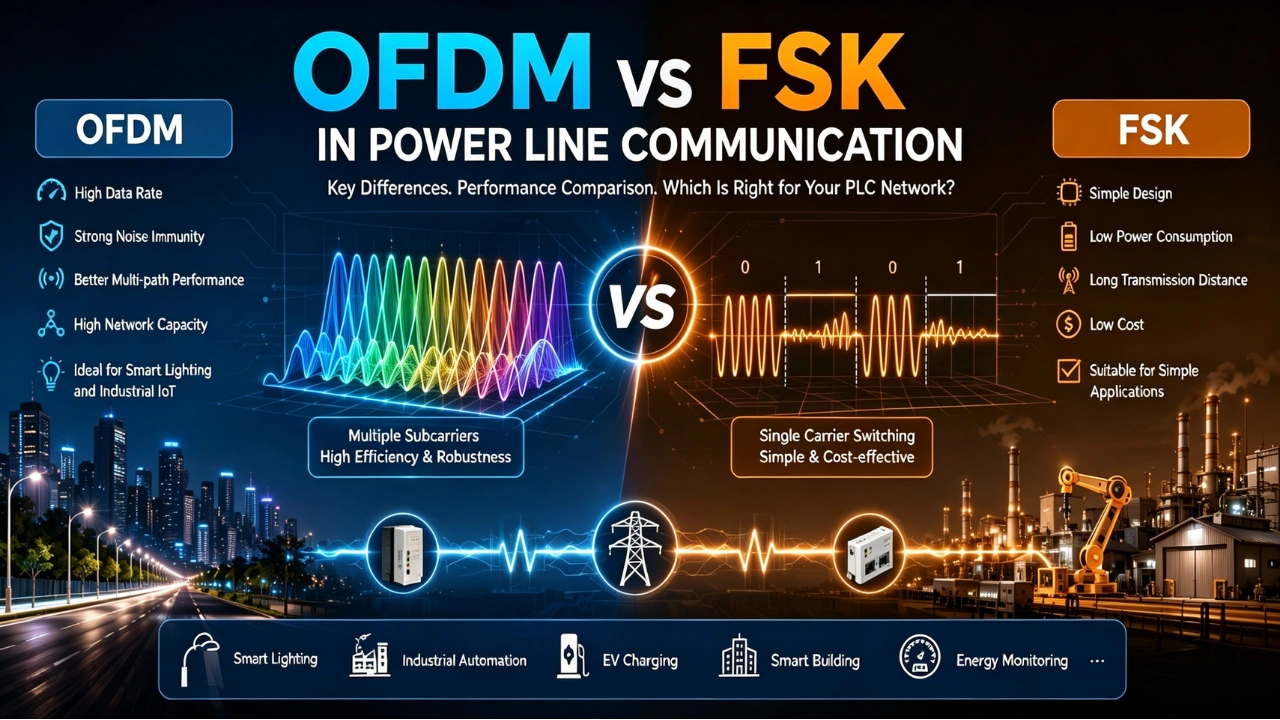
Instead of transmitting data on one carrier frequency, OFDM divides the available bandwidth into dozens or even hundreds of orthogonal subcarriers.
Each subcarrier carries part of the information simultaneously.
This provides much higher communication efficiency while improving resistance to interference.
Modern PLC standards such as IEEE 1901 and G.hn widely adopt OFDM because of its superior performance.
Advantages of OFDM
Compared with FSK, OFDM offers several significant advantages.
Higher Data Rates
OFDM supports hundreds of kilobits to hundreds of megabits per second depending on the PLC standard.
This makes it suitable for:
- Smart lighting control
- Video surveillance
- AI edge devices
- Industrial IoT
- Smart buildings
Better Noise Immunity
Power lines contain significant electrical noise from:
- Motors
- Variable frequency drives
- LED drivers
- Air conditioners
- Switching power supplies
OFDM can automatically avoid noisy frequencies while continuing communication on clean subcarriers.
This greatly improves network reliability.
Superior Multi-path Performance
Power lines naturally create signal reflections.
Instead of treating reflections as interference, OFDM uses advanced signal processing to compensate for them.
This improves communication quality in large buildings and complex electrical networks.
Higher Network Capacity
One OFDM PLC network can support hundreds or thousands of devices depending on system architecture.
This is ideal for smart city lighting deployments where thousands of street lights communicate simultaneously.
OFDM vs FSK: Side-by-SSide Comparison
| Feature | OFDM | FSK |
|---|---|---|
| Communication Speed | Very High | Low |
| Bandwidth Efficiency | Excellent | Poor |
| Noise Immunity | Excellent | Moderate |
| Multi-path Resistance | Excellent | Weak |
| Processing Complexity | High | Low |
| Hardware Cost | Higher | Lower |
| Network Capacity | Large | Small |
| Best Applications | Smart Lighting, Industrial IoT, Smart Grid | Simple Remote Control, Meter Reading |
Signal Transmission Comparison
FSK
FSK uses one carrier frequency at a time.
If interference occurs on that frequency, communication quality drops significantly.
OFDM
OFDM distributes data across many narrow subcarriers.
If several frequencies become noisy, only those subcarriers are affected while the remaining channels continue transmitting data.
This makes OFDM far more robust in electrically noisy environments.
Performance in Smart Lighting Systems
Smart lighting systems require:
- Real-time dimming
- Group control
- Fault reporting
- Energy monitoring
- OTA firmware updates
- Remote diagnostics
These applications continuously exchange data between gateways and hundreds of luminaires.
OFDM is better suited because it provides:
- Faster response times
- Lower packet loss
- Higher throughput
- Greater scalability
- Stable communication under electrical interference
FSK can still work for small installations but becomes inefficient as network size grows.
Industrial Environment Comparison
Factories often generate heavy electromagnetic interference. How to Integrate a PLC Module into Embedded Systems is important to study.
Examples include:
- Welding equipment
- Large motors
- Frequency converters
- High-power machinery
OFDM adapts dynamically to changing channel conditions, making it much more reliable in industrial environments.
FSK may require repeated retransmissions when interference becomes severe.
Communication Distance
One common misconception is that OFDM always has a shorter transmission distance.
In reality, transmission distance depends on:
- Line quality
- Noise level
- Coupling circuit
- Transmit power
- Frequency band
- PLC chipset design
Many modern OFDM PLC systems achieve communication distances comparable to or better than traditional FSK systems while delivering significantly higher data throughput.
Which Technology Uses Less Power?
FSK generally consumes less processing power because of its simple modulation scheme.
OFDM requires:
- FFT processing
- Channel estimation
- Error correction
- Adaptive modulation
Modern PLC chipsets integrate dedicated DSP hardware, making the power consumption difference much smaller than in earlier generations.
Which Technology Is Better for Smart Cities?
For modern smart city infrastructure, OFDM has become the preferred solution.
It supports:
- Large-scale street lighting
- Traffic management
- EV charging stations
- Smart buildings
- Energy monitoring
- Distributed IoT sensors
Its higher bandwidth allows future expansion without replacing the communication infrastructure.
When Should You Choose FSK?
FSK remains a good option when:
- Budget is extremely limited
- Data transmission is infrequent
- Only simple ON/OFF commands are required
- Very low hardware complexity is desired
- Existing systems already use FSK infrastructure
When Should You Choose OFDM?
OFDM is the better choice if your project requires:
- High-speed communication
- Large PLC networks
- Smart lighting systems
- Industrial automation
- AI-enabled edge devices
- Remote monitoring
- Firmware updates
- Future scalability
Most modern PLC-IoT platforms use OFDM because it provides greater flexibility and long-term performance.