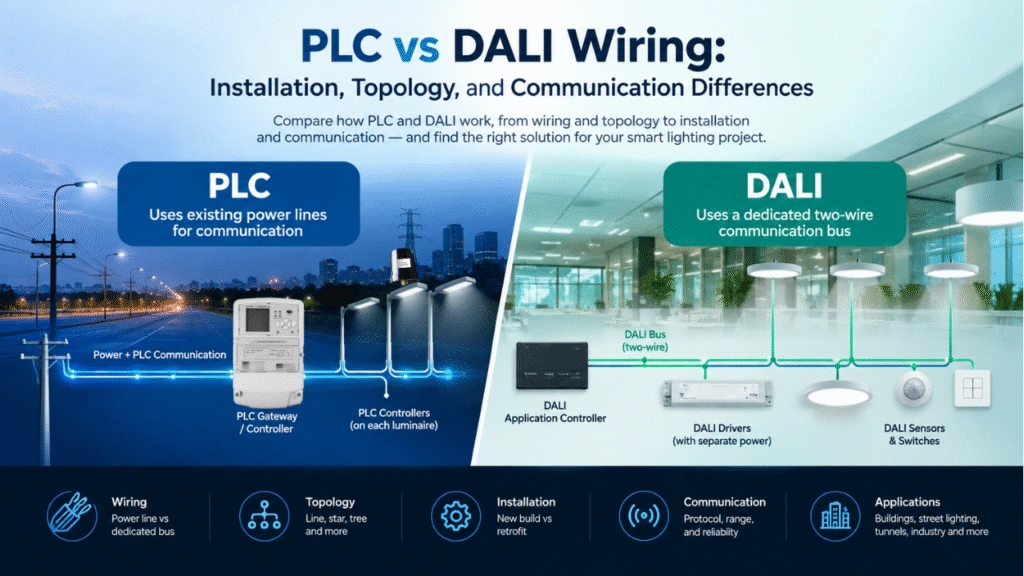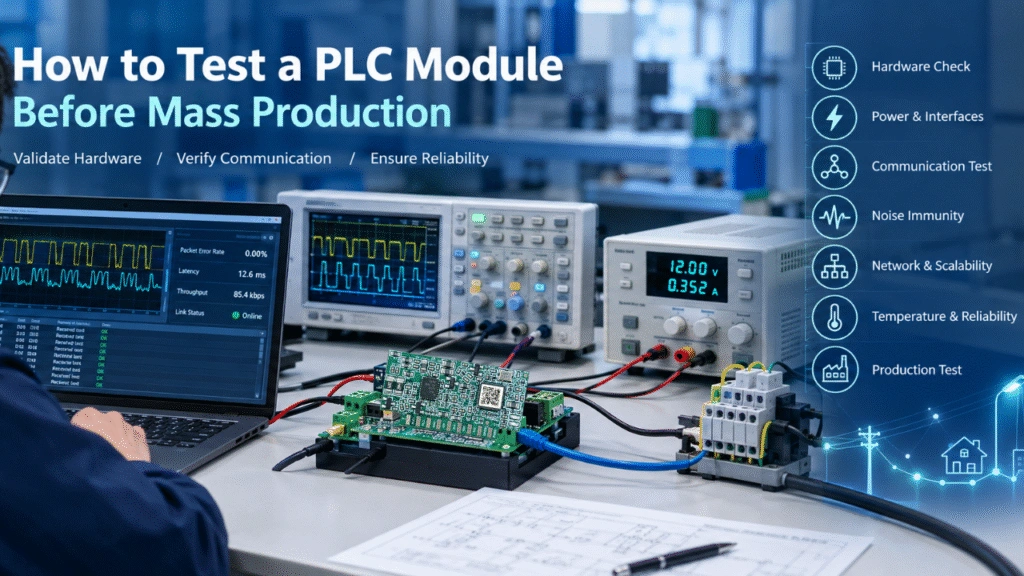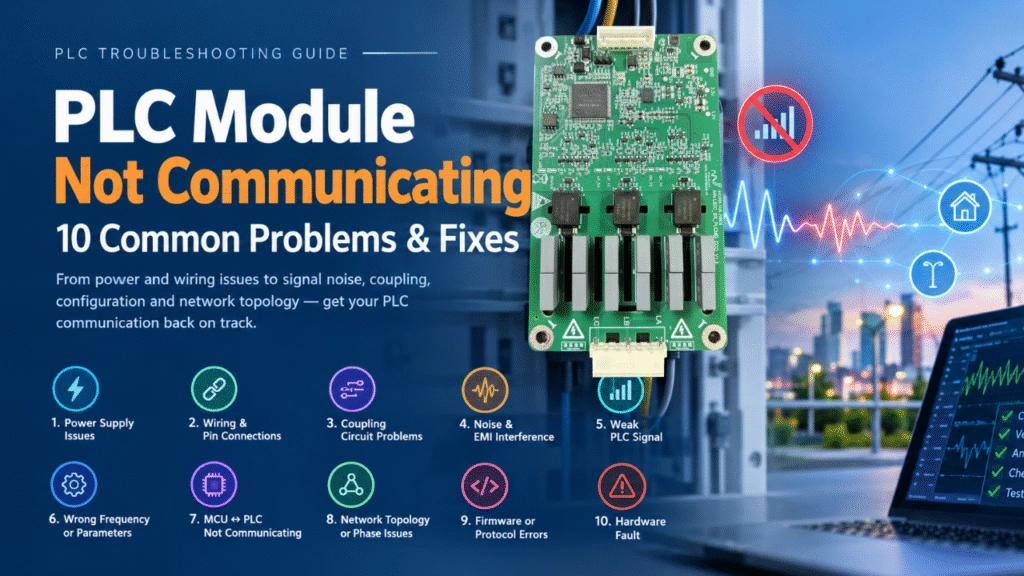

Power Line Communication (PLC) technology is becoming the preferred communication solution for smart street lighting, industrial lighting, smart buildings, EV charging, and energy management because it uses existing power lines for data transmission without installing additional communication cables.
When engineers begin developing a PLC system, one common question arises:
Should I use a PLC chipset or a PLC module?
Although these terms are often used interchangeably, they represent two very different products with different development costs, integration complexity, certification requirements, and time-to-market.
This guide explains the differences between PLC chipsets and PLC modules, helping OEM manufacturers, system integrators, and lighting companies choose the right solution.
What Is a PLC Chipset?
A PLC chipset is the core integrated circuit (IC) responsible for transmitting and receiving data over power lines. Many PLC chipsets are designed to comply with international broadband-over-power-line standards such as ITU-T G.hn, ensuring interoperability and reliable communication across electrical networks.
It provides the communication engine but requires additional hardware before it can function inside a product.
Typical components required around a PLC chipset include:
- MCU
- Memory
- Power supply
- Analog front-end
- Isolation circuits
- Coupling circuits
- Crystal oscillator
- RF filtering
- PCB design
- Firmware development
Think of the chipset as the engine of a car—it provides the power, but it cannot drive the vehicle by itself.
A PLC chipset is mainly intended for:
- Semiconductor companies
- Experienced embedded developers
- Large OEMs
- Companies designing custom hardware from scratch
What Is a PLC Module?
A PLC module is a complete communication subsystem built around a PLC chipset. If you’re looking for ready-to-integrate solutions, explore our Power Line Communication Modules.
Instead of purchasing only the IC, users receive an integrated communication module that already includes:
- PLC chipset
- MCU
- Memory
- Power management
- Communication interfaces
- RF filtering
- Isolation design
- Firmware
- Certified hardware design
- Testing and optimization
The module can usually be connected directly to the host controller through UART, SPI, or other interfaces.
This allows developers to focus on application software instead of communication hardware.
PLC Module vs PLC Chipset Comparison
| Feature | PLC Chipset | PLC Module |
|---|---|---|
| Product Type | Communication IC | Complete communication module |
| Hardware Design | Required | Already completed |
| PCB Development | Required | Minimal |
| Firmware | User develops | Usually provided |
| EMC Optimization | User responsibility | Already optimized |
| Time to Market | Long | Short |
| Development Cost | Higher | Lower |
| Integration Difficulty | High | Low |
| Technical Expertise | Advanced | Moderate |
| Best For | Chip-level development | Product manufacturers |
Architecture Comparison
PLC Chipset Solution
PLC Chip
      ↓
MCU
      ↓
Power Supply
      ↓
Coupling Circuit
      ↓
Isolation Circuit
      ↓
PCB Design
      ↓
Firmware Development
      ↓
Final Product
PLC Module Solution
PLC Module
      ↓
Host MCU
      ↓
Final Product
The module removes most of the complex RF and communication design work.
Development Time Comparison
Developing a product using only a PLC chipset typically requires:
- Hardware schematic design
- PCB layout
- EMC debugging
- Firmware development
- Driver development
- Protocol implementation
- System testing
- Certification
Development can easily take 6–12 months, depending on project complexity. Proper network planning is equally important. Our PLC Network Capacity Calculation Guide explains how to estimate the number of devices and optimize communication performance.
By comparison, a PLC module allows manufacturers to focus primarily on application software, often reducing integration time to just a few weeks to a few months.
Why Many OEM Manufacturers Choose PLC Modules
For most lighting manufacturers, communication technology is not the core business.
Their expertise lies in:
- LED drivers
- Lighting fixtures
- Electrical safety
- Smart lighting software
- System integration
Developing a communication subsystem from scratch can significantly increase engineering costs.
Using a PLC module provides several advantages:
Faster Product Launch
No RF tuning or communication hardware design is required.
Lower Development Risk
The communication subsystem has already been validated.
Reduced Engineering Cost
Smaller engineering teams can complete integration.
Easier Certification
Modules are generally designed with EMC performance in mind, reducing redesign cycles.
Better Technical Support
Many PLC module suppliers provide SDKs, APIs, reference designs, and engineering assistance.
When Should You Choose a PLC Chipset?
A PLC chipset may be the better choice if your company:
- Has experienced embedded hardware engineers
- Wants complete hardware customization
- Produces very high product volumes
- Needs maximum BOM cost optimization
- Develops proprietary communication protocols
Large semiconductor companies and major electronics manufacturers often choose this approach.
When Should You Choose a PLC Module?
A PLC module is ideal if your company:
- Wants fast product development
- Has limited RF or PLC expertise
- Needs lower engineering costs
- Requires proven communication performance
- Plans to integrate PLC into existing products
Industries that commonly adopt PLC modules include:
- Smart street lighting
- Tunnel lighting
- Industrial lighting
- High-bay lighting
- Warehouse lighting
- Smart buildings
- EV charging systems
- Solar energy monitoring
- Power distribution monitoring
Performance Differences
One common misconception is that PLC modules perform worse than chipsets.
In reality, communication performance depends on:
- PLC chipset quality
- Firmware optimization
- Coupling circuit design
- Noise immunity
- Signal processing algorithms
- Network protocol
A well-designed PLC module often delivers equal or better real-world performance than a custom design because it has already undergone extensive optimization and validation.
Cost Comparison
Many engineers initially assume purchasing only the chipset is less expensive.
While the unit price of a chipset is lower, the total project cost includes:
- PCB development
- Firmware engineering
- EMC testing
- Prototype revisions
- Certification
- Technical support
- Longer development cycles
For low- to medium-volume production, a PLC module frequently results in a lower overall cost and faster return on investment.
Which Option Is Best for Smart Lighting?
For most smart lighting projects, PLC modules are the preferred solution because they enable:
- Faster deployment
- Reliable communication
- Lower development risk
- Easier maintenance
- Scalable network expansion
Whether deploying hundreds or tens of thousands of luminaires, PLC modules simplify integration while maintaining robust communication performance.
Chipsets remain a suitable option for companies developing highly customized PLC platforms or manufacturing at very large scale.