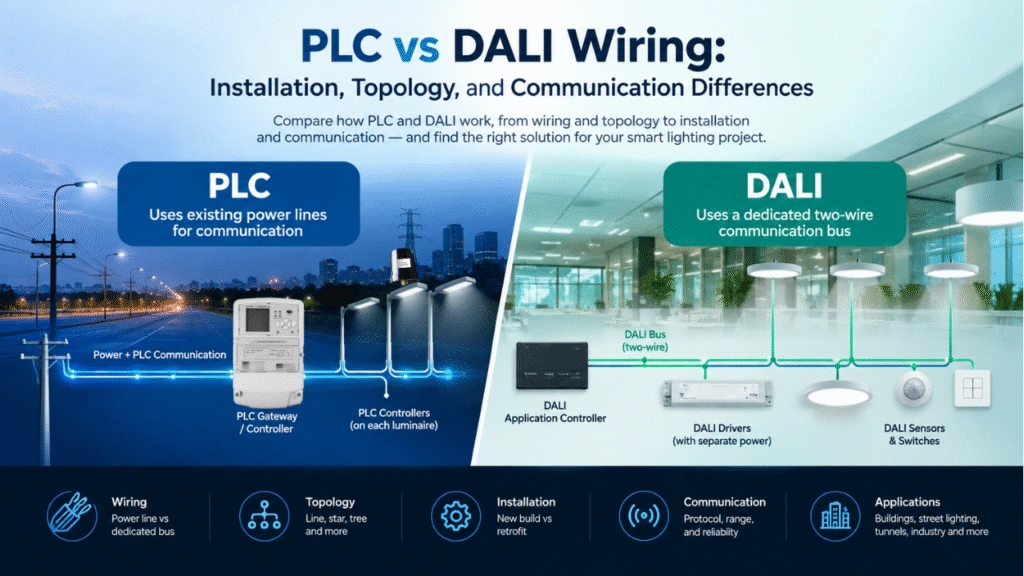
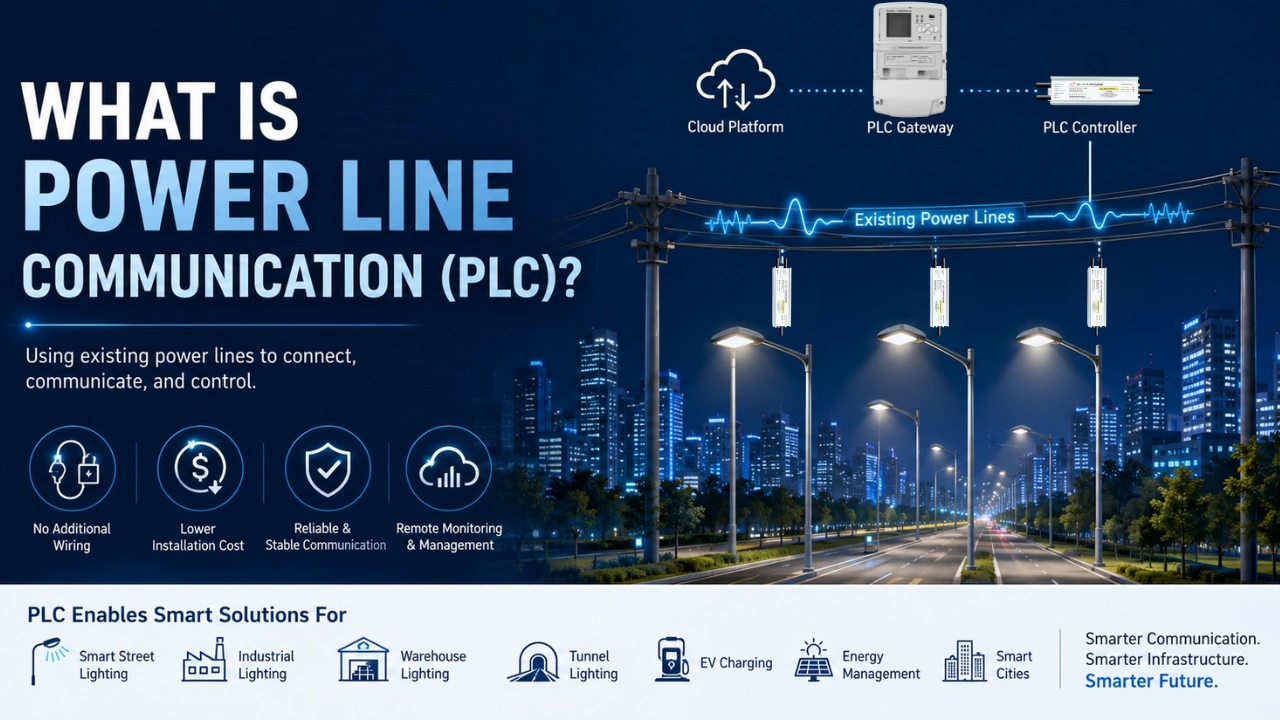
Power Line Communication (PLC) is a communication technology that transmits digital data over existing electrical power lines. Instead of installing separate communication cables, PLC uses the same wires that already deliver electrical power to exchange information between connected devices.
Because no additional communication wiring is required, PLC has become one of the most cost-effective and reliable networking technologies for smart lighting, smart cities, industrial automation, smart buildings, and energy management systems.
For municipalities and industrial facilities, PLC significantly reduces deployment costs while simplifying installation and maintenance.
Table of Contents
- What is Power Line Communication?
- How PLC Works
- PLC Network Architecture
- Types of PLC
- Advantages of PLC
- PLC Applications
- PLC vs Wireless Communication
- Why PLC is Ideal for Smart Lighting
- Frequently Asked Questions
What is Power Line Communication?
Power Line Communication (PLC), is standardized by international organizations such as IEEE and the ITU. Also known as Power Line Carrier Communication (PLCC) or Power Line Networking, enables electrical wiring to serve two purposes simultaneously:
- Deliver electrical power
- Carry communication data
Special communication chips modulate digital signals onto power cables at high frequencies while allowing normal AC or DC electricity to continue flowing uninterrupted.
Every connected PLC device can send and receive commands without requiring Ethernet cables or wireless radios.
How Does Power Line Communication Work?
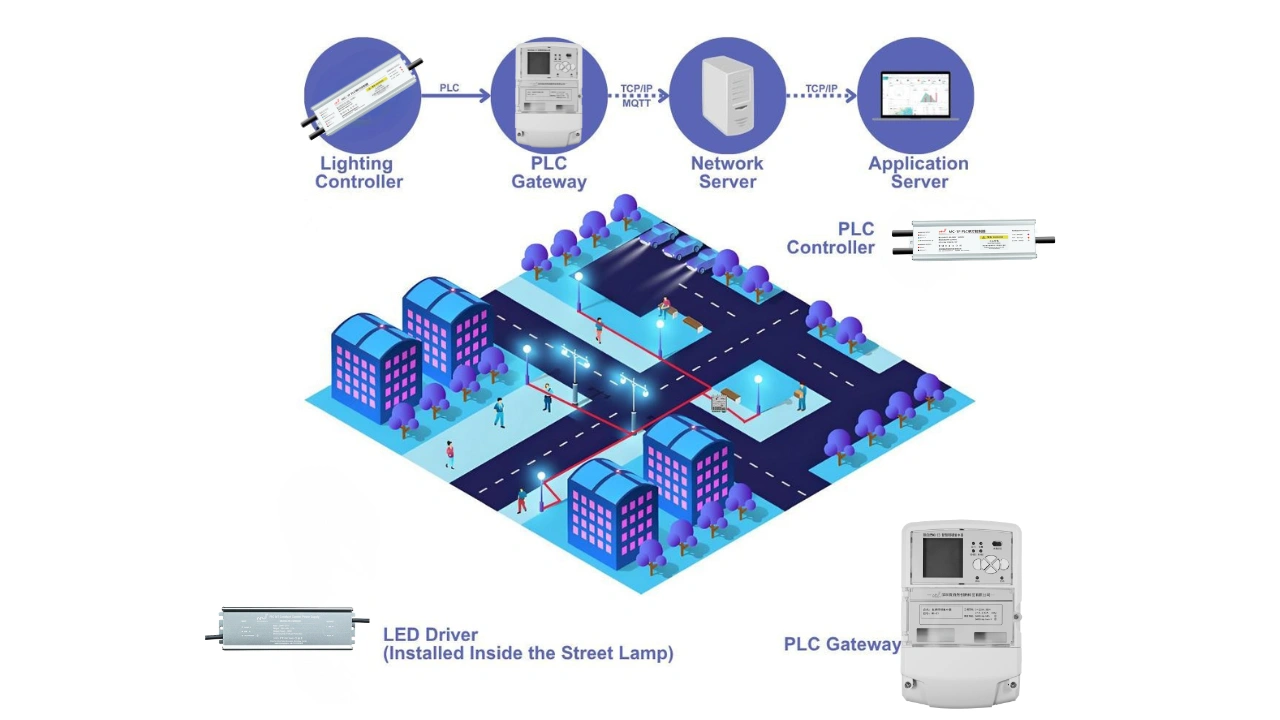
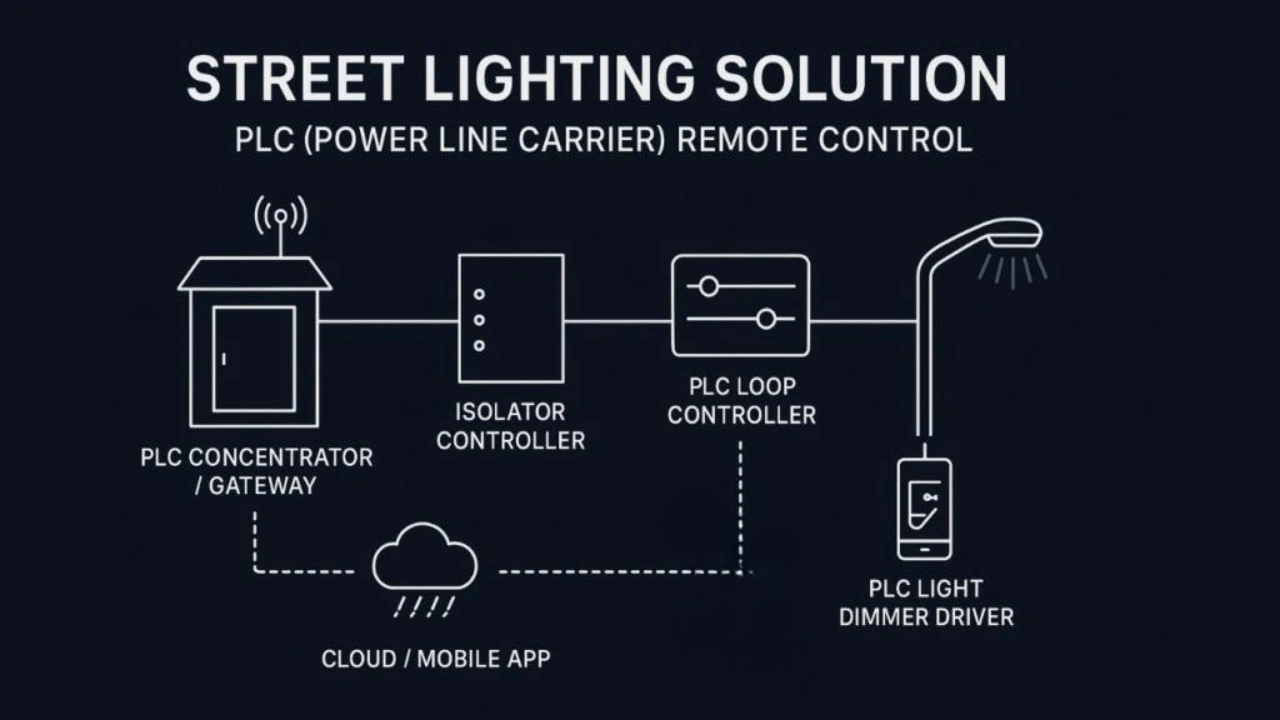
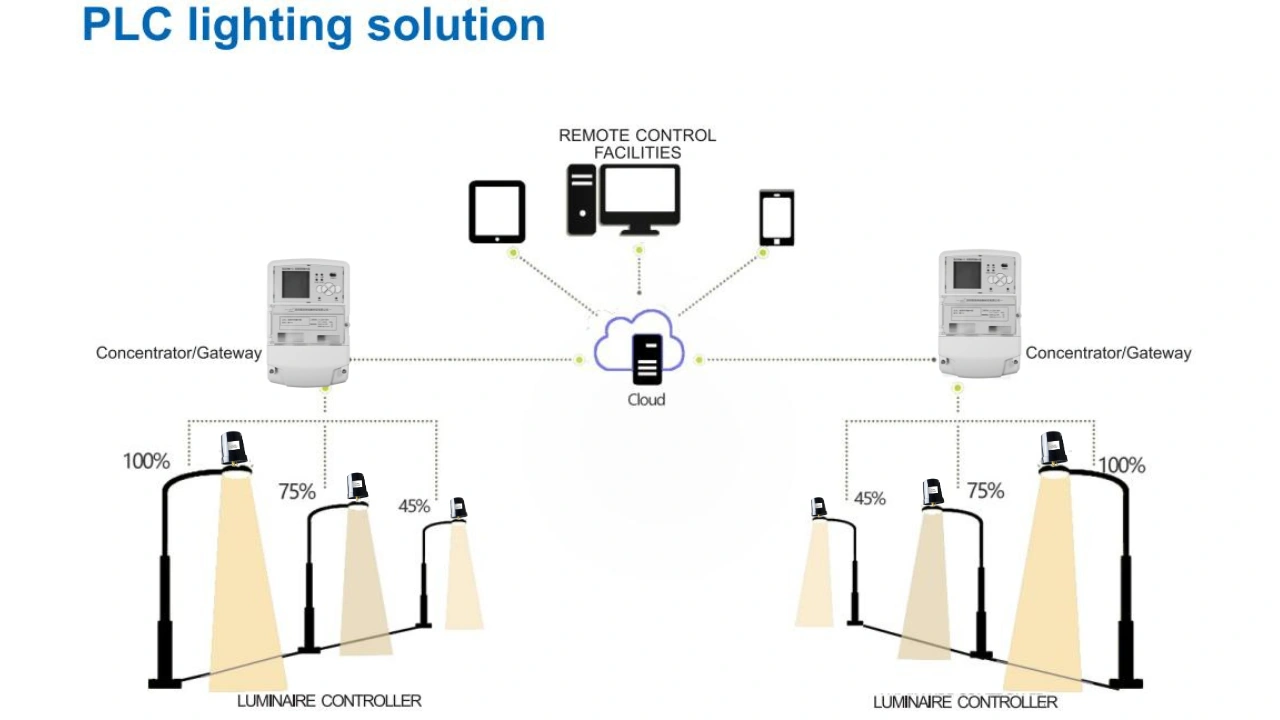
A PLC system consists of several essential components.
1. PLC Controller
The central controller sends communication commands across the electrical network.
Examples include:
- Smart lighting gateways
- PLC concentrators
- Smart control cabinets
2. PLC Communication Module
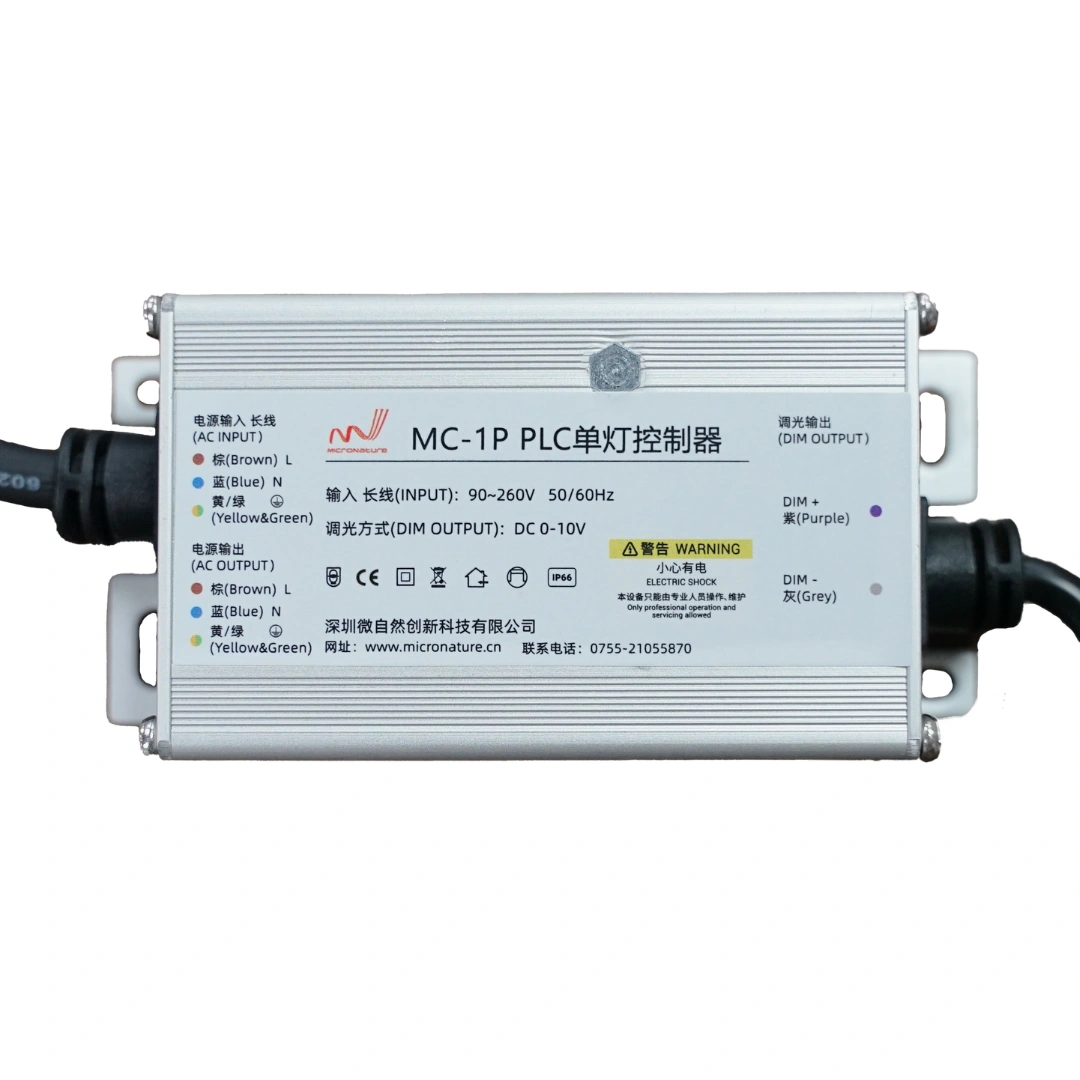
Each lighting device contains a PLC communication module.
Its responsibilities include:
- Encoding data
- Modulating signals
- Receiving commands
- Reporting device status
3. Existing Power Lines
The electrical cables serve as both:
- Power transmission medium
- Communication medium
No additional communication cables are required.
4. Smart Devices
PLC connects devices such as:
- LED drivers
- Street lights
- Sensors
- Industrial equipment
- Energy meters
- EV chargers
Typical PLC Communication Process
- Cloud platform issues a command.
- Gateway receives the instruction.
- PLC controller sends the command onto the power line.
- PLC modules decode the signal.
- Target device executes the command.
- Status information is returned through the same power line.
PLC Network Architecture
Cloud Platform
        │
Ethernet / 4G
        │
PLC Gateway
        │
PLC Controller
        │
──────────────────────────
 Existing Power Lines
──────────────────────────
   │      │      │
 Light  Sensor Driver
 Controller
To learn how to design a scalable PLC communication network for large projects, read our PLC Smart Lighting System Architecture Guide.
Types of Power Line Communication
Narrowband PLC (NB-PLC)
Typically operates below 500 kHz.
Characteristics:
- Long communication distance
- Excellent anti-interference capability
- Lower bandwidth
- Ideal for smart grids and street lighting
Broadband PLC (BB-PLC)
Typically operates between 1.8 MHz and 250 MHz.
Characteristics:
- Higher bandwidth
- Faster data rates
- Shorter transmission distance
- Suitable for home networking and multimedia applications
Advantages of Power Line Communication
No Additional Communication Wiring
Existing power infrastructure is reused, dramatically reducing installation costs.
Lower Installation Cost
Because there is no need for Ethernet or fiber installation, PLC is often the most economical communication solution for large outdoor lighting projects.
Reliable Communication
Unlike wireless technologies, PLC is not affected by:
- Building walls
- Signal shadowing
- Radio congestion
Easy Expansion
Adding new devices usually requires only connecting them to the existing electrical network.
Remote Monitoring
Operators can remotely:
- Switch lights
- Dim lighting
- Monitor energy consumption
- Detect faults
- Schedule operations
- Upgrade firmware
Common Applications of PLC


PLC is widely used across many industries, including:
- Smart street lighting
- Smart city infrastructure
- Industrial lighting
- Warehouses
- Tunnels
- Ports
- Airports
- Parking lots
- Commercial buildings
- Smart campuses
- Smart factories
- EV charging systems
- Solar photovoltaic monitoring
- Energy management systems
PLC vs Wireless Communication
| Feature | PLC | Wireless |
|---|---|---|
| Uses existing wiring | ✅ | ❌ |
| Extra communication cable | ❌ | ❌ |
| Signal blocked by walls | No | Yes |
| EMI resistance | High | Medium |
| Long-distance lighting control | Excellent | Depends on environment |
| Installation cost | Low | Medium |
| Maintenance | Easy | Medium |
Each technology has strengths, but PLC is particularly advantageous where reliable wired infrastructure already exists.
Why PLC is Ideal for Smart Lighting
Street lighting networks already have power lines connecting every luminaire.
PLC makes use of this existing infrastructure to create an intelligent communication network without installing separate communication cables.
Benefits include:
- Remote switching
- Adaptive dimming
- Energy monitoring
- Fault alarms
- Lighting schedules
- Asset management
- AI sensor integration
- Cloud management
- Reduced operating costs
For municipalities and industrial campuses, PLC enables scalable smart lighting with lower deployment costs and dependable communications.