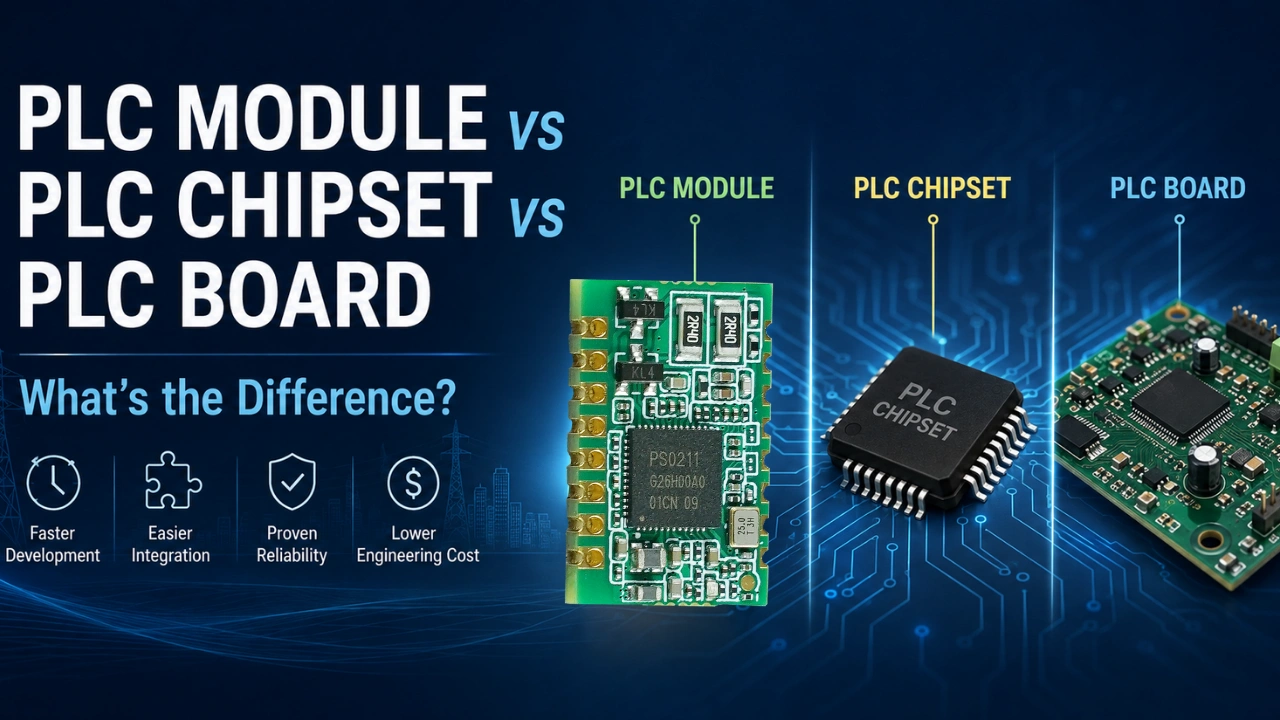
Power Line Communication (PLC) technology can be implemented in several different hardware forms. However, terms such as PLC module, PLC chipset, and PLC board are often used interchangeably—even though they describe very different products.
For OEM manufacturers, lighting companies, embedded system developers, and smart infrastructure integrators, understanding these differences is important when selecting the right PLC communication solution. For companies developing OEM products, choosing the right Power Line Communication module can significantly reduce PLC hardware development complexity and accelerate product integration.
This article explains the differences between a PLC module vs PLC chipset vs PLC board, including their structure, development requirements, advantages, and typical applications.
What Is a PLC Module?
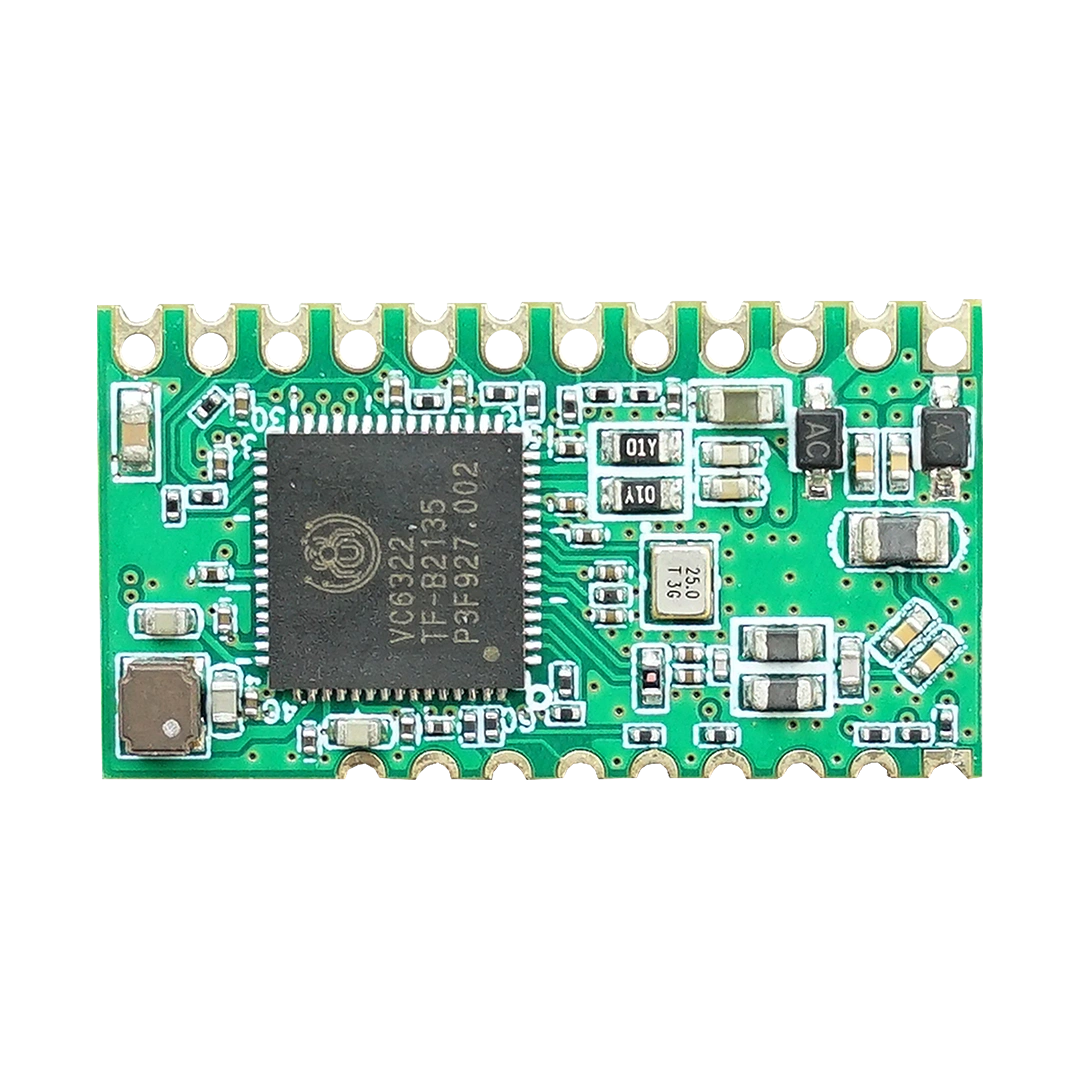
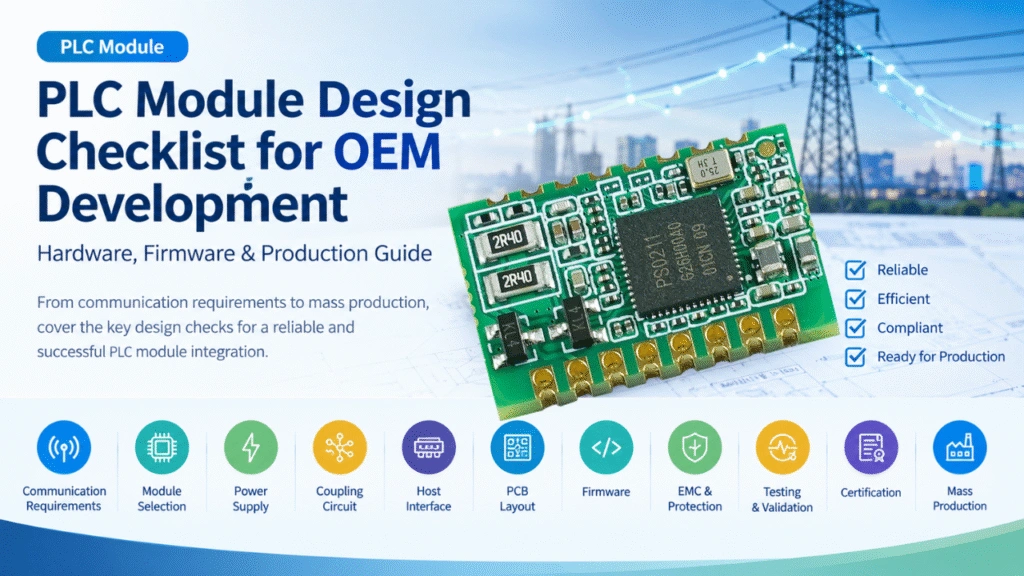
A PLC module, also called a Power Line Communication module, is a compact communication module designed to provide PLC functionality that can be integrated into an OEM product or custom PCB.
A typical PLC module usually includes the essential components required for PLC communication, such as:
- PLC communication chipset
- Processor or embedded controller
- Memory
- PLC communication interface
- Signal processing components
- Firmware or communication protocol support
- External interfaces such as UART, SPI, GPIO, or other interfaces
The OEM developer integrates the PLC module into their own PCB or product design.
How Does a PLC Module Work?
The PLC module connects to the host device through an embedded interface. The host system sends data to the PLC module, and the module transmits that data through the existing power line.
This allows manufacturers to add communication capabilities without designing the complete PLC communication hardware from the beginning.
Advantages of Using a PLC Module
Using a PLC module can provide several advantages:
- Faster product development
- Reduced hardware development risk
- Lower engineering cost
- Easier OEM integration
- Pre-developed PLC communication functionality
- Smaller development workload
- Faster time to market
For many OEM projects, a PLC module provides a balance between performance, customization, development cost, and integration speed.
What Is a PLC Chipset?
A PLC chipset is the semiconductor-level solution used to perform Power Line Communication functions.
The chipset is typically the core component responsible for functions such as:
- PLC signal processing
- Modulation and demodulation
- Data transmission and reception
- Network communication
- Protocol processing
- Error detection and correction
Depending on the PLC technology and application, communication solutions may be designed around standards and specifications such as IEEE P1901.1, which defines Power Line Communication technologies for certain smart grid and infrastructure applications.
A PLC Chipset Requires Additional Hardware Development
Unlike a ready-to-integrate PLC module, a PLC chipset is usually not a complete communication solution by itself.
A manufacturer using a PLC chipset typically needs to develop additional components, including:
- PCB design
- Power supply circuits
- Signal coupling circuits
- Analog front-end circuits
- Memory circuits
- Clock circuits
- Protection circuits
- EMC and EMI design
- Firmware development
- Communication protocol integration
This gives developers more control over the final product but requires significantly more engineering resources.
Advantages of Using a PLC Chipset
A chipset-level solution may be suitable when a company needs:
- Maximum hardware customization
- High-volume production optimization
- Custom PCB architecture
- Specialized communication performance
- Complete control over firmware and hardware design
However, the development cycle is generally longer than using a PLC module.
What Is a PLC Board?
A PLC board is a broader and less standardized term.
Depending on the manufacturer, a PLC board may refer to:
- A PCB containing a PLC chipset
- A development board for PLC technology
- A complete PLC communication controller
- A prototype evaluation board
- A custom PCB with an integrated PLC module
Because the term PLC board does not have one universally standardized meaning, it is important to check the actual hardware architecture and specifications.
PLC Board vs PLC Module
A PLC board is usually a larger PCB assembly, while a PLC module is typically designed as a compact embedded component.
For example:
PLC Module:
A compact communication component that is integrated into an OEM PCB.
PLC Board:
A larger PCB that may include the PLC module or chipset together with other components such as:
- Power supply circuits
- Controllers
- Connectors
- Sensors
- Relay circuits
- Lighting interfaces
- Protection circuits
Therefore, a PLC module can be part of a PLC board, but a PLC board is not necessarily a PLC module.
PLC Module vs PLC Chipset vs PLC Board: Quick Comparison
| Feature | PLC Module | PLC Chipset | PLC Board |
|---|---|---|---|
| Product Level | Embedded communication solution | Semiconductor component | PCB-level hardware assembly |
| Ready for OEM Integration | High | Low | Depends on design |
| Requires PCB Development | Minimal integration required | Yes | Already assembled |
| Firmware Development | Often partially pre-developed | Usually required | Depends on product |
| Development Time | Shorter | Longer | Depends on design |
| Hardware Customization | Medium to high | Very high | High |
| Engineering Complexity | Lower | High | Medium to high |
| Typical User | OEM manufacturers and system developers | Semiconductor and advanced hardware developers | System integrators and product developers |
The Relationship Between PLC Chipsets, Modules, and Boards
The easiest way to understand the difference is to look at the hardware hierarchy.
Level 1: PLC Chipset
The PLC chipset is the semiconductor-level communication core.
It provides the fundamental technology required for Power Line Communication.
Level 2: PLC Module
The PLC module integrates the chipset with supporting hardware and communication interfaces.
It provides a more complete and easier-to-integrate PLC communication solution.
Level 3: PLC Board or Final Product
The PLC module can then be integrated into a larger PCB or complete product.
For example:
PLC Chipset → PLC Module → Custom PCB → Smart Lighting Controller
This architecture allows OEM manufacturers to select the appropriate level of integration based on their engineering capabilities and product requirements.
Why OEM Manufacturers Often Choose PLC Modules
For many OEM manufacturers, developing a complete PLC communication system from a chipset can require significant engineering resources.
PLC communication design involves more than simply placing a communication chip on a PCB.
Engineers may need to consider:
- Power line characteristics
- Signal coupling
- Electrical noise
- EMI and EMC performance
- Isolation and protection
- Network architecture
- Communication protocols
- Firmware integration
- Production testing
A ready-to-integrate PLC module can reduce these development challenges.
Instead of developing the complete communication layer, OEM manufacturers can focus on their primary product functions.
For example, a smart lighting manufacturer can focus on:
- LED driver control
- Dimming functions
- Lighting sensors
- NEMA interfaces
- Energy management
- User applications
while integrating a PLC module for power-line communication.
PLC Modules for Smart Lighting Applications
PLC modules are particularly useful in smart lighting systems because the existing electrical infrastructure can be used for both power distribution and communication.
Typical applications include:
- Smart street lighting
- Industrial lighting
- Warehouse lighting
- Tunnel lighting
- High-mast lighting
- Stadium lighting
- Park lighting
- Shipyard lighting
- Building lighting
- Smart city infrastructure
A PLC module can be integrated into devices such as:
- Smart light controllers
- LED drivers
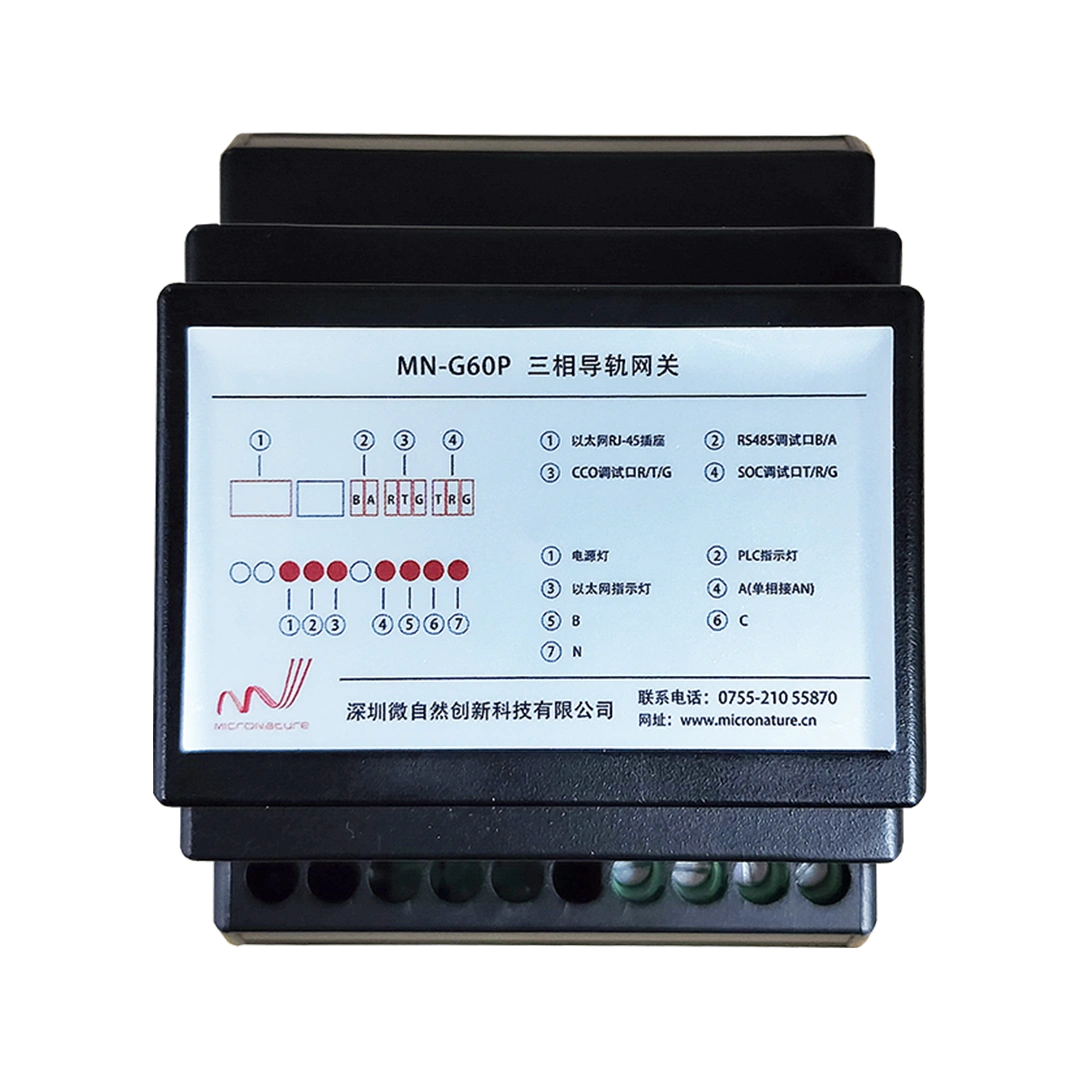
- Lighting gateways
- NEMA controllers
- Loop controllers
- Energy monitoring devices
- Sensor controllers
This enables devices to communicate through existing power cables without requiring separate communication wiring.
When Should You Choose a PLC Module?
A PLC module is usually a good choice when you want:
- Faster product development
- Lower hardware development complexity
- OEM or ODM integration
- A compact communication solution
- Custom product development
- Faster time to market
- Reduced PLC engineering risk
PLC modules are especially suitable for companies that have experience developing their own products but do not want to develop the complete PLC communication hardware from the chipset level.
When Should You Choose a PLC Chipset?
A PLC chipset may be the right choice when your company has:
- A dedicated hardware engineering team
- PLC communication development experience
- RF or high-frequency circuit design capabilities
- Large production volumes
- Specialized hardware requirements
- A need for maximum PCB customization
However, the total development cost and engineering time should be considered carefully.
For many projects, the lower component cost of a chipset may be offset by additional costs related to:
- PCB development
- Firmware development
- Testing
- Certification
- EMC optimization
- Engineering resources
When Should You Choose a PLC Board?
A PLC board may be suitable when you need a more complete hardware solution.
For example, a PLC board may already include:
- PLC communication
- Power supply
- Microcontroller
- Input and output interfaces
- Relay control
- Sensor interfaces
- Protection circuits
This can be useful for system prototypes, development projects, or applications where a complete controller board is required.
However, if you are developing a compact OEM product, a PLC module may provide more flexibility because it can be integrated directly into your own PCB design.
PLC Module vs PLC Chipset: Which Is Better?
Neither solution is universally better.
The right choice depends on your development requirements.
Choose a PLC Module If:
- You want faster integration.
- You want to reduce PLC hardware development.
- You are developing an OEM product.
- You want to reduce engineering risk.
- You need a proven communication solution.
Choose a PLC Chipset If:
- You need maximum hardware control.
- You have strong embedded hardware expertise.
- You are developing a completely customized architecture.
- You have the resources for PLC hardware and firmware development.
For most OEM manufacturers developing smart lighting or industrial IoT products, a PLC module can significantly simplify the integration process.
Can a PLC Module Be Integrated into a Custom PCB?
Yes. This is one of the primary purposes of an embedded PLC module. Manufacturers can integrate a PLC module into an embedded system or custom PCB to add Power Line Communication capabilities without developing the complete PLC communication hardware from the chipset level.
This is one of the primary purposes of an embedded PLC module.
The module is installed on a custom PCB designed by the OEM manufacturer.
The custom PCB may contain other components such as:
- Microcontrollers
- LED drivers
- Sensors
- Power management circuits
- NEMA interfaces
- Relay circuits
- RS-485 interfaces
- Ethernet interfaces
The PLC module provides the Power Line Communication function while the main PCB handles the product-specific functions.
This modular design can reduce development time while maintaining flexibility for customized products.
Important Factors When Choosing a PLC Module
Before making a final hardware decision, OEM manufacturers should understand the key technical and application requirements involved in choosing the right PLC communication module.
1. Communication Standard
Check which PLC communication standard or technology is supported.
Different PLC systems may use different protocols and communication architectures.
Compatibility with the target network should be confirmed before product development.
2. Communication Interface
Check how the PLC module communicates with the host system.
Common interfaces may include: For embedded product developers, understanding the difference between UART vs SPI for PLC modules can help determine the most suitable interface for communication between the host controller and the PLC module.
- UART
- SPI
- GPIO
- Ethernet
The selected interface should match the OEM product architecture.
3. Power Line Environment
Power lines can be electrically noisy, and PLC signal noise can affect communication reliability, network stability, and overall system performance.
The communication solution should be designed for the actual installation environment.
For example:
- Industrial facilities
- Outdoor lighting systems
- Long power cables
- High-interference environments
may require additional consideration for PLC network design and signal reliability.
4. Network Capacity
Consider how many devices will be connected to the PLC network. Engineers should also consider PLC bandwidth calculation when estimating how much communication traffic a PLC network can support.
Network capacity depends on multiple factors, including:
- Network architecture
- Communication traffic
- Power line conditions
- Device configuration
- PLC technology
5. Customization Requirements
Some OEM manufacturers require customized:
- Hardware interfaces
- Firmware
- Communication protocols
- PCB form factors
- Product functions
Working with a PLC module supplier that supports OEM and ODM customization can simplify product development.