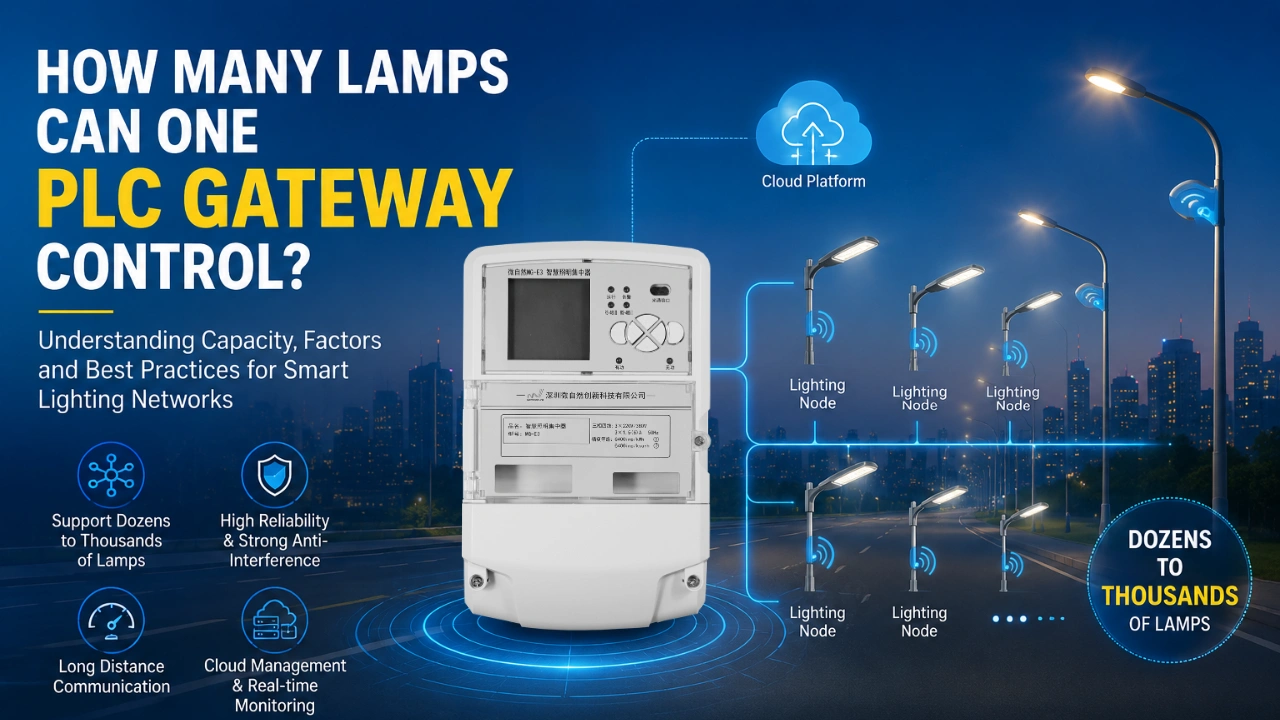
When engineers, EPC contractors, and municipal planners evaluate a Power Line Communication (PLC) lighting system, one of the first questions they ask is:
How many lamps can one PLC gateway control?
The short answer is that a single PLC gateway can typically manage dozens, hundreds, or even thousands of lighting nodes, depending on the network topology, communication protocol, electrical environment, and system design.
Unlike traditional wireless technologies, PLC uses existing power cables as communication channels, eliminating the need for additional communication wiring while providing highly reliable data transmission for street lighting, warehouses, tunnels, industrial facilities, campuses, ports, and smart cities.
However, determining the actual number of supported lamps requires a closer look at several technical factors.
What Does a PLC Gateway Do?
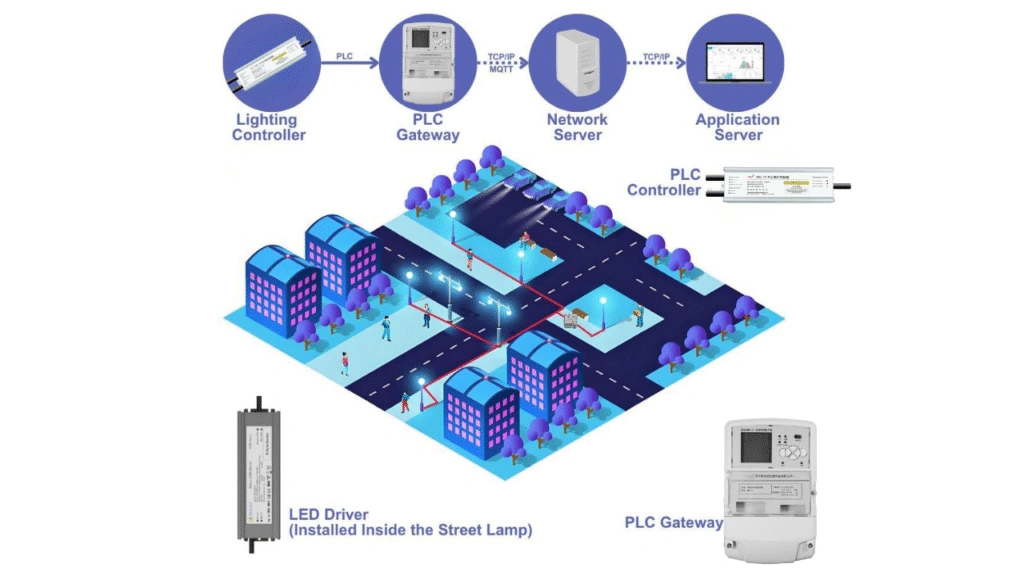
A PLC gateway serves as the central communication hub of the entire lighting network. It is responsible for:
- Managing communication between the cloud platform and field devices
- Collecting operating data from individual lamps
- Sending switching and dimming commands
- Monitoring energy consumption
- Detecting failures and issuing alarms
- Managing scheduling policies
In a typical smart lighting architecture, the gateway connects to:
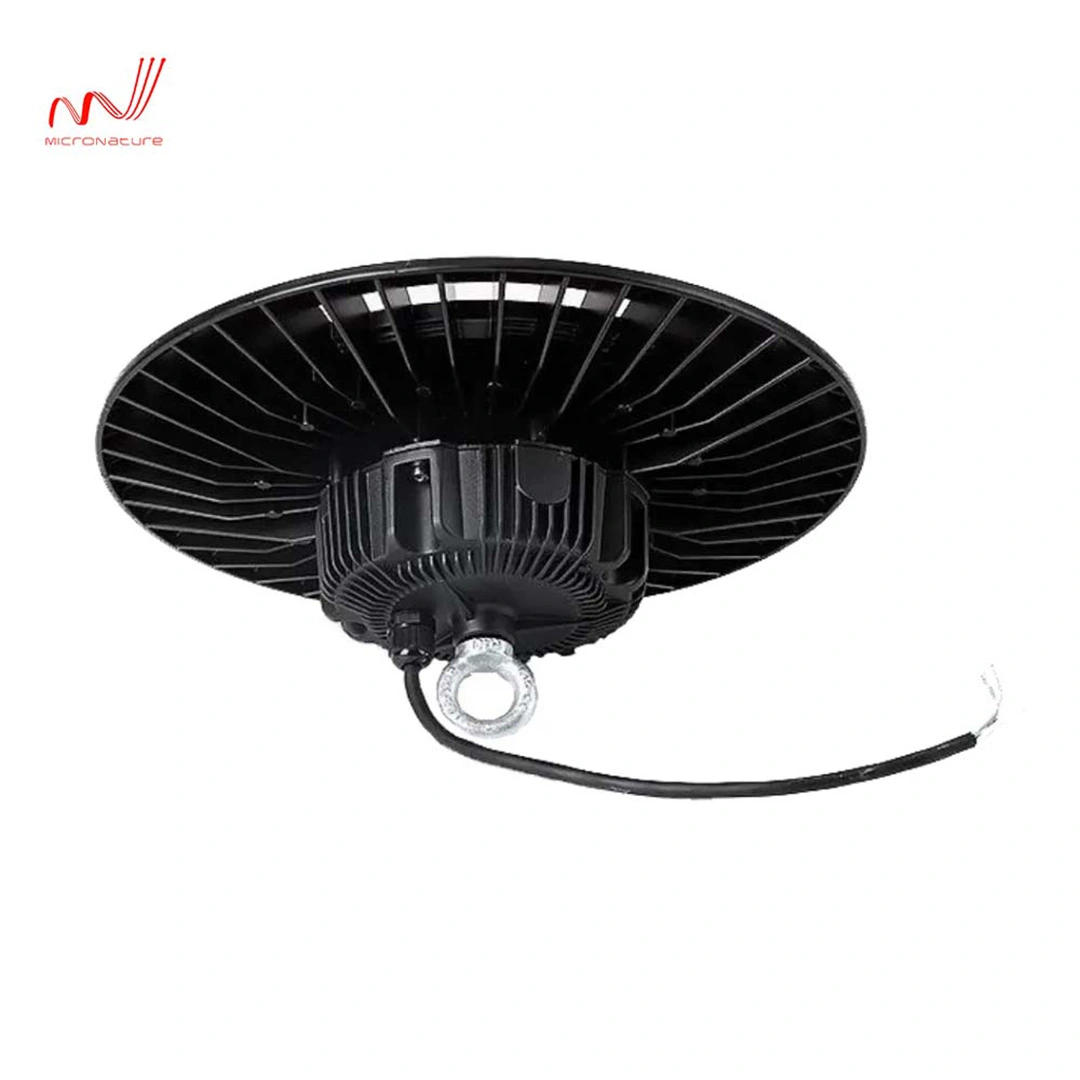
- PLC single-lamp controllers
- Loop controllers
- Sensors
- Cloud management platforms
- Ethernet, Wi-Fi, or cellular networks
The gateway acts as a bridge between local power line networks and remote management systems.
Factors That Determine the Number of Lamps
Several variables directly influence gateway capacity.
1. Communication Protocol
Different PLC protocols provide different levels of performance.
Common technologies include:
- OFDM (Orthogonal Frequency Division Multiplexing)
- FSK (Frequency Shift Keying)
- IEEE P1901.1 standards
- Proprietary PLC protocols
OFDM-based systems generally offer higher bandwidth, better resistance to noise, and greater network capacity.
2. Network Topology
The network structure significantly affects overall performance. If you are a new user, can see our article PLC Network Capacity Calculation Guide for Smart Lighting.
Typical topologies include:
- Star topology
- Tree topology
- Mesh topology
- Hybrid topology
Mesh networking is especially useful because every node can help forward information to other nodes, extending the communication range and improving reliability.


3. Communication Distance
Communication distance is another important consideration.
Factors affecting transmission distance include:
- Cable quality
- Transformer distribution
- Electrical noise
- Branch circuits
- Signal attenuation
- Electromagnetic interference
As communication distance increases, data throughput typically decreases.
4. Network Traffic
The communication load within the network also affects system capacity. How to Design a PLC Smart Lighting Network this article may help you know more about it.
Examples include:
- Real-time dimming
- Energy monitoring
- Fault reporting
- Sensor integration
- Firmware upgrades
- AI-based analytics
A network that only sends simple on/off commands can generally support more nodes than a network transmitting large amounts of sensor data.
5. Response Time Requirements
Different projects have different requirements.
| Application | Response requirement |
|---|---|
| Street lighting | Seconds |
| Industrial lighting | Hundreds of milliseconds |
| Tunnel lighting | Near real-time |
| Stadium lighting | Real-time |
Faster response requirements generally reduce the maximum number of devices supported by a gateway.
Typical PLC Gateway Capacity
The following table provides general estimates.
| Deployment scenario | Approximate number of lamps |
|---|---|
| Small office building | 20–100 |
| Warehouse | 50–300 |
| Industrial facility | 100–500 |
| Tunnel lighting | 100–800 |
| Street lighting system | 300–1,000+ |
| Smart city deployment | Thousands |
Actual performance will vary according to local conditions.
Example: Municipal Street Lighting Project
Imagine a city deploying 1,000 intelligent streetlights across several kilometers.
The installation might include:
- Four PLC gateways
- Two electrical distribution cabinets
- One cloud management platform
- Multiple PLC controllers
- Light sensors and environmental sensors
In this scenario, each gateway could manage approximately 250 lamps while maintaining stable communication and rapid response times.
This distributed architecture offers several advantages:
- Easier maintenance
- Greater redundancy
- Lower communication latency
- Higher reliability
- Better scalability
How to Increase Gateway Capacity
System designers often use several methods to expand the network.
Segment the network
Divide large deployments into smaller communication domains.
Use repeaters or mesh networking
Signal forwarding improves both coverage and stability.
Reduce communication frequency
Longer reporting intervals decrease network congestion.
Improve power quality
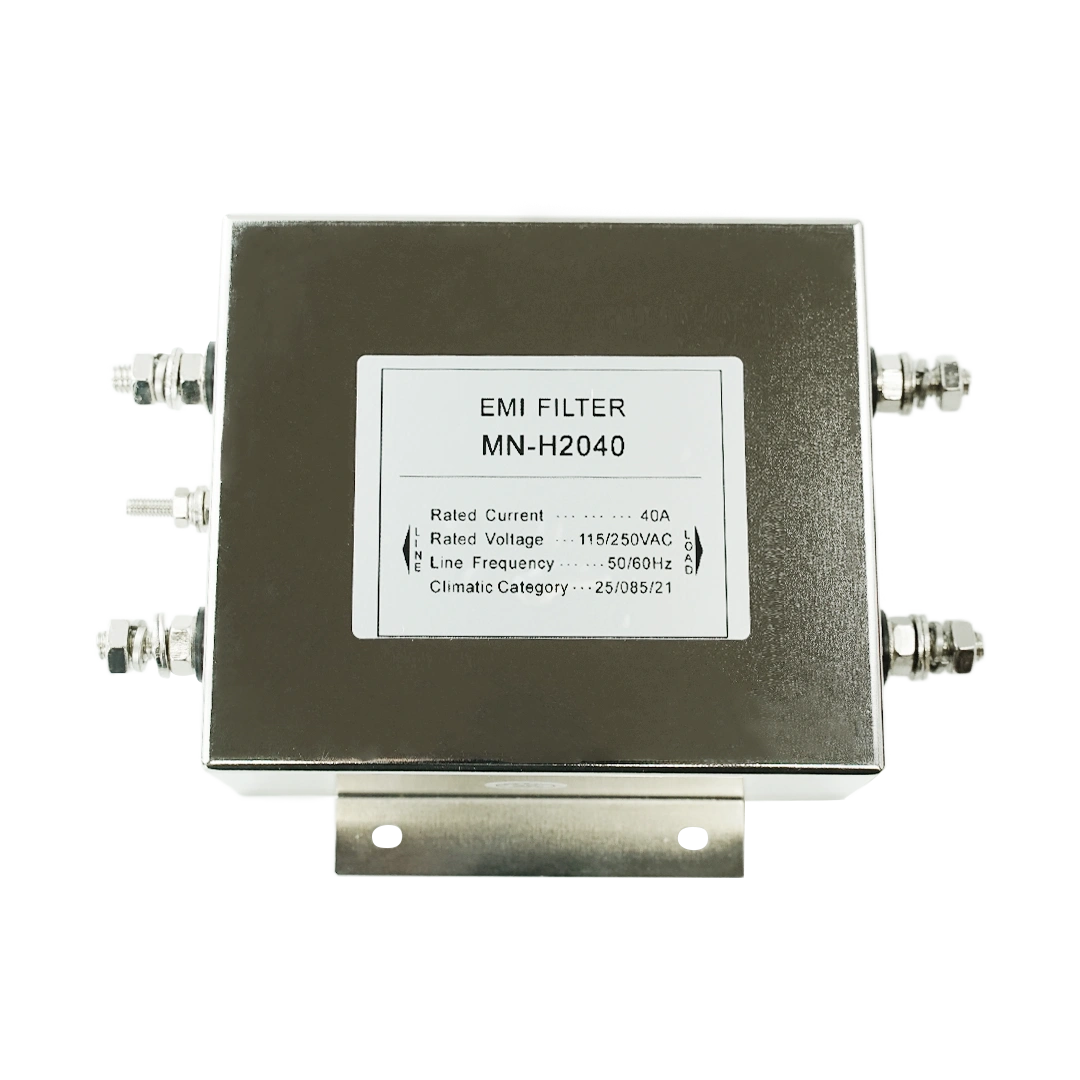
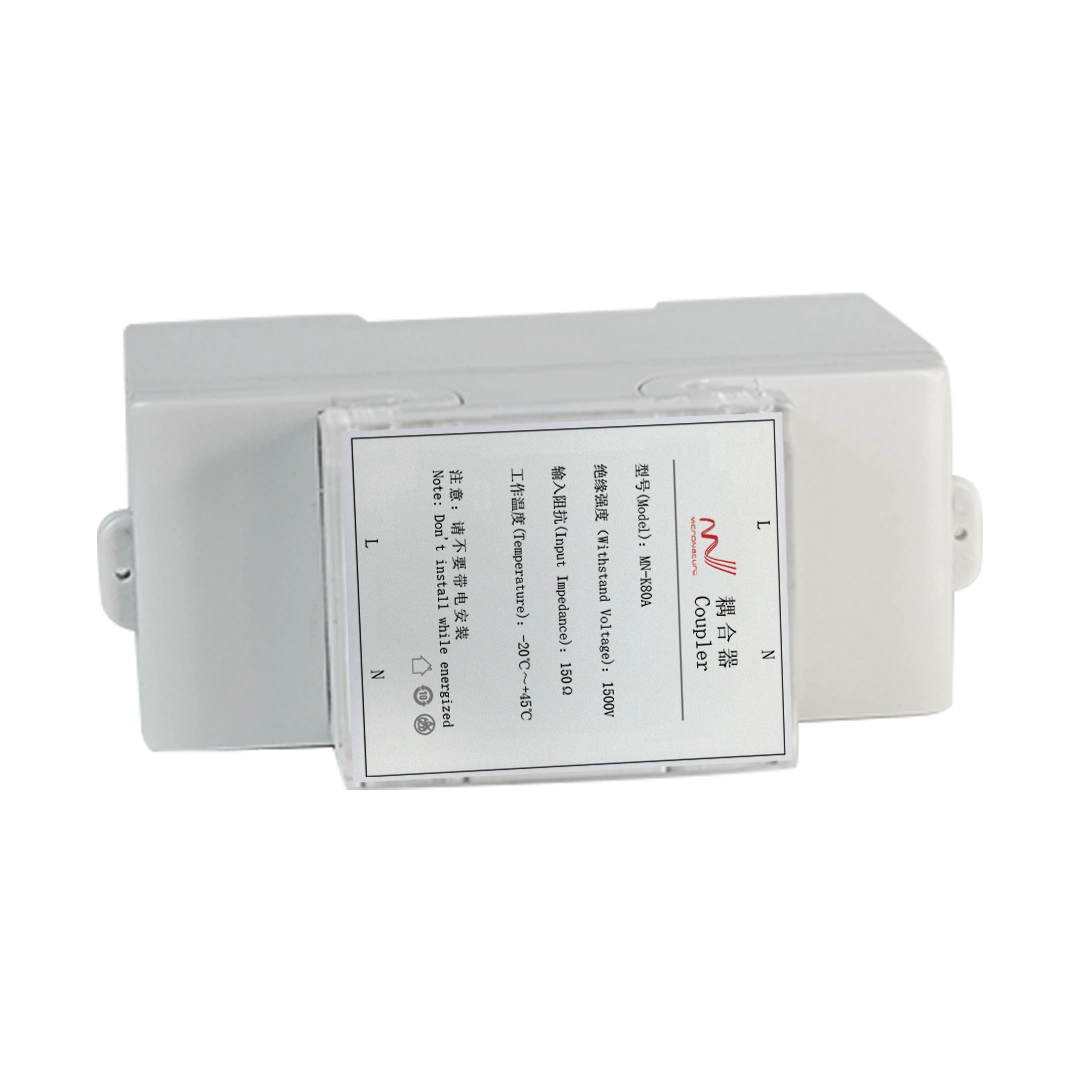
Signal filters and isolation devices can significantly reduce interference.
Select industrial-grade PLC modules
High-performance modules provide better sensitivity and stronger noise immunity.
Why PLC Is Ideal for Large Lighting Networks
Compared with wireless solutions, PLC technology offers several advantages:
| Feature | PLC technology | Wireless technology |
|---|---|---|
| Additional wiring | Not required | Usually required |
| Electromagnetic interference resistance | Excellent | Moderate |
| Installation complexity | Low | Moderate |
| Long-distance communication | Excellent | Limited |
| Reliability | High | Medium |
| Maintenance costs | Low | Higher |
These advantages explain why PLC technology has become increasingly popular in smart city applications.
Final Thoughts
There is no universal answer to the question, “How many lamps can one PLC gateway control?”
The answer depends on numerous factors, including communication protocols, electrical conditions, network topology, reporting intervals, and project requirements.
For most professional smart lighting deployments, system architects prioritize reliability, scalability, and maintainability rather than simply maximizing the number of connected lamps.
A well-designed PLC network can provide stable communication for hundreds or even thousands of lighting nodes while significantly reducing installation and maintenance costs.