
Industrial lighting systems are no longer just about illumination. In modern factories, ports, tunnels, warehouses, mines, and infrastructure projects, lighting networks have become part of the broader Industrial IoT ecosystem. When comparing PLC vs wireless industrial lighting systems, reliability is one of the most important factors in industrial environments.
As industries move toward automation and smart facility management, communication reliability becomes critical. This is where the debate between PLC (Power Line Communication) and wireless technologies such as Wi-Fi, Zigbee, LoRaWAN, and RF mesh becomes increasingly important.
While wireless solutions are widely promoted for convenience and flexibility, many industrial environments demand something more important: stable, interference-resistant, and predictable communication.
That is why more industrial operators are turning to PLC lighting systems.
| PLC Lighting | Wireless Lighting |
|---|---|
| Uses power lines for communication | Uses RF signals |
| Strong EMI resistance | Susceptible to interference |
| Stable in tunnels/factories | Signal blockage possible |
| Lower infrastructure complexity | Requires gateways/repeaters |
What Is PLC in Industrial Lighting?
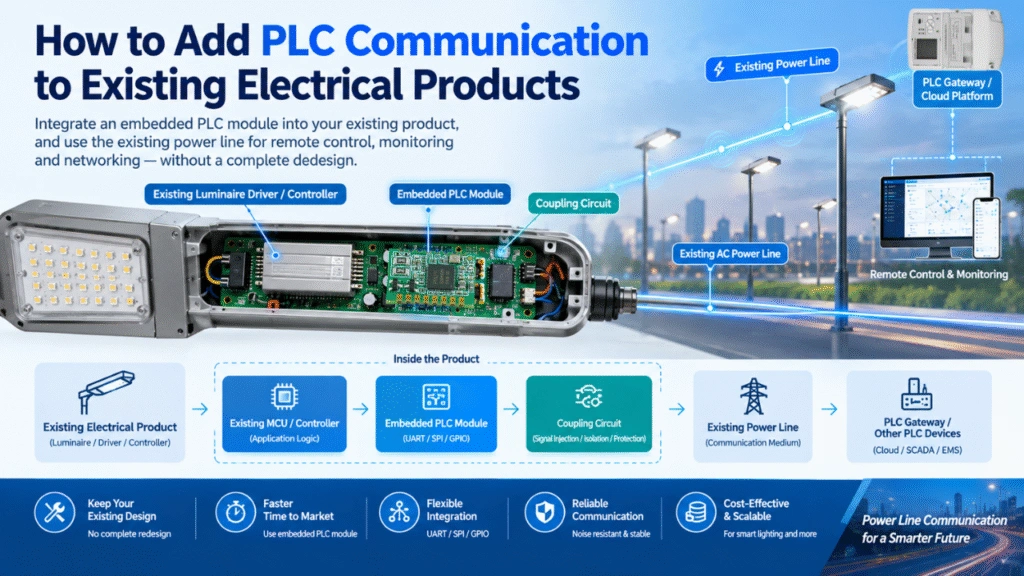
Power Line Communication (PLC) is a communication technology that transmits data over existing electrical power lines. Instead of deploying separate communication cables or relying on wireless radio signals, PLC allows lighting devices to communicate through the same infrastructure already supplying electrical power.
In industrial lighting systems, PLC enables:
- Remote lighting control
- Real-time monitoring
- Energy management
- Fault detection
- Dimming and scheduling
- Smart automation integration
Because communication and power travel through the same wiring, PLC creates a highly integrated and reliable lighting network.
Why Wireless Communication Faces Challenges in Industrial Environments
Wireless lighting systems work well in offices, homes, and small commercial spaces. However, industrial environments are very different.
Factories, ports, tunnels, and heavy industrial facilities contain many elements that can weaken or disrupt wireless communication.
Common Wireless Problems in Industrial Facilities
1. Electromagnetic Interference (EMI)
Industrial facilities contain:
- Motors
- Transformers
- High-voltage equipment
- Variable frequency drives (VFDs)
- Welding systems
- Heavy machinery
These devices generate strong electromagnetic interference that can affect wireless signals and reduce communication stability.
2. Metal Structures and Signal Blocking
Industrial buildings often include:
- Steel frameworks
- Reinforced concrete
- Large machinery
- Underground structures
- Storage racks and containers
These obstacles block, reflect, or absorb wireless signals, causing:
- Dead zones
- Signal attenuation
- Unstable mesh routing
- Communication delays
3. Long-Distance Coverage Issues
Wireless systems become less reliable over large industrial areas such as:
- Seaports
- Oil & gas facilities
- Mining operations
- Airport lighting
- Highway tunnels
Maintaining stable wireless coverage across these environments often requires:
- Additional gateways
- Repeaters
- Antennas
- Mesh optimization
This increases both deployment complexity and maintenance costs.
4. Network Congestion
Industrial sites increasingly use wireless communication for:
- Cameras
- Sensors
- Mobile devices
- AGVs
- Robotics
- Wi-Fi networks
As more wireless devices operate simultaneously, RF congestion increases and network reliability decreases.
Why PLC Is More Reliable Than Wireless
PLC avoids many of the physical limitations associated with wireless communication.
Because data travels through wired electrical infrastructure, PLC communication is less vulnerable to environmental interference.
1. PLC Uses Existing Power Lines as a Stable Communication Medium
Unlike wireless signals traveling through the air, PLC communication remains inside the electrical wiring system.
This provides several advantages:
- Reduced signal loss
- Minimal obstruction issues
- Stable communication paths
- Predictable network behavior
In industrial environments filled with metal structures and electrical equipment, this creates a major reliability advantage.
2. Better Resistance to Electromagnetic Interference
Industrial-grade PLC systems are specifically designed to operate in electrically noisy environments.
Modern narrowband and broadband PLC technologies include:
- Noise filtering
- Error correction
- Adaptive modulation
- Robust signal processing
As a result, PLC communication often remains stable even in environments where wireless systems struggle.
3. No RF Dead Zones
Wireless systems depend heavily on signal propagation quality.
PLC does not rely on radio transmission between fixtures.
As long as power wiring exists, communication can typically be established without worrying about:
- RF shadow areas
- Antenna positioning
- Signal reflections
- Mesh instability
This is particularly valuable in:
- Underground tunnels
- Industrial plants
- Warehouses
- Multi-building facilities
4. More Predictable Network Performance
Wireless mesh systems dynamically reroute communication paths, which can introduce:
- Latency fluctuations
- Packet loss
- Routing instability
PLC networks generally provide more deterministic communication because the electrical topology is fixed and predictable.
For industrial automation systems, predictable communication is often more important than peak transmission speed.
5. Reduced Infrastructure Complexity
Wireless industrial lighting deployments often require:
- Gateways
- RF coordinators
- Repeaters
- Dedicated antennas
PLC can reduce infrastructure requirements because communication already uses the existing power network.
Benefits include:
- Fewer hardware components
- Simplified installation
- Lower maintenance workload
- Easier troubleshooting
PLC vs Wireless in Industrial Lighting
| Feature | PLC Lighting | Wireless Lighting |
|---|---|---|
| Communication Medium | Existing power lines | RF signals |
| Resistance to EMI | High | Moderate to low |
| Metal Obstruction Impact | Minimal | Significant |
| Reliability in Tunnels | Excellent | Often unstable |
| Infrastructure Complexity | Lower | Higher |
| RF Spectrum Dependency | None | High |
| Coverage Stability | Predictable | Environment-dependent |
| Maintenance Requirements | Lower | Higher |
| Security Exposure | Closed wired network | Wireless attack surface |
| Scalability in Harsh Environments | Strong | More challenging |
Industrial Applications Where PLC Performs Better
Smart Factory Lighting
Factories contain high EMI environments and dense metal equipment layouts.
PLC lighting enables:
- Stable control communication
- Reliable centralized management
- Real-time energy optimization
- Predictable automation integration
Tunnel Lighting Systems
Tunnels are one of the most difficult environments for wireless communication due to:
- Concrete walls
- Underground positioning
- Signal reflection
- Long narrow structures
PLC is highly effective because the entire tunnel already contains continuous power infrastructure.
Port and Container Terminal Lighting
Ports feature:
- Massive outdoor areas
- Metal container interference
- Heavy machinery
- Harsh weather conditions
PLC lighting systems provide more stable communication without depending on complex RF mesh coverage.
Mining Operations
Underground mines create extreme communication challenges.
PLC can leverage existing electrical distribution networks for lighting communication while avoiding many wireless propagation issues underground.
Oil & Gas Facilities
Industrial safety and communication reliability are critical in oil & gas environments.
PLC lighting helps operators maintain:
- Stable lighting control
- Centralized monitoring
- Reduced communication interruptions
- Lower RF-related risks
Security Advantages of PLC Lighting
Wireless networks are inherently exposed to external RF access attempts.
PLC networks operate through physical electrical infrastructure, which can provide additional security advantages such as:
- Reduced wireless attack surface
- Less RF interception risk
- Easier network isolation
- Improved infrastructure control
For critical industrial infrastructure, this can be an important operational consideration.
Is Wireless Always a Bad Choice?
Not necessarily.
Wireless lighting systems still offer advantages in certain situations:
- Temporary installations
- Retrofit projects with difficult wiring access
- Small commercial buildings
- Flexible office layouts
- Rapid deployment scenarios
In some projects, hybrid architectures combining PLC and wireless technologies may provide the best balance.
However, for environments where reliability is the highest priority, PLC often provides stronger long-term performance.
The Future of Industrial Lighting Communication
As industrial automation expands, lighting systems are becoming integrated with:
- Smart sensors
- Energy management platforms
- Building management systems (BMS)
- Digital twins
- Industrial IoT networks
- AI-driven predictive maintenance
In these environments, communication stability becomes mission-critical.
PLC is increasingly recognized not just as a lighting control method, but as a reliable industrial communication backbone.
As industrial smart lighting systems continue to evolve, interoperability, cybersecurity, and communication reliability are becoming increasingly important. Industry organizations such as the IEEE Official Website, IEC International Standards, and the TALQ Consortium are helping drive the development of smarter and more standardized lighting communication infrastructures.